
If your vending machine accepts card payments, EMV and PCI obligations apply whether or not you have confirmed it. The first move is simple: verify your terminal model and check its PCI PTS POI device requirements and P2PE listing status with your acquirer. Some managed vending machine providers handle this verification as part of managed installations, which is worth knowing before you tackle it alone.
TL;DR:
- Verifying your vending machine’s PCI PTS POI listing number and tamper-evident features is essential before installation.
- Supporting both chip and contactless interfaces prevents future compatibility issues as standards evolve.
- Using validated P2PE solutions simplifies PCI compliance by limiting the scope to a single device touching card data directly.
- Procurement and certification processes can take longer than hardware delivery; start planning early and coordinate with processors first.
- Ongoing maintenance, such as tamper checks and firmware updates, is necessary to sustain EMV compliance over time.
Table of Contents
- What EMV is and how it differs from magstripe and contactless payments
- How EMV and PCI interact for unattended vending terminals
- Hardware requirements for vending point-of-interaction devices
- Encryption, tokenization, and keeping vending data out of PCI scope
- Liability shift rules and what triggers fines or chargebacks
- Operator checklist for achieving EMV compliance
- Keeping compliance current after installation
- Pragmatic priorities for vending operators
- How Jeeves Vending supports a compliant vending program
- FAQ
- Sources
What EMV is and how it differs from magstripe and contactless payments
EMV stands for Europay, Mastercard, and Visa, the three companies that built the chip card standard. A chip transaction generates a one-time cryptogram for each purchase, so stolen card data from one transaction cannot be reused to forge another, unlike the static data stored on a magnetic stripe.
Contact and contactless are two different interfaces under the EMV umbrella. Contact requires inserting the chip, while contactless uses near-field communication (NFC) for a tap. EMVCo has been standardizing contactless kernels to improve how terminals support multiple payment types without requiring full hardware swaps, according to EMVCo’s kernel specification guidance.
For vending specifically:
- A reader that only swipes magstripe cards is not EMV-compliant, regardless of what the machine’s marketing says.
- Dual-interface readers, supporting both chip and tap, are the practical standard for unattended terminals since customer behavior varies.
- “Accepts cards” is not the same claim as “meets EMV requirements,” and conflating the two is the most common mistake operators make.
How EMV and PCI interact for unattended vending terminals
PCI DSS compliance and EMV hardware are related but separate obligations, and the connection runs through the Self-Assessment Questionnaire (SAQ) you file. Operators using a validated Point-to-Point Encryption (P2PE) solution may qualify for SAQ P2PE, the shortest and simplest questionnaire available, according to a PCI DSS self-assessment questionnaire reference.
Validated P2PE can make the terminal itself the only device that touches clear-text card data, which is what simplifies the SAQ P2PE eligibility criteria. That narrows your audit scope considerably compared to older SAQ types built around systems that handle unencrypted card numbers.
To stay eligible and documented, operators generally need to:
- Confirm the P2PE solution is formally validated, not just marketed as encrypted.
- Follow every control in the P2PE Instruction Manual (PIM) issued by the solution provider.
- Complete the Attestation of Compliance (AOC), listing the specific POI devices in use and confirming PIM implementation, per the PCI DSS v4.0 AOC template.
Older or unlisted readers can force you into a larger SAQ with heavier documentation requirements.
Hardware requirements for vending point-of-interaction devices
PCI PTS POI requirements define how payment devices handle tamper resistance, key management, and secure integration, and they explicitly cover unattended classifications like vending terminals. The PCI PTS POI Security Requirements spell out what “approved” actually means for a device sitting in a hallway with no cashier watching it.
Before trusting any reader, request documentation that confirms:
- The device’s specific PTS listing number, not just a general claim of “EMV-ready.”
- Tamper-evident features and what happens operationally if tampering is detected.
- The vendor’s written security policy covering key management and firmware integrity.
Dual-interface support matters beyond convenience. As contactless kernels standardize, terminals that only support older contact-only kernels risk falling behind newer wallet and card formats, creating forward-compatibility gaps that are expensive to fix later.
Pro Tip: Ask your reader vendor for the exact PTS listing number in writing before installation, not after an assessor asks for it.
Encryption, tokenization, and keeping vending data out of PCI scope
A validated P2PE solution encrypts card data the instant it hits the POI device, so the encrypted payload passes through your network without ever existing in readable form on systems you control. That is the mechanism behind the scope reduction described in the SAQ P2PE eligibility documentation.
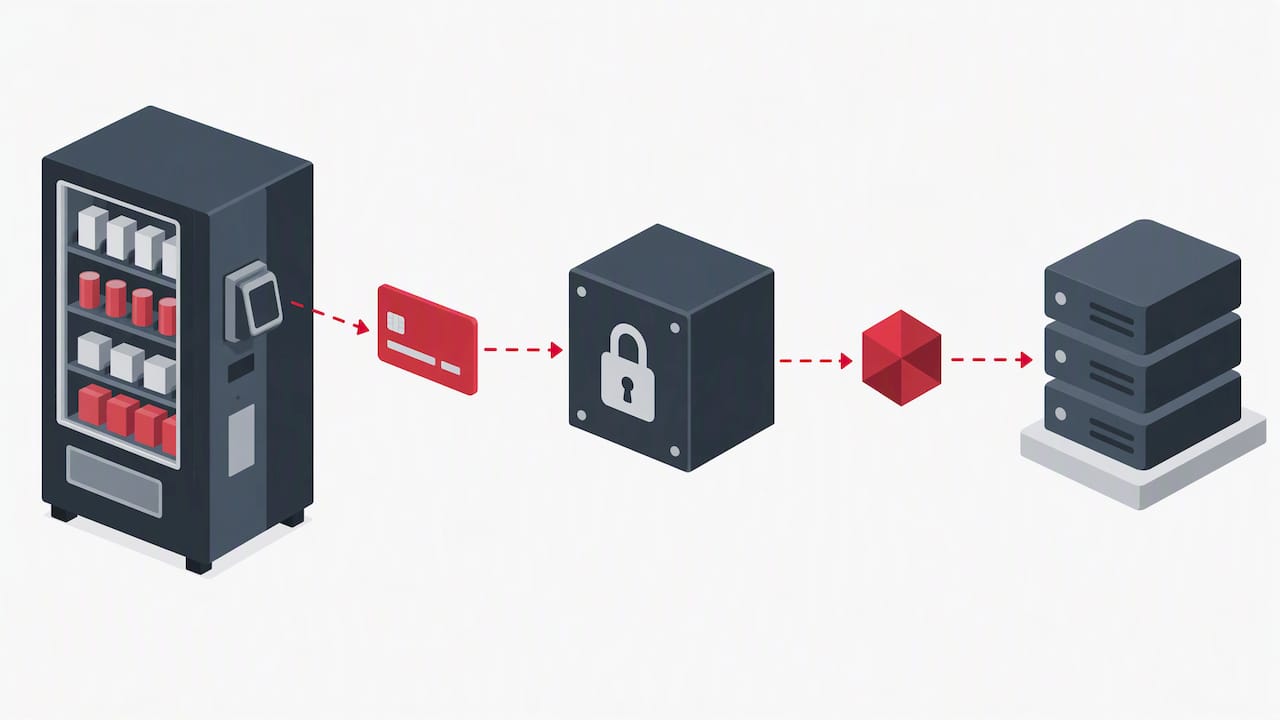
Tokenization complements this by replacing card numbers with a substitute value for any recurring processes, like refunds or loyalty tracking, so stored data has no resale value to an attacker. Secure Read and Encrypt of Data (SRED) capability, built into PTS-approved devices, is the technical feature that makes true point-to-point encryption possible at the hardware level.
Operational habits matter just as much as the technology stack:
- Push firmware and software updates only through the path specified by your P2PE provider, never an ad hoc connection.
- Segment vending payment traffic from other business networks where machines share a facility’s connectivity.
- Favor cellular or a dedicated connection over open or public Wi-Fi for any machine handling card data.
A guide on secure payment processing for small businesses covers these network basics in more depth for operators building their first security checklist.
Liability shift rules and what triggers fines or chargebacks
The EMV liability shift places counterfeit-fraud liability on whichever party has not adopted chip technology, a rule that has applied to card-present transactions since October 2015 and includes specific provisions for unattended terminals under Unattended Card Acceptance Terminal (UCAT) guidance, according to Visa’s liability shift documentation.
For vending operators, the practical triggers are predictable:
- A terminal that cannot read chips at all pushes counterfeit-fraud liability onto you by default.
- Magstripe fallback, whether intentional or caused by a failed chip read, carries the same liability exposure and should trigger an alert, not a shrug.
- Unsupported or outdated contactless kernels can create acceptance failures that frustrate customers even before liability becomes the issue.
Configuring terminals to prefer chip and tap over stripe, and logging every fallback event, closes most of this gap.
Operator checklist for achieving EMV compliance
Treat the rollout as a project with real dependencies, not a single hardware order. A kiosk industry overview of EMV compliance challenges notes that certification and processor testing cycles are often the longest bottleneck, longer than sourcing the hardware itself.
- Inventory every reader across your fleet and note model, age, and interface type.
- Request PTS and P2PE listing documentation from each device vendor for anything not already confirmed.
- Confirm processor and acquirer support for your chosen P2PE solution before ordering new hardware.
- Plan staged upgrades, prioritizing high-traffic locations first to limit disruption.
- Test transactions on a small batch of machines before fleet-wide rollout.
- Document your SAQ and AOC, keeping device listing numbers on file for future audits.
Processor certification windows commonly run longer than hardware procurement, so start both tracks in parallel rather than sequentially.
Pro Tip: Call your acquirer before you call a hardware vendor. Processor approval timelines, not equipment availability, usually set your real deadline.
Keeping compliance current after installation
EMV compliance is not a one-time certificate. It requires routine hygiene: physical tamper inspections on a set schedule, a defined policy for remote firmware updates, ongoing telemetry monitoring for fallback or error events, and a quarterly review of your SAQ status as hardware or processors change.
Managed service arrangements shift much of this workload off the operator. When a vending partner supplies validated P2PE hardware and handles monitoring directly, the reduced PCI scope and vendor accountability can outweigh the flexibility of managing it in-house. Jeeves Vending’s approach to payment rails and cashless acceptance reflects this pattern, pairing modern readers with remote monitoring and uptime tracking so device health issues surface before they become compliance gaps.
- Schedule tamper checks on a fixed rotation rather than reactively.
- Monitor fallback and decline rates as an early signal of reader problems.
- Revisit your SAQ eligibility whenever you add or replace terminals.
Pragmatic priorities for vending operators
Most of the EMV compliance conversation gets buried in acronyms when the real priority list is short. Confirm your devices carry valid PTS and P2PE listings first. Everything else, tokenization, network segmentation, receipt rules, matters less if that foundation is missing.
Budget real time for processor certification, since that step derails more rollouts than hardware ever does. Where the ongoing monitoring and inspection work feels like more than your team wants to own, partnering with a vendor who already carries that burden is a reasonable trade, not a shortcut.
— Gary
How Jeeves Vending supports a compliant vending program
Keeping up with reader listings, firmware updates, and SAQ documentation is a lot to manage alongside running a business. Some vending machine providers install and service machines at no cost to the host location, coordinating payment hardware, remote monitoring, and maintenance so compliance work does not land entirely on your team.

For businesses weighing a managed path instead of handling device audits alone, Jeeves Vending’s free full-service vending program outlines how installation and ongoing service work, with next steps available through Jeevesvending.
FAQ
What is EMV compliance?
EMV compliance means a payment terminal meets the chip card standard set by EMVCo, including proper handling of chip and contactless transactions rather than relying on magnetic stripe alone. For vending operators, it also ties into PCI DSS obligations, since the terminal and surrounding systems must meet documented security requirements, including PCI PTS POI device standards.
How many vending machines do you need to make $100,000?
There is no published, verifiable figure for this because revenue per machine varies enormously by location, product mix, and foot traffic. Operators should treat any specific machine count as a rough planning estimate rather than a benchmark, and build projections from their own sales data instead.
What are EMV standards?
EMV standards are the technical specifications, maintained by EMVCo, that define how chip cards communicate with payment terminals, including contact and contactless kernel behavior. They work alongside PCI DSS and PCI PTS POI requirements, which govern how the physical device and surrounding systems must protect cardholder data, as described in EMVCo’s contactless kernel guidance.
Is EMV the same as NFC?
No. EMV is the broader chip card standard, while NFC is the wireless technology that enables contactless taps, one of two interfaces (along with physical chip insertion) that EMV-compliant terminals can support. A dual-interface reader handles both, which is why it is the practical choice for unattended vending terminals.
Sources
- PCI DSS self-assessment questionnaire (SAQ) types reference (UCSF controller summary)
- PCI PTS POI Security Requirements (v6.1) – PCI Security Standards
- 4 key features of the new EMV contactless kernel specification (EMVCo)
- Visa liability shift guidance