
Securing vending payments comes down to five moves: harden the cabinet, confirm your terminal carries a valid PCI PTS POI approval, isolate payment traffic from telemetry and guest networks, patch firmware on a fixed schedule, and run a documented inspection and incident-response routine. Every one of those controls maps back to a real standard, not a vendor’s marketing sheet. Skip any single one and you’ve left the weakest link exactly where a thief or a card-testing bot will find it.
TL;DR:
- Ensuring vending machine cabinets are anchored, with tamper sensors and anti-skimming housings, eliminates common physical access points for theft.
- Verifying terminals have current PCI PTS approval, P2PE enabled, and support EMV/contactless reduces fraud and keeps the network scope manageable.
- Segmenting payment traffic from other networks and encrypting all data transport prevents lateral movement from breaches and tampering.
- Applying routine firmware updates, with vendor-signed firmware and prompt patching, maintains security without risking machine downtime.
- Managing keys electronically, monitoring transaction patterns for anomalies, and having a clear incident response plan help detect and contain compromises early.
Table of Contents
- Vending Payment Security Starts With the Cabinet
- Payment Terminals: What PCI PTS/POI and P2PE Actually Cover
- Segmenting Payment Traffic From Everything Else on the Network
- Keeping Firmware and Software Current Without Breaking Uptime
- Key Management, Monitoring, and What an Incident Response Plan Needs
- Choosing a Payment Platform and Processor That Won’t Leave You Exposed
- A Route Crew Checklist for Catching Problems Early
- Uptime, Friction, and When a Managed Partner Makes Sense
- Where Jeeves Vending Fits if You’d Rather Not Manage This Alone
- Standards Worth Keeping on File
- Sources
- FAQ
Vending Payment Security Starts With the Cabinet
Most fraud against unattended machines still begins with a screwdriver, not a laptop. A reinforced cabinet with anti-pry seams, a floor or wall anchor, and placement under decent lighting with clear sightlines eliminates the easiest attacks before anyone touches the payment reader.
Standard barrel locks get picked in seconds. Swap them for patented, key-registered lock systems or electronic access where the machine supports it, so a lost key doesn’t mean rekeying your whole fleet. Door switches and vibration or accelerometer-based tamper sensors catch what a visual check misses between routes, and sealed card-reader housings with anti-skimming overlays stop the quiet attacks that don’t leave obvious marks.
- Anchor cabinets to floor or wall studs; never leave a machine free-standing in a low-traffic corner.
- Replace generic barrel locks with registered or electronic locking systems.
- Install door and vibration sensors tied to an alert, not just a log entry.
- Inspect reader housings regularly for added devices, loose bezels, or adhesive residue.
Pro Tip: Walk the machine like a thief would. Crouch down and check the underside of the card reader, not just the front. That’s where cheap skimmers get taped on.
Payment Terminals: What PCI PTS/POI and P2PE Actually Cover
An unattended terminal has to carry a current PCI PTS POI approval, and that approval covers specific device classes: PIN Entry Devices, Encrypting PIN Pads, Unattended Payment Terminals, and Secure Card Readers. Opening the case or swapping an internal component without authorization voids that approval instantly, which is one reason tamper-evident housings matter as much as the encryption inside them.
Point-to-point encryption (P2PE) encrypts card data at the swipe or tap and keeps it encrypted until it reaches the processor, which removes huge chunks of your network from PCI scope. Pair that with EMV chip and contactless acceptance instead of magstripe-only readers. EMV’s dynamic cryptogram makes cloned cards far less useful to a fraudster than a static magstripe track, which is why chip and tap transactions carry a fraction of the counterfeit-card risk that swipe transactions do.
Before any terminal goes on route, verify:
- It appears on the current PCI-approved device list, not just the vendor’s own claim.
- P2PE is enabled and the encryption keys are properly injected, not defaulted.
- EMV and contactless are both active, not just physically present.
- The vendor documents its firmware-signing process and security update policy in writing.
A defense-in-depth approach that layers cabinet hardening, network segmentation, and P2PE together is what actually holds up when one layer fails.
Segmenting Payment Traffic From Everything Else on the Network
Payment data has no business sharing a network segment with your telemetry feed, your remote-management console, or a location’s guest Wi-Fi. NIST’s segmentation guidance lays out a six-step approach for grouping assets into risk-based zones, and it’s just as relevant to a fleet of vending machines as it is to a factory floor. The core idea: if one device gets compromised, segmentation stops the attacker from walking laterally into everything else.
A growing number of operators route telemetry over private, carrier-managed backhauls instead of public internet connections, keeping that traffic invisible to anyone scanning open networks nearby. Whatever transport you use, encrypt it end to end and lock down remote management ports so they aren’t sitting open to the internet.
- Put payment traffic on its own segment, isolated from admin and guest networks.
- Use private or carrier-managed telemetry links where the volume justifies the cost.
- Encrypt all transport, including machine-to-processor and machine-to-management-console links.
- Physically protect exposed network cabling from casual tampering.
When full endpoint protection isn’t realistic for older machines, a firewall around the device zone plus strict logging is a reasonable compensating control, and it costs far less than replacing hardware fleet-wide.
Keeping Firmware and Software Current Without Breaking Uptime
Unpatched firmware is the quiet failure mode nobody notices until a card network flags unusual activity tied to a specific terminal model. Set a fixed cadence and stick to it:
- Apply routine firmware updates monthly, batched with your regular route schedule.
- Push critical security patches within days of vendor release, not on the next convenient visit.
- Require signed firmware only, and confirm your vendor won’t accept unsigned or side-loaded updates.
- Disable any service or port the terminal doesn’t need for normal operation.
- Log every update with a version number and timestamp so you can prove compliance during an audit.
Secure provisioning and key-loading should follow your terminal vendor’s PCI PTS/POI-aligned procedures, not an in-house shortcut. On route, a quick version check against your master log tells you in seconds whether a machine missed its last push.
Key Management, Monitoring, and What an Incident Response Plan Needs
Every physical and electronic key in your fleet should be registered to a named individual, not shared loosely among route techs. Restrict who can open a cabinet, and move toward electronic access logging wherever the hardware supports it, so you have a record of who opened what and when.
On the transaction side, watch for signals a human eye won’t catch fast enough: repeated reversals on one terminal, refund rates that spike at a single location, or vend patterns that don’t match a machine’s normal traffic. Set alert thresholds now, before you need them.
- Register every key to a person; audit the list periodically.
- Alert on abnormal reversal, refund, or vend-volume patterns per terminal.
- Document a lockdown procedure that any route tech can execute without waiting for approval.
- Reconfirm PCI scope annually, especially after adding new terminal models.
Industry voices in vending consistently point out that operators plan for the technology and skip the response plan, which is backwards. Decide now who gets notified, how fast a compromised machine gets pulled offline, and what evidence gets preserved for the processor and card networks.
Pro Tip: Write your incident response plan as a one-page checklist taped inside your ops binder. In a real event, nobody wants to hunt through a 20-page PDF.
Choosing a Payment Platform and Processor That Won’t Leave You Exposed
Not every processor pitch mentions PCI certification status upfront, so ask directly. A platform worth signing with should support P2PE, confirm EMV and contactless capability out of the box, and document its tamper-detection and firmware-update process in the contract, not just in a sales call. Reviewing your payment rail options before committing to a processor saves you from discovering gaps after machines are already deployed.
Before signing anything, require these in writing:
- Breach-notification timeline, ideally 24 to 72 hours from discovery.
- Clear division of PCI reporting responsibility between operator and processor.
- Firmware-update service-level commitment, not a vague “as needed” clause.
- Liability allocation if a terminal is compromised due to a vendor-side flaw.
During procurement, ask directly:
- Which PCI PTS device classes does your terminal carry approval for?
- Is P2PE built in, or is it an add-on with separate key management?
- What’s your average time to patch a critical vulnerability?
- Who absorbs cardholder notification costs if your device is the point of compromise?
A Route Crew Checklist for Catching Problems Early
Daily, glance at seals, cables, and the reader housing for anything that looks added or loose. Weekly, do a closer pass checking for pry marks around the cabinet frame and door alignment. Monthly, reconcile firmware versions against your master list rather than trusting that an update actually landed.
- Daily: visual check of seals, cabling, and card-reader housing.
- Weekly: closer inspection for pry marks, door gaps, and locking-mechanism wear.
- Monthly: firmware version reconciliation against your fleet log.
- Ongoing: store inspection logs centrally so they’re ready for a PCI scope review or an incident investigation.
If something looks off, pull the machine offline first and document second. Photos and timestamps matter more once a processor or card network gets involved.
Uptime, Friction, and When a Managed Partner Makes Sense
Lock everything down too hard and you’ll cut fraud while also driving away customers stuck with a jammed reader or a machine pulled offline for a false alarm. The goal is picking controls that cut risk without adding friction to every transaction. Jeeves Vending’s approach to remote monitoring and secure installs reflects that balance: catch problems early, keep machines running. Build the checklist above into your routine, and push your vendors for specific commitments instead of vague assurances.
— Gary
Where Jeeves Vending Fits if You’d Rather Not Manage This Alone
Everything above is manageable in-house with discipline and the right vendor commitments. But device selection, secure provisioning, telemetry monitoring, firmware management, and route inspections add up to a second job most operators didn’t sign up for. Jeeves Vending installs and manages state-of-the-art vending machines and custom micro-market solutions at no upfront cost to the host business, handling machine selection, remote stock and telemetry monitoring, and ongoing maintenance as part of the service.

That doesn’t erase every responsibility on your end. You still choose the location, review inspection reports, and stay involved in vendor conversations about breach notification and PCI scope. What changes is who’s carrying the day-to-day technical load. For network-level protection beyond the machine itself, a managed service like NEXTmsp’s cybersecurity offerings can round out segmentation and monitoring for a broader device fleet. If you’re weighing whether to build this internally or hand it to a partner, see what Jeeves Vending’s full-service program covers and get a sense of what a managed setup looks like for your location.
Standards Worth Keeping on File
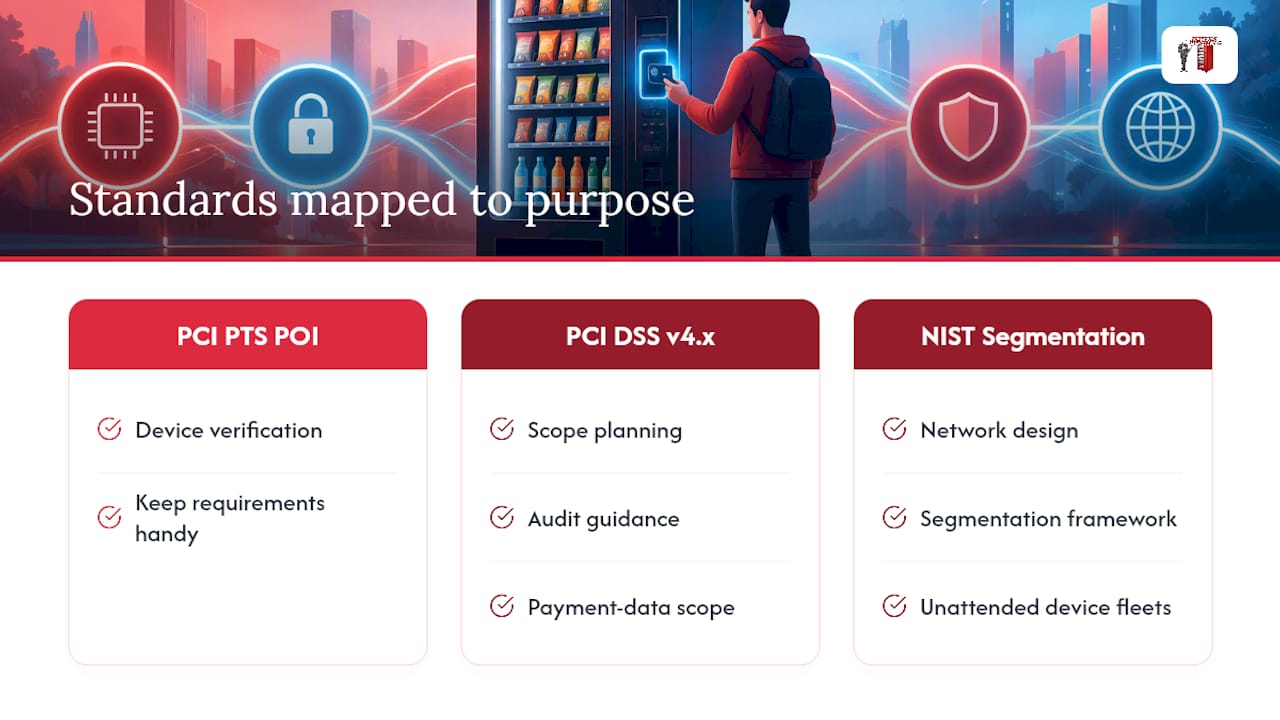
For device verification, keep the PCI PTS POI requirements handy. For scope planning and audits, reference PCI DSS v4.x guidance. For network design, NIST’s segmentation framework applies directly to unattended device fleets.
This article is general information, not a substitute for advice from a qualified financial advisor. Consult a qualified financial professional about your own circumstances before acting on anything here.
Sources
- PCI PTS POI modular security requirements (v6.1)
- Ensuring business and payments security | Vending Market Watch
- Now is the time for organizations to adopt the future-dated requirements of PCI DSS v4.x
- NIST cybersecurity guidance: security segmentation for manufacturing
FAQ
What Is Payment Security in a Vending Context?
Payment security means protecting cardholder data and transaction integrity from the moment a customer taps or swipes until the funds settle with the processor. For vending, that spans cabinet hardening, PCI-approved terminals, encrypted network transport, and a documented response plan if something goes wrong.
How Many Vending Machines Do You Need to Reach $100,000 in Revenue?
There’s no fixed machine count that guarantees a specific revenue figure. It depends heavily on location traffic, product mix, and pricing, and figures vary too widely across operators to state as a reliable number.
What Are the Best Payment Systems for Vending Machines?
The strongest setups combine EMV chip and contactless acceptance with point-to-point encryption and a terminal carrying current PCI PTS POI approval. Reviewing available payment rail options before choosing a processor helps confirm which systems actually meet those standards.
How Do I Secure a Vending Machine Contract at a New Location?
Location owners increasingly ask about payment security before signing, so come prepared with proof of PCI-compliant terminals, tamper-detection features, and a written incident response process. Jeeves Vending’s free full-service vending program is built around handling that compliance conversation for the host business, which removes a common objection during negotiations.