
A working office vending policy spells out four things in writing: which machines and locations it covers, a measurable nutrition target (a common benchmark is that at least 50% of items meet defined nutrition standards like calorie and sugar caps), specific vendor obligations on restocking and payment, and a named person who owns enforcement. Skip any one of those four and the policy becomes a suggestion nobody follows.
TL;DR:
- Implementing a clear, one-page vending policy that includes scope, responsible person, nutrition standards, vendor obligations, and monitoring is essential for compliance.
- A covered threshold of at least 50% healthy items meeting caps of 250 calories, 10 grams of fat, and 20 grams of sugar is supported by public health guidelines and simplifies enforcement.
- Starting with a pilot on one machine over six to twelve months helps identify issues early and prevents widespread resistance during a full rollout.
- Vendor contracts must specify restock response times, telemetric reporting, product swaps, and pricing arrangements to ensure policy adherence.
- Regular review at six to twelve months with sales data and employee feedback keeps the policy effective and allows for adjustments as needed.
Table of Contents
- The Required Elements Every Vending Policy Checklist Should Include
- What Nutrition Standards Should the Policy Set?
- How Do You Roll Out a Vending Policy Step by Step?
- What Should the Vendor Contract Require?
- Where Should Healthy Items Go in the Machine?
- How Do You Monitor Whether the Policy Is Working?
- Where Managers Usually Go Wrong Enforcing This
- Ready to Put an Office Vending Policy Into Action?
- Sources
- FAQ
The Required Elements Every Vending Policy Checklist Should Include
A vending policy that actually gets used fits on one page. Vague language about “encouraging wellness” gets ignored. Specific, checkable rules get followed.
Here’s what belongs in that document:
- Scope and effective date: which buildings, floors, or machines the policy covers, and when it starts.
- Responsible role: a named title (facilities manager, HR coordinator, wellness lead) who monitors compliance and talks to the vendor.
- Nutrition standards: a stated percentage target and numeric caps for calories, fat, and sugar.
- Vendor obligations: restock frequency, service response windows, and payment methods spelled out in the contract.
- Placement and labeling rules: where healthy items sit in the machine and how they’re marked.
- Pricing and promotion guidelines: whether healthy items are priced the same as or below indulgent ones.
- Monitoring schedule: when sales data and employee feedback get reviewed, and what happens if targets aren’t met.
A sample policy checklist built for workplaces uses nearly this exact structure, down to the 50% requirement and the compliance line naming who’s responsible. Copy the format. Adjust the numbers to your building.
What Nutrition Standards Should the Policy Set?
The Washington State Department of Health’s vending guidelines set that threshold at 50% of items per machine, with caps around 250 calories per package, 10 grams of total fat, and 20 grams of sugar.
Nutrition Benchmark: At least 50% of items per machine should meet caps of roughly 250 calories, 10g fat, and 20g sugar per package, according to Washington State’s public health guidelines.
A traffic-light system makes enforcement simple for whoever’s stocking the machine:
- GREEN: meets all three caps, no restriction on quantity.
- YELLOW: meets one or two caps, limit to a set number of slots per machine.
- RED: meets none, allowed but capped at a minority share of total slots.
The South Dakota vending policy guide uses this exact color coding and pairs it with visible calorie labeling at the point of purchase. For beverages, a practical rule is capping added sugar per 12-ounce serving and requiring at least one water or unsweetened option in every slot row. Hand your vendor a written approved-product list built around these three tiers, and restocking decisions stop being guesswork.
How Do You Roll Out a Vending Policy Step by Step?
Most workplaces that get this right don’t flip a switch. They test, adjust, and expand over six to twelve months. Rushing straight to a building-wide mandate is the fastest way to get pushback from both employees and your vendor.
- Run a baseline assessment. Pull current sales data by SKU and survey employees on what they’d actually buy if healthier options were available. Ask about price sensitivity, too. Fifteen questions is plenty.
- Form a small committee and name an owner. Facilities, HR, and one or two employee volunteers is enough. One person, not the committee, owns day-to-day compliance.
- Draft the policy language. Write the scope, the nutrition target, and the vendor requirements into a single document using the checklist structure above.
- Adopt measurable standards. Set the percentage target and numeric caps before you touch a single machine.
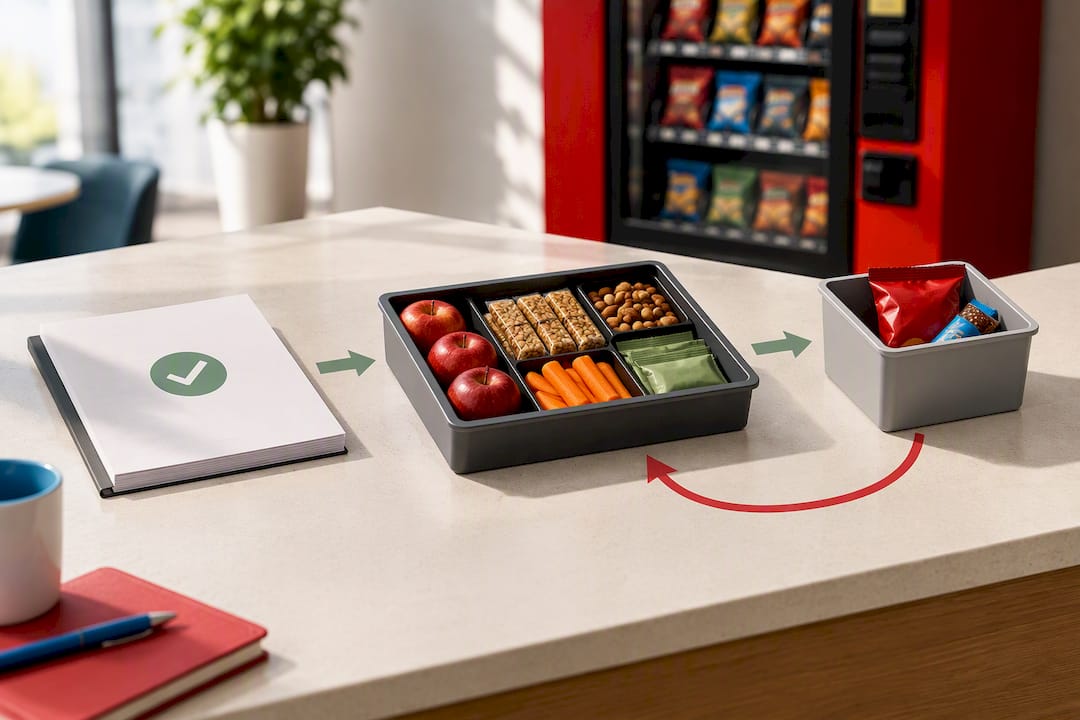
- Pilot with one machine or one location. Work with your vendor to rebuild the planogram and swap in an approved product list for that pilot unit only.
- Communicate the change. Send an email, post a flyer near the machine, and mention it in a team meeting before the new stock arrives.
- Evaluate the pilot at three months. Compare sales by SKU against the old lineup and ask a short follow-up survey question: did people notice, and did they buy the new items?
- Formally review at six to twelve months. Public health toolkits consistently recommend this window for a full policy review, giving you enough sales history to judge whether targets are realistic before scaling to other locations.
That pilot step matters more than most managers assume. Testing on one machine before a building-wide rollout limits your downside if the vendor’s first pass at an approved product list flops, and it gives you real numbers to bring back to leadership instead of a guess.
What Should the Vendor Contract Require?
Your policy is only as strong as what’s written into the vendor agreement. Good intentions don’t restock a machine or fix a jammed coin mechanism.
Put these clauses in writing:
- Restock frequency and response windows. A 24 to 48 hour response time for service calls is a reasonable standard to request.
- Cashless and mobile payment support. Most modern vending operators support tap-to-pay and app-based purchases as standard, not an upgrade.
- Sales telemetry or regular reporting. Requiring vendor telemetry turns compliance monitoring into a data pull instead of someone manually counting what’s left in each slot.
- Exclusivity and termination terms. Spell out what happens if the vendor consistently misses the nutrition target or restock schedule.
- Product swap process. Who initiates a change to the approved list, and how fast can it happen?
- Pricing terms. State whether healthy items are priced at parity with or below less healthy options, and who covers the cost difference if there is one.
- Signage costs. Decide upfront whether the vendor or your business pays for in-machine decals and point-of-purchase labels.
Pro Tip: Ask any vendor candidate for a sample sales report before you sign anything. If they can’t produce SKU-level data on request, you won’t be able to enforce your nutrition target six months in.
Where Should Healthy Items Go in the Machine?
Placement decides more purchases than most managers expect. Items at eye level and at arm’s reach get bought more often, regardless of how healthy they are, so the fix is simple: move the good stuff there.
- Eye-level and reach-level slots go to GREEN category items, grouped together rather than scattered.
- Calorie counts and labels should be visible at the point of purchase, not buried on the wrapper.
- Price parity or a temporary subsidy on new healthy items removes the biggest excuse for skipping them.
- Taste tests during the pilot let employees sample new items before they commit real money to an unfamiliar snack.
- Signage, an email blast, and on-machine decals announce the change so nobody feels ambushed by a suddenly different lineup.
A customized vending menu built from actual employee input, rather than a generic healthy list, tends to see far less pushback in the first month.
How Do You Monitor Whether the Policy Is Working?
Set a review cadence before launch, not after complaints start rolling in. Waiting until someone flags a problem means you’ve already lost months of usable data.
- Track percent-healthy stocked versus sold. Stocking 50% healthy items means nothing if they’re the 50% sitting unsold at month’s end.
- Watch for stockouts on popular SKUs. A GREEN item selling out every week is a signal to expand its slot count.
- Survey employees at the pilot’s end and again annually. Short surveys beat long ones for actual response rates.
- Set remediation triggers. A vendor warning after one missed restock cycle, contract renegotiation after three, termination after repeated failures.
Review Window: Public health toolkits recommend a formal policy review at six to twelve months, giving enough sales history to judge whether the nutrition targets and vendor terms need adjusting.
Document the results each cycle. A policy nobody revisits in writing quietly dies the first time a vendor pushes back.
Where Managers Usually Go Wrong Enforcing This
Most vending policy failures Jeeves Vending sees aren’t about the paperwork. They’re about installation and follow-through. A machine placed on a circuit that also runs the break room microwave trips constantly. One shoved against a wall with no ventilation clearance overheats and shortens compressor life. Both are avoidable with a five-minute site check before install.
Taste tests work best when you sample three or four candidate SKUs at once, right by the machine, and ask employees to rank rather than rate. Ranking forces a real preference instead of everyone saying “sure, fine” to whatever’s in front of them.
— Gary
Ready to Put an Office Vending Policy Into Action?
Writing the policy is the easy part. Enforcing it depends on whether your equipment and vendor can actually deliver on what you promised employees. Some vending providers install and manage vending machines and micro-markets at no upfront cost to your business, which can help reduce operational burdens related to restocking, payment, and stock monitoring.
Before you sign with any vendor, ask three questions: what’s their service response window, do they provide sales reporting you can actually use for compliance tracking, and will they work from an approved product list you build together, like those suggested if you Start a Sweets and Treats Vending Franchise today. Jeeves Vending’s full-service vending program is built around exactly those three answers, with remote stock monitoring that turns your monitoring section from a manual chore into a dashboard pull. If your office needs more retail footprint than a single machine can carry, a micro-market setup gives employees a wider healthy selection with self-checkout. Reach out to get your location assessed and a placement plan built around the nutrition targets your policy already sets.
Sources
- Washington State Department of Health — Healthy nutrition guidelines (vending)
- New York State Department of Health — Healthy workplace food initiative toolkit
- South Dakota Healthier Vending and Snack Bar Policy Implementation Guide
FAQ
What Is an Office Vending Policy?
An office vending policy is a written set of rules covering which machines it applies to, nutrition targets for stocked items, vendor obligations like restocking and payment methods, and who’s responsible for enforcing it. It’s different from government vending regulations, which cover licensing and public property, not internal workplace rules.
What Percentage of Vending Items Should Be Healthy?
A widely used benchmark is that at least 50% of items per machine meet defined nutrition standards, typically capping calories around 250 per package, fat at 10 grams, and sugar at 20 grams. Some workplaces set a higher bar once the pilot phase proves employees will actually buy the healthier options.
How Long Does It Take to Implement a Vending Policy?
Most workplaces move from baseline assessment to a fully reviewed policy in six to twelve months, including a pilot phase and a three-month check-in. Trying to skip the pilot and roll out building-wide on day one usually creates more vendor friction than it saves in time.
Does Jeeves Vending Charge for Installation?
Jeeves Vending installs vending machines and custom micro-markets at no upfront cost to the host business, with revenue coming from product sales rather than installation fees. Specific equipment options and current offerings are listed on the Jeeves Vending site.
Who Should Be Responsible for Vending Policy Compliance?
Policy templates typically name a specific role, often in facilities, HR, or a wellness coordinator position, to monitor compliance and stay in contact with the vendor. Assigning this to a committee without a single named owner is one of the most common reasons policies stop being enforced after the first few months.