
The best placement is almost always the break room, or for machines only, a semi-secured lobby or transit corridor near main foot traffic. Before you commit to either, verify fire, electrical, and ADA clearances first. Facility teams that skip that check are the ones who end up relocating equipment weeks later. Headcount and security drive the final format decision: fewer than 75 people usually means a machine, more than 200 opens the door to a full micro-market.
TL;DR:
- Ensuring site approval from facilities, electrical, IT, and security teams before installation prevents delays and costly relocations.
- Critical zones include break rooms for longer dwell time and transitory areas like lobbies for quick sales, with placement visibility affecting sales volume.
- Sites must have dedicated power, internet connectivity, and ADA-compliant space with proper drainage and climate control, especially for refrigerated units.
- Headcount thresholds determine the best fit: machines for under 75, smart coolers for 75-200, and micro-markets for 200 or more people, with security access influencing choice.
- Effective signage, lighting, and coordinated approvals are key to maximizing sales and ensuring smooth installation and ongoing servicing.
Table of Contents
- Outdoor Vending Placement: Site Selection Checklist
- Which Zones On Your Property Work Best?
- What Infrastructure And Permits Does A Site Need?
- Machine, Smart Cooler, or Micro-Market: How Do You Decide?
- How Do You Launch And Measure A New Placement?
- Who Handles Restocking And Repairs Without Disrupting Your Site?
- Does Signage Actually Change How Much People Buy?
- How Do You Coordinate Approvals Across Departments?
- What Do Facility Managers Get Wrong About Placement?
- Ready For A Managed Micro-Market Or Vending Install?
- Sources
Outdoor Vending Placement: Site Selection Checklist
Not every space on your property earns the right to host equipment. Before you sign off on a spot, run it through this checklist.
Measure your captive population. Count the people who realistically pass or linger near the proposed site every day, not your total headcount. A 150-person office with a locked floor plan and no nearby food options is a stronger site than a 300-person building with three restaurants across the street. Population captivity is consistently the single biggest driver of office vending revenue, with qualified sites producing $500 to $4,000 or more per month.
Audit what already exists nearby. Check for cafeterias, coffee bars, or a corner store within a two-minute walk. Every existing amenity siphons capture rate away from your machine or market.
Before finalizing a spot, confirm these internally:
- Facilities or property management sign-off on the physical footprint
- Building engineer confirmation of available circuit capacity
- IT approval for network or cellular connectivity at that exact location
- Fire marshal or local code review for the specific space
- Landlord or lease clause review if you’re a tenant, not the owner
On the negotiation side, lock in exclusivity language so a competing operator can’t install a second machine down the hall, and confirm staging and delivery access for restock trucks before install day, not after.
Which Zones On Your Property Work Best?
Every property has a handful of zones that consistently outperform the rest, and a few that quietly underperform no matter how much traffic they see.
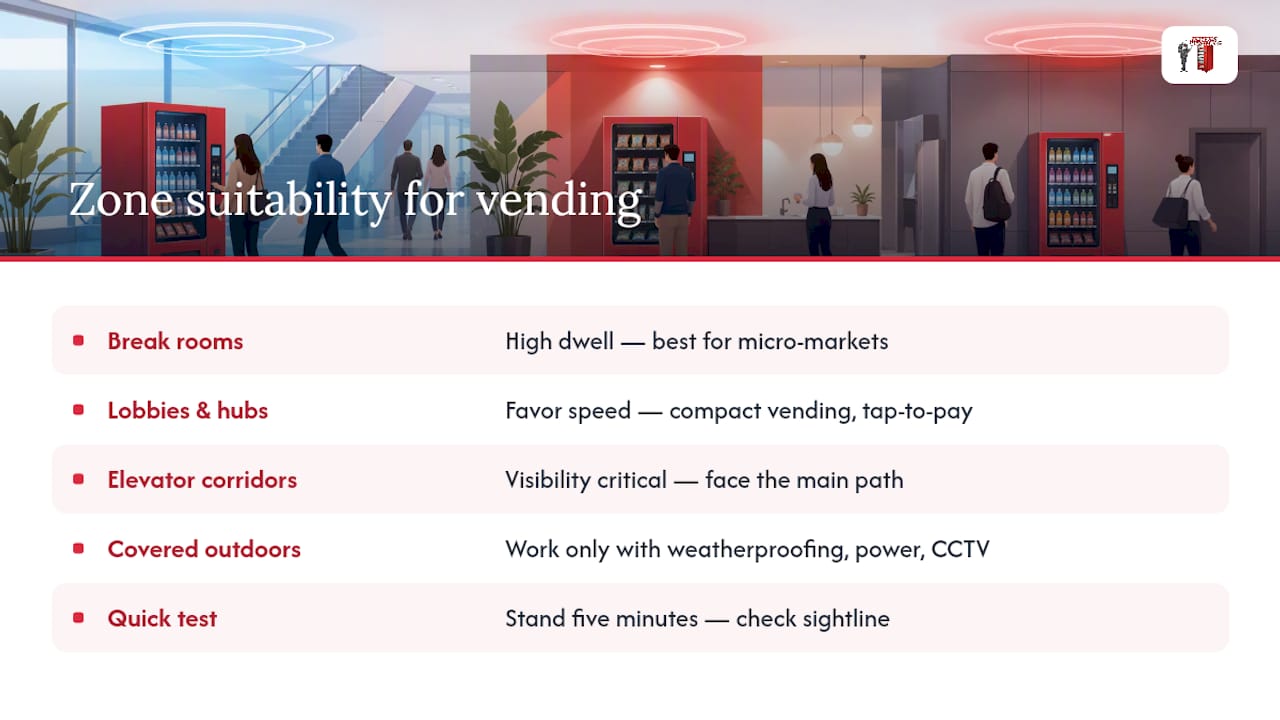
Break rooms win on dwell time. People linger, browse, and are far more likely to convert on a micro-market’s wider selection than on a quick vending purchase. This is also where smart coolers and full markets perform best because the audience is already captive and unhurried.
Lobbies and transit hubs favor speed. Visitors and employees passing through want a fast transaction, so a compact vending machine with tap-to-pay usually outperforms a market here. Lobby placement can generate multiple times the revenue of a poorly sited basement machine, largely because of visibility and lighting.
Elevator corridors and main thoroughfares matter more than most managers assume. A machine facing away from the walking path, or tucked ten feet off the main line, can see sales drop sharply just from lost sightlines.
Covered outdoor or adjacent exterior spaces can work, but only under specific conditions: a genuine weatherproof enclosure, dedicated power, drainage that keeps water away from the base, and CCTV coverage. Hardware selection should always match the building’s demographics rather than whatever unit happens to be available.
Pro Tip: Stand at the proposed spot for five minutes during a shift change. If you can’t see the machine from the main hallway without turning your head, neither can your employees.
What Infrastructure And Permits Does A Site Need?
Get this wrong and your install date slips by weeks. Get it right before the operator ever measures the space, and everything else moves fast.
Run through these technical checks first:
- Confirm a dedicated 120V circuit with surge protection, separate from lighting or HVAC loads
- Test cellular signal strength at the exact install spot, since managed cellular gateways are often preferred over a VLAN’d Ethernet drop to keep payment traffic off the corporate network
- Measure clear floor space against ADA requirements for reach ranges and queuing width
- Check with your local health department, since micro-markets selling refrigerated or perishable food sometimes trigger a notification even in a private workplace
For refrigerated units specifically, plan for 4 to 6 inches of rear clearance and keep ambient temperature under 80°F, or the compressor will short-cycle and fail early.
Micro-market fit-outs carry heavier requirements than a single machine:
- Roughly 200 to 400 square feet of usable space for a population of 100 to 300 employees
- Multiple dedicated 20A circuits, not a single shared outlet
- Aisle widths that meet ADA clearance even with a kiosk and shelving in place
- A cellular or network drop tested at the kiosk location, not just somewhere in the building
Skipping any of these checks is one of the most common reasons an otherwise great location fails inspection after the equipment is already on-site.
Machine, Smart Cooler, or Micro-Market: How Do You Decide?
Headcount is the fastest filter, but it’s not the only one.
-
Under 75 people: A single vending machine or smart cooler almost always makes more sense than a market. The footprint and revenue don’t justify a full build-out.
-
75 to 200 people: This is where smart coolers start to shine, especially in semi-secure areas where shrink risk is lower but demand for fresher options is climbing.
-
200 or more people: A full micro-market becomes worth the investment. Markets can generate 80% to 100% more revenue than a comparable vending setup in the same space when population and access control support it, though setup costs run $15,000 to $50,000 with kiosks alone costing $3,500 to $7,500.
Security shapes the decision as much as headcount. Open shelving in a market only works where access is genuinely restricted to employees or members; anywhere else, a closed smart cooler protects your margin better. Average transaction value climbs when the mix includes fresh food and grab-and-go options rather than just packaged snacks.
How Do You Launch And Measure A New Placement?
The install itself is the easy part. What happens in the first 90 days determines whether the placement earns its spot permanently.
Before go-live day, run through this sequence:
- Test the outlet under load, not just with a multimeter, to catch circuit issues before restock day
- Confirm connectivity and telemetry are reporting correctly from the exact unit, not a test device
- Install signage that’s visible from the main walking path, plus CCTV if the location is semi-public
- Notify staff through email or a break room flyer so day-one traffic isn’t confused by a new machine
During the first 30 days, restock weekly and adjust the planogram fast. If a SKU sits untouched for two restock cycles, pull it. A machine sitting even ten feet off the main traffic line can see daily sales drop by roughly 30%, so don’t be afraid to physically move a poor performer during the pilot rather than waiting out the lease term.
Track four numbers weekly: daily capture rate, average transaction value, SKU sell-through, and service call frequency. If capture rate climbs steadily and stockouts happen more than once a week, that’s your signal to talk to your operator about expanding to a smart cooler or full market at the 90-day mark.
Who Handles Restocking And Repairs Without Disrupting Your Site?
Placement decisions live and die on one overlooked detail: can a technician actually get to the machine without disrupting the building?
A spot that looks perfect for foot traffic can be a nightmare for servicing if it sits behind a locked security door that requires an escort, or down a hallway too narrow for a restock cart. Before finalizing any location, walk the delivery route from the nearest loading dock or parking area to the install spot, and time it. If a route requires an elevator, confirm the elevator’s dimensions can fit a hand truck loaded with cases.
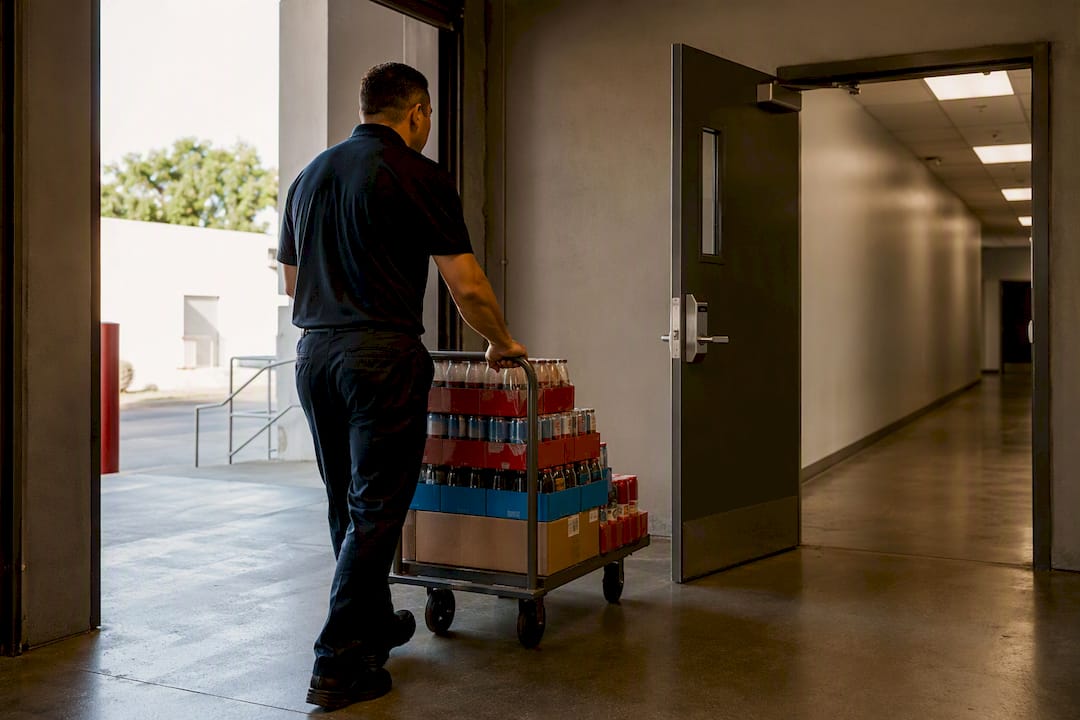
Rear and side clearance matters just as much for servicing as it does for airflow. Technicians need enough room to open panels fully, pull trays, and access the coin or cashless payment module without contorting around a wall or another piece of furniture. For micro-markets, plan a service window that doesn’t overlap with peak break times, since restocking during a lunch rush frustrates both the technician and your employees.
Badge access is the detail most managers forget until the first restock day. If your building requires visitor badges or escort for vendors, set up a standing access arrangement with the operator ahead of time rather than routing every visit through a front desk call. A property manager’s early planning checklist can help you catch these access issues before they become a recurring headache.
Does Signage Actually Change How Much People Buy?
Yes, and more than most facility teams expect. A machine or market that’s technically visible but poorly marked still loses sales to people who simply don’t register it’s there.
Signage works on two levels: directional and product-level. Directional signage points people toward the machine from a hallway junction or lobby entrance, especially useful when the unit sits around a corner from the main thoroughfare. Product-level signage, meanwhile, sits on or near the unit itself and highlights what’s inside, which matters more for micro-markets stocking a rotating mix than for a standard snack machine.
Lighting is part of the same equation. A machine tucked into a dim alcove reads as an afterthought even with great signage on it. Adding a simple overhead fixture or relocating the unit six feet into better light routinely lifts discovery without any change to the product mix.
For gyms and schools, consider timing. A digital sign or screen that rotates promotional messaging around class changeovers or shift breaks captures attention when the most people are actually walking past. For offices, a QR code linking to the day’s stocked items gives remote or hybrid employees a reason to check the market on the days they’re in.
How Do You Coordinate Approvals Across Departments?
Getting a placement approved rarely comes down to one signature. Facilities, IT, security, and sometimes HR all have a stake, and missing one of them is what causes install delays.
Start with facilities or the building engineer, since they confirm the physical space and circuit capacity. IT needs to sign off separately on network or cellular access, particularly if the operator wants a dedicated line isolated from the corporate LAN. Security should weigh in on any location with open shelving or extended after-hours access, and HR sometimes gets pulled in for schools and hospitals where food options intersect with wellness policy.
Permitting varies by property type more than most managers expect. A standard vending machine in a private office rarely triggers a formal permit. A micro-market selling refrigerated or prepared food, however, can trigger a local health department notification depending on your jurisdiction, so it’s worth a quick call before signing anything. Fire code review deserves its own line item too. Reliable Fire Protection’s guide to commercial fire-safety requirements is a useful reference for what inspectors typically flag around new equipment near exits or sprinkler zones.
Build a short approval sheet with each department’s name and sign-off date. It turns a scattered email chain into a document you can hand to your vending operator on day one.
What Do Facility Managers Get Wrong About Placement?
The most common mistake isn’t a technical one. It’s picking the easiest spot to get a “yes” on, usually an empty corner nobody will argue about, instead of the spot that actually sees foot traffic. That single shortcut explains more underperforming machines than bad hardware ever will.
The second mistake is skipping the electrical walkthrough because the outlet “looks fine.” A shared circuit that trips during a lunch rush costs you a full afternoon of lost sales and an emergency service call. The third is failing to negotiate exclusivity up front, which opens the door for a second operator to install competing equipment down the hall six months later and split your capture rate in half.
Professional operators treat placement as a retail decision, not a facilities afterthought. They measure captivity, test connectivity on-site, and plan signage before the unit ever ships. That discipline is the real gap between a machine that earns its keep and one that gets ignored by month three.
— Gary
Ready For A Managed Micro-Market Or Vending Install?
If you’ve worked through the checklist above and landed on a format, the next question is who installs and services it. Jeeves Vending puts state-of-the-art vending machines and custom micro-markets into offices, schools, gyms, and hospitals across the Dallas-Denton region at no cost to the host business, handling the equipment, stocking, and maintenance so your team never has to.
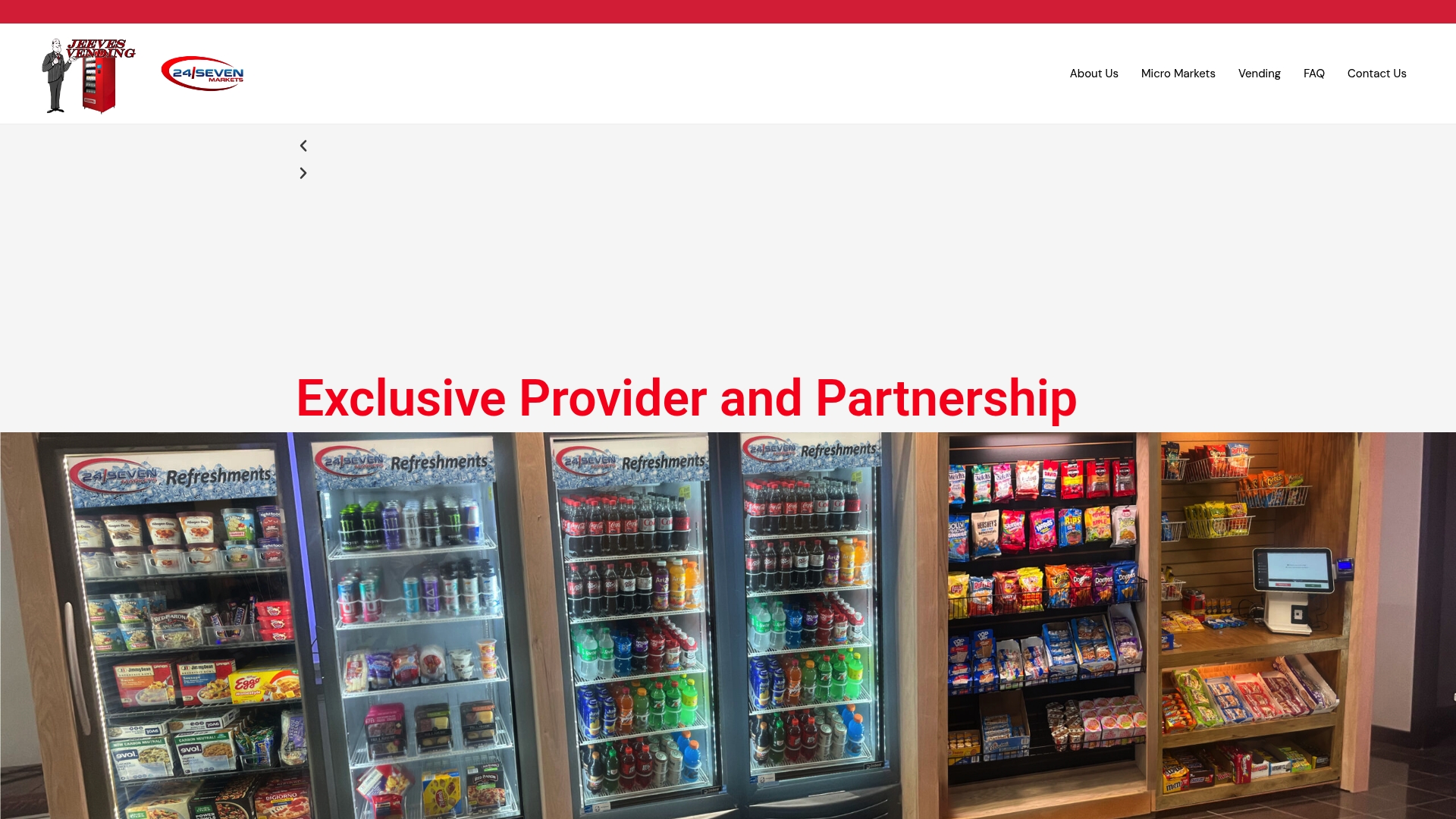
Every install starts with a site survey against the same fire, electrical, and connectivity checks covered above, followed by a tailored product mix and a seamless setup that doesn’t pull your facilities team into weeks of coordination. Each placement is backed with ongoing service and remote stock monitoring, so restocking gaps and service calls get caught before they become complaints. If your site already checks the boxes on headcount and captivity, the next step is simple: request a site survey and get a pilot scheduled.
Sources
- Office Vending Machine Placement – PVOS Academy
- Office & Corporate Vending Playbook – Complete Guide
- Vending Machine Placement Guide: Where to Put Your Machine (2026)
- Micro Market Fit-Out: Space, Power, Network, and Security Checklist