
A qualification-driven placement process combined with telemetry monitoring is the fastest path to consistent vending revenue in modern offices. Before you sign anything, score the site, require a 60-day trial, and confirm telemetry is in place. Here is the short checklist that should govern every placement decision:
- Priority spots: main lobby or entrance, mail/package room, main corridors with nearby seating, team breakrooms adjacent to work zones, production floors, and amenity hubs
- Minimum site thresholds: stable onsite population of a significant number of people daily, predictable shift patterns or business hours, and no full cafeteria within the building
- Required contract terms: exclusivity clause (building-level or radius), 48-hour service SLA, restock frequency defined in writing, and a formal 60-day performance review
- Walk-away rule: if a site scores below 30 out of 50 on the qualification rubric, pass unless the location sits within one mile of an existing high-performing machine
- Jeeves Vending standard: use the 60-day telemetry trial and a Minimum Viability Agreement (MVA) for any borderline site before committing long-term
Table of Contents
- Why does placement need agility in modern office workflows?
- Where should you place vending machines inside an office?
- How do you score office locations objectively?
- How do you evaluate a specific office site before signing?
- What contract terms protect your office vending revenue?
- How do you approach office decision-makers and win placements?
- What product mix works best for office vending?
- What technology and operations keep office machines profitable?
- What permits, insurance, and compliance steps do you need?
- Qualification-driven placement: Jeeves Vending’s approach for office workflows
- Key Takeaways
- What operators actually learn from hybrid office placements
- Jeeves Vending brings turnkey office placement to Dallas
- Useful sources and further reading
Why does placement need agility in modern office workflows?
Static placement assumptions are unreliable now. Hybrid work schedules mean the same office that had 200 people on-site every day in 2019 might average 80 today, with Tuesday and Wednesday drawing twice the traffic of Monday and Friday. A machine placed based on a pre-hybrid headcount figure will underperform on three out of five days every week.
Hybrid-work shifts require ongoing telemetry to detect changing foot traffic and product demand. That is not a nice-to-have anymore. Operators who rely on monthly manual counts miss the mid-week spikes and the Friday dead zones that determine whether a machine performs well or poorly in a given month.
Industry signal: Telemetry and cashless payments are now baseline features for workplace vending, enabling remote restock alerts and usage analysis that predict demand peaks before stockouts occur.
The practical implication: build flexibility into every office agreement. Prefer a qualification-first approach over a fast sale, write a 60-day trial into the contract, and review telemetry data at the 30-day mark before the formal review. If foot traffic drops sharply after a company shifts to a three-day in-office policy, you want the data and the contractual right to act on it.
Where should you place vending machines inside an office?
Lobbies and main entrances consistently outperform every other spot in the building. Placement within a building can change revenue by a multiple, with lobbies at the top and basements at the bottom. The logic is simple: a lobby machine catches every person entering and leaving, regardless of which floor or department they work on.
Here are the site types ranked by typical performance, with practical placement notes:
- Main lobby or entrance: highest visibility, captures all foot traffic, position within 15 feet of the main door and ensure good lighting
- Mail/package room: captive dwell time while employees wait or sort packages, often overlooked by competitors
- Main corridors near seating: natural pause points between meetings, place where sightlines are clear from 30+ feet away
- Team breakrooms adjacent to work zones: consistent repeat users, lower visibility but high purchase frequency; confirm the room serves 25+ people
- Production floors and shift areas: captive demand during breaks, often the highest per-transaction volume in manufacturing-adjacent offices
- Amenity hubs (near gym, locker rooms, or wellness rooms): impulse purchases, good for beverages and protein snacks
For site-size suitability, 50+ regular onsite employees is the practical floor for a single snack/beverage combo machine. Below that, a single-category machine (beverages only) is more appropriate. At 150+ employees across multiple floors, consider a micro-market instead of a single machine. Micro-markets generate significantly higher revenue per square foot and give employees a full self-checkout experience.
One thing consistent daily presence predicts revenue better than raw headcount. An office with 80 people in five days a week beats one with 200 people who show up unpredictably.
How do you score office locations objectively?
Score each site across five weighted categories before committing. The goal is a number you can defend, compare across sites, and revisit at the 60-day review. Experienced operators use a 1–5 rubric across multiple categories and walk away from sites scoring below 30/50 to avoid machines that net as little as $120 per month.
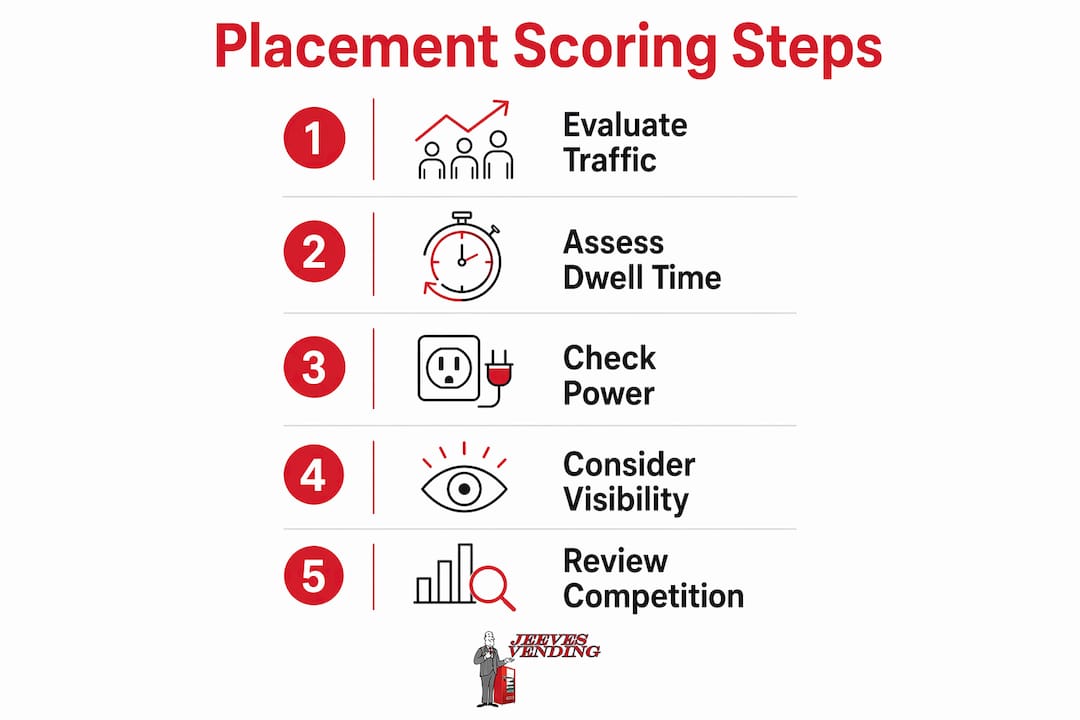
| Scoring Category | What to Measure | Weight | Score Range |
|---|---|---|---|
| Dwell time and captive hours | Hours employees are on-site and unable to leave easily | 25% | 1–5 |
| Repeat users | Percentage of population present daily vs. sporadically | 25% | 1–5 |
| Food alternatives nearby | Cafeteria, food trucks, or restaurants within a 5-minute walk (invert: fewer = higher score) | 20% | 1–5 |
| Visibility and accessibility | Sightlines, lighting, ADA clearance, proximity to main paths | 15% | 1–5 |
| Operational efficiency | Power access, Wi-Fi/cellular signal, restocking ease, parking | 15% | 1–5 |
Scoring example: A lobby placement in a 120-person office with no cafeteria scores 5 on dwell/captive hours, 4 on repeat users, 5 on alternatives, 4 on visibility, and 4 on operations — total 44/50. Sign it. A basement break area in the same building with a cafeteria two floors up scores 2, 3, 2, 2, 3 — total 24/50. Pass or use it as a route-filler only if it is within one mile of a high-performer.
KPIs to monitor post-install:
- Revenue per machine per month
- Sales per day (track by day of week to catch hybrid dips)
- Inventory turnover rate per SKU
- Restock frequency vs. planned cadence
- Machine uptime percentage
- Percentage of cashless transactions
Operator benchmark: IoT-enabled machines send restock alerts and allow usage analysis to predict demand peaks, cutting both stockouts and unnecessary service runs.
How do you evaluate a specific office site before signing?
Perform at least two visits at different times of day before scoring a site. A building that looks busy at 10 AM on a Tuesday can be empty by 3 PM on a Thursday. The goal is to measure what the location actually does, not what the property manager says it does.
Site-visit checklist:
- Count heads present during peak window (typically 8–10 AM and 12–1 PM)
- Observe whether employees linger or move through quickly
- Test cellular and Wi-Fi signal at the exact machine footprint
- Note every food alternative within a five-minute walk
- Check machine sightlines from the main corridor
- Confirm power outlet location and amperage (dedicated 20-amp circuit preferred)
- Measure door clearance for delivery (standard machine needs 32+ inches)
- Ask the property manager about planned renovations or lease changes in the next 24 months
Trial timeline: commit to a 30–60 day trial with telemetry active from day one. Review data at 30 days for early warning signs, then conduct a formal 60-day review to decide keep, swap product mix, or pull the machine. For borderline sites (scores of 20–29), use a Minimum Viability Agreement that requires the location host to cover revenue shortfalls below a defined monthly floor during the trial.
Pro Tip: Photograph the machine footprint, the power outlet, the corridor sightline, and the nearest food alternative during your first visit. A one-page site summary with these photos cuts your decision time in half and gives you a paper trail if the property manager later disputes what was agreed.
What contract terms protect your office vending revenue?
The single most important negotiation move is securing exclusivity before you discuss commission. Exclusivity clauses and placement-position negotiations materially affect machine revenue outcomes. A 5% commission advantage means nothing if a competitor installs a machine 30 feet from yours six months later.
Negotiation tactics:
- Frame the machine as a free amenity from the first conversation. You provide the equipment, stocking, and maintenance at zero cost to the property.
- Start commission at 5% of gross revenue. Move to 10–15% only for genuinely high-volume locations.
- Walk away from any deal above 15–20% unless the location generates $8,000+ per month.
- Offer flat rent ($50–$75 per month) as an alternative for smaller businesses that prefer predictability over percentage splits.
- Push for building-level exclusivity or a defined radius exclusivity clause.
- Include a removal clause: if the machine fails to hit a defined monthly revenue floor after 60 days, you have the right to pull it without penalty.
Sample contract terms to request:
- Building-level or 500-foot radius exclusivity
- 48-hour repair response SLA
- Defined restock frequency (weekly or bi-weekly, in writing)
- Access provisions (key card or escort policy for restocking)
- 60-day performance review with defined keep/pull criteria
- 30-day mutual termination notice after the trial period
One nuance worth knowing: many premium corporate offices accept zero commission when the operator presents professionally and frames the machine as a tenant amenity. Lead with that frame and let them ask about money.
How do you approach office decision-makers and win placements?
Walk in. Pop-ins close three times more often than cold calls because they demonstrate that you are a local, professional operator, not a telemarketer. Lead with the free amenity frame every time.

Recommended outreach script:
“Hi, I run a local vending service in the Dallas area. I noticed your building doesn’t have convenient snack and drink access for your employees. I’d love to provide a modern, fully-stocked machine at zero cost to you. I handle all restocking, maintenance, and service. Most of my locations receive a monthly commission check. Do you have 60 seconds?”
Follow-up cadence:
- Week 1: Three pop-ins on different days and times
- Weeks 2–4: One pop-in per week
- Monthly: Phone call or email check-in
- Quarterly: Drop by with a product sample or updated one-pager
Most office placements require 2–4 professional touchpoints over 2–4 weeks to convert. Operators who give up after one visit lose deals that would have closed on visit three or four.
What to leave behind:
- One-pager with your name, photo, business name, phone, email, key benefits, commission structure, and one or two references
- Sample product menu with price points
- Service cadence summary (restock frequency, repair SLA)
- MVA/trial option clearly stated
On using placement locators: locator services can accelerate prospecting by returning ranked leads with employee counts and decision-maker titles. The tradeoff is cost and fit. Use a locator to build your initial prospect list, then run your own qualification scoring before any visit. For scale beyond 20 machines, outsourcing outreach to a BD specialist while you focus on operations often makes financial sense.
What product mix works best for office vending?
Match SKUs to the site’s daily rhythm, not just the demographic. An office breakroom at 8 AM needs coffee and ready-to-drink beverages. At noon it needs light meals, protein bars, and chips. Near conference rooms, single-serve pain relievers and phone chargers drive incremental transactions that a standard snack machine misses entirely.
SKU recommendations by site type:
- Lobby machine: bottled water, energy drinks, premium snacks, gum, and mints. Price at or slightly above local convenience store rates.
- Breakroom machine: coffee, ready-to-drink beverages, chips, candy, protein bars, and a few light meal options (sandwiches or wraps if refrigerated). Price competitively with nearby food options.
- Production floor machine: high-calorie snacks, energy drinks, sports drinks, and quick meals. Workers on physical shifts buy volume. Price slightly below retail to encourage frequency.
- Near meeting spaces: single-serve pain relievers, chargers, earbuds, and premium beverages. These are convenience purchases with high margin tolerance.
Use telemetry to track SKU velocity weekly. Rotate any item that has not sold in 14 days. A slow mover sitting in a slot blocks a fast mover and costs you revenue on every restock cycle. The vending variety and productivity connection is real: employees who find what they want buy more frequently and rate the amenity higher in workplace surveys.
Pro Tip: Maintain a small “essentials” bay at mixed-use offices: two or three slots for phone chargers, single-serve ibuprofen, and travel-size toiletries. These items rarely go stale, carry strong margins, and generate purchases from employees who would not otherwise visit the machine that day.
What technology and operations keep office machines profitable?
Telemetric machines with cashless payments and remote alerts are the baseline for any office placement worth signing. The operational math is straightforward: a machine that sends a restock alert when a top-selling SKU hits 20% inventory prevents a stockout that might cost you 30–40 sales before your next scheduled visit.
Recommended tech stack:
- Cellular telemetry (does not depend on the building’s Wi-Fi)
- Cashless and mobile wallet acceptance (Apple Pay, Google Pay, tap-to-pay credit cards)
- Remote pricing control via the machine’s CMS
- Telemetry-to-facility integration for building management systems (requires written approval from the property manager)
- Remote alerts for jams, door-open events, and temperature excursions on refrigerated units
Operational best practices:
- Set restock cadence based on telemetry data, not a fixed calendar. A machine that sells out Thursdays needs a Wednesday restock, not a Friday one.
- Carry a spare-parts kit on every route: bill validator, coin mech, and motor fuses cover 80% of field repairs.
- Create a tenant/staff reporting channel (a QR code on the machine linking to a simple jam/refund form) to catch issues between visits.
- Optimize routes by clustering machines geographically to cut drive time per stop.
Operations note: IoT-enabled machines allow usage analysis to predict demand peaks, which means you can shift from reactive restocking to a demand-driven schedule that reduces both stockouts and wasted trips.
For offices with 150+ employees, pairing a standard vending machine with a self-checkout micro-market dramatically increases revenue per square foot and gives the property manager a stronger amenity story for tenant retention.
What permits, insurance, and compliance steps do you need?
Confirm property permission and insurance coverage before the machine goes in the door. A verbal agreement with a facilities manager does not protect you if the building’s ownership changes or a liability claim arises.
Compliance checklist:
- Written property permission from the building owner or authorized property manager (not just the tenant)
- Certificate of general liability insurance naming the property as an additional insured
- Business license and any local vending permit required by the city or county (Dallas requires a food service permit for machines selling perishable items)
- Allergen signage on or adjacent to the machine for any product containing the nine major allergens
- ADA-compliant placement: 60-inch turning radius clearance, controls reachable from a seated position (no higher than 48 inches)
- Food-safety compliance for refrigerated machines: temperature logs and a documented cleaning schedule
- Security provisions: anchor the machine to a wall stud or floor plate, confirm camera coverage of the machine footprint, and avoid isolated placement in areas with no foot traffic after hours
On privacy: telemetry systems should capture only machine-level transaction data, never personal employee information. Any integration with the office’s building management or HR systems requires written approval from the property manager and, in most cases, the company’s IT or legal team.
Vandalism prevention in office settings is mostly about placement. A machine visible from a staffed reception desk or a camera-covered corridor rarely gets hit. Avoid basement or parking-level placements where foot traffic drops to zero after 6 PM.
Qualification-driven placement: Jeeves Vending’s approach for office workflows
Jeeves Vending applies a qualification rubric, a 60-day telemetry trial, and an exclusivity clause as standard practice on every Dallas-area office placement. The result is a route built on locations that perform, not locations that were simply available.
The process follows six steps any operator can replicate:
- Pre-qualify on paper: confirm daily onsite population, operating hours, and absence of a full cafeteria before visiting
- Score the site in person: run the traffic and convenience matrix during a peak-hour visit; require a minimum score of 30/50 to proceed
- Run 2–4 touchpoints: follow the pop-in cadence over 2–4 weeks; leave a one-pager and a sample menu on every visit
- Negotiate the contract: secure exclusivity, a 48-hour service SLA, and a 60-day performance review clause before signing
- Install with telemetry active: connect cellular telemetry on day one; review data at 30 days for early warning signs
- Conduct the 60-day review: use telemetry KPIs (revenue per day, SKU velocity, cashless transaction rate) to decide keep, adjust, or pull
Jeeves Vending publishes its placement requirements and office setup guidance so facility managers can confirm site feasibility before the first conversation. That transparency shortens the qualification process and signals the kind of operator professionalism that closes deals at zero commission in premium office buildings.
For HR teams managing the internal approval process, the office vending machine setup guide covers signage, employee communication, and facilities logistics in detail.
Key Takeaways
Qualification-driven site selection combined with 60-day telemetry trials and exclusivity contracts is the most reliable method for building a profitable office vending route in 2026.
| Point | Details |
|---|---|
| Score before you sign | Run the traffic and convenience matrix on every site; walk away from any location scoring below 30/50. |
| Require a 60-day trial | Install with telemetry active from day one and conduct a formal review at 60 days to decide keep, adjust, or pull. |
| Negotiate exclusivity first | Secure building-level exclusivity and a 48-hour service SLA before discussing commission splits. |
| Enable cashless and telemetry | Cellular telemetry and cashless payments are baseline requirements that cut stockouts and reduce unnecessary service runs. |
| Jeeves Vending in Dallas | Jeeves Vending offers no-cost installation, telemetry-enabled machines, and a qualification-driven process for Dallas-area offices. |
What operators actually learn from hybrid office placements
The conventional wisdom says find a busy office and put a machine in the breakroom. That advice costs operators thousands of dollars in wasted placements every year.
The real lesson from hybrid-era office routes is that persistence and data beat optimism every time. The operators who struggle are the ones who accepted the first available spot, underestimated the cafeteria two floors up, or stopped following up after the second visit. The ones who build profitable routes are the ones who scored the site, walked away from a 22/50, and came back three weeks later with a better prospect.
Three mistakes come up repeatedly. First, operators accept a basement or back-hallway placement because the property manager says “that’s where the last machine was.” That history is a warning, not a recommendation. Second, they underestimate food alternatives. A single decent food truck that parks outside three days a week can cut machine revenue by 30% on those days. Third, they follow up once and assume silence means no. Most office facilities decisions move slowly because the decision-maker needs to loop in HR, legal, or building ownership. The deal that felt dead on visit two often closes on visit four.
What actually predicts long-term success on a site visit? Employees who linger. A breakroom with chairs and a table where people sit for 10–15 minutes will outperform a corridor machine every time, even with lower raw headcount. Dwell time is the variable most operators underweight, and it is visible in 20 minutes of observation during a peak window. Pair that with indoor office amenities like plants and comfortable seating, and you have an environment where employees genuinely spend time, which translates directly to vending revenue.
Jeeves Vending brings turnkey office placement to Dallas
Zero upfront cost, telemetry-enabled machines, and a qualification-driven process: that is what Jeeves Vending delivers to offices across the Dallas-Denton region. You get the machine, the stocking, the maintenance, and the 60-day performance trial without writing a single check.
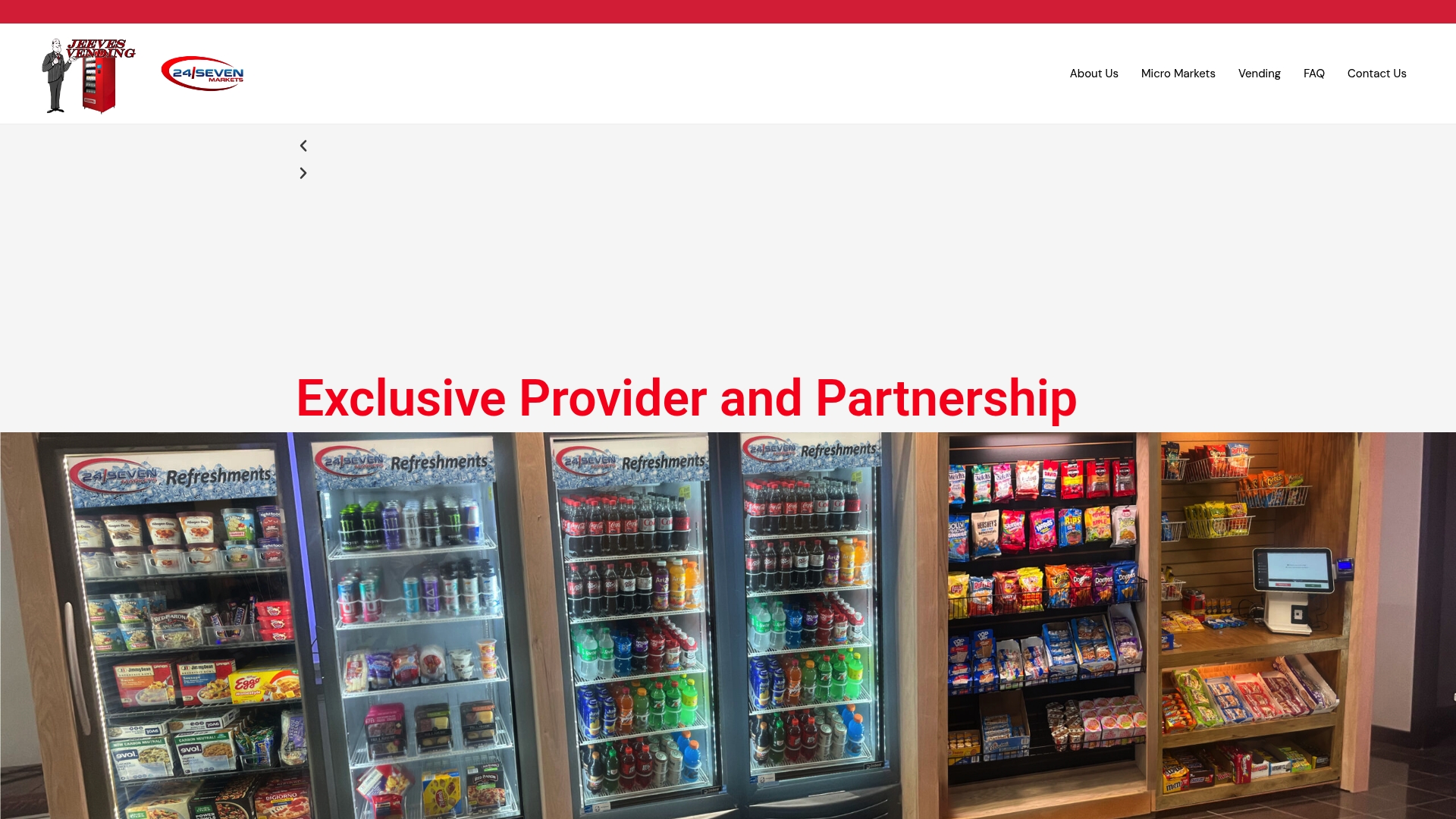
Jeeves Vending handles installation, menu customization, remote telemetry monitoring, and regular restocking. Every placement starts with a site qualification visit, so you know the machine fits your office workflow before it goes in. The 60-day trial includes full performance reporting so your facilities team can see exactly what the machine is doing. For larger offices, Jeeves also installs custom micro-markets that give employees a full self-checkout experience at no cost to the business.
Ready to see whether your Dallas office qualifies? Contact Jeeves Vending to schedule a site visit and get a same-week proposal.
Useful sources and further reading
- Seaga: Rethinking Vending Machine Placement in a World of Hybrid Work — Industry guidance on using telemetry to adapt placements to hybrid work patterns; covers IoT restock alerts and cashless payment standards.
- PVOS Academy: Vending Machine Placement Guide — Comprehensive operator guide covering the qualification-first approach, scoring rubrics, and route-building strategy.
- PVOS Academy: Office Vending Machine Placement — Focused guide on office-specific outreach cadence, touchpoint strategy, and conversion timelines.
- PVOS Academy: How to Find Vending Machine Locations — Covers Minimum Viability Agreements and advanced contractual tools for borderline placements.
- Vendbuddy: Vending Machine Placement for Maximum Revenue — Placement hierarchy analysis showing how building position (lobby vs. basement) affects revenue multiples.
- Vendbuddy: Location Scoring Checklist — The 10-factor, 50-point scoring rubric used by experienced operators to qualify sites before signing.
- Vendbuddy: How to Negotiate Vending Machine Locations — Pop-in scripts, commission negotiation tactics, and the five-objection response framework.
- Coges: Where to Place a Vending Machine for Maximum Success — Explains why consistent daily presence predicts revenue better than peak or irregular headcount.
- Jeeves Vending: Requirements for Vending Machine Placement — Jeeves Vending’s published placement requirements and office setup guidance for facility managers.
- Jeeves Vending: Office Vending Machine Setup Guide for HR Teams — Step-by-step logistics for HR and facilities teams managing a new office vending installation.