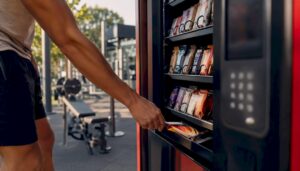

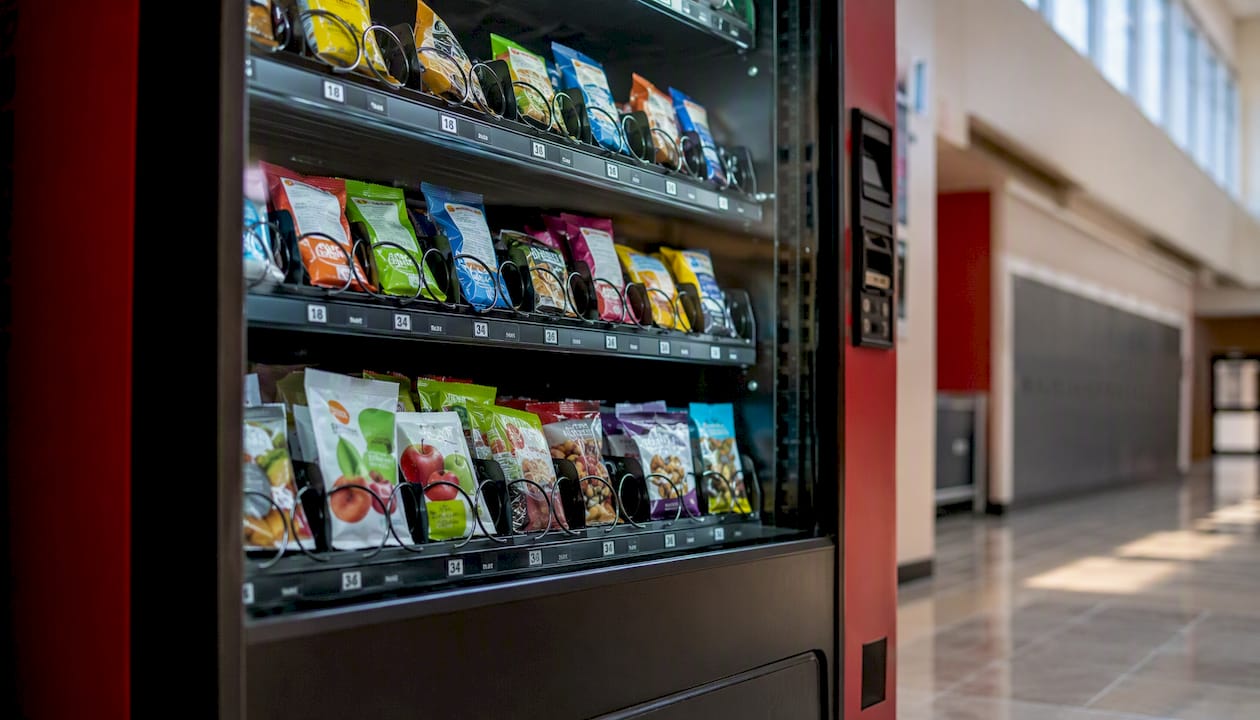
The Smart Snacks in School rule is the federal nutrition standard that governs nearly every food and beverage sold to students on campus during the school day, outside the National School Lunch and Breakfast Programs. Authorized by the Healthy, Hunger-Free Kids Act of 2010 and administered by the USDA Food and Nutrition Service (FNS), the rule went into effect July 1, 2014. If you run a school vending machine, manage à la carte lines, stock a school store, or organize PTA fundraisers. These standards apply to you.
The rule covers:
- Vending machines on school grounds during the school day
- À la carte cafeteria lines selling items outside the reimbursable meal
- School stores and snack bars open during school hours
- Fundraisers held on campus during the school day (with limited state exemptions)
The fastest way to check whether a specific product qualifies is the Smart Snacks Product Calculator, hosted by the Alliance for a Healthier Generation. The USDA FNS Smart Snacks landing page links directly to it and to all official guidance.
Table of Contents
- What does the Smart Snacks Act require nutritionally?
- Where and when do Smart Snacks standards apply?
- How do you check whether a product meets the standards?
- What resources make implementation practical?
- Key Takeaways
- Why Smart Snacks compliance is harder than it looks in practice
- Jeeves Vending takes the compliance work off your plate
- Useful sources and official references
What does the Smart Snacks Act require nutritionally?
These are the federal minimum standards. States and districts may set stricter rules, but no school participating in federal meal programs may go below them.
The USDA Smart Snacks guidance PDF organizes compliance into two product categories: snacks and entrées. An entrée is technically defined as a combination item pairing meat or meat alternates with grains, vegetables, or fruits. Many items people assume are entrées actually fall under snack rules, so check the definition carefully.
Numeric limits by category:
| Nutrient / Attribute | Snack | Entrée (sold as competitive food) |
|---|---|---|
| Calories | ≤200 per portion | ≤200 per portion |
| Sodium | ≤200 mg per portion | ≤200 mg per portion |
| Total sugars | ≤35% of weight | ≤35% of weight |
| Saturated fat | <10% of total calories | <10% of total calories |
| Trans fat | 0 g (label) | 0 g (label) |
Beyond the numbers, a product must also pass an ingredient-first rule: the first ingredient must be a whole grain, fruit, vegetable, dairy, or protein food. A chip with enriched white flour listed first fails, even if the calorie count is fine.
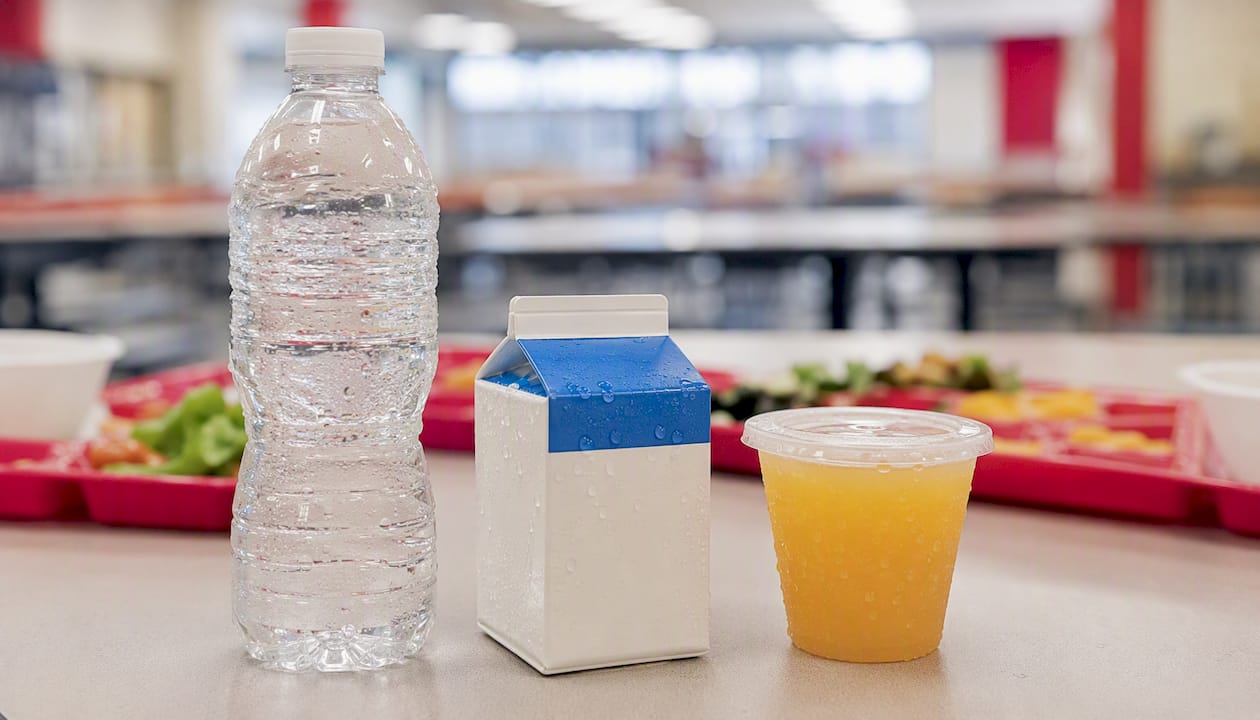
Allowable beverages follow their own track. Plain water, plain low-fat milk, plain or flavored fat-free milk, and 100% fruit or vegetable juice (in portion-controlled sizes) are permitted. Portion size caps apply to juice and milk depending on grade level.
Pro Tip: Watch combination foods and add-ons. A compliant granola bar paired with a non-compliant dipping sauce becomes a non-compliant combination item. Condiments and add-ons sold together with a snack are evaluated as a unit, not separately.
The CDC’s Smart Snacks summary confirms these limits reflect science-based nutrition guidance, and the Federal Register rule text provides the full regulatory language and formal tables if you need the legal citation for a vendor contract.
Where and when do Smart Snacks standards apply?
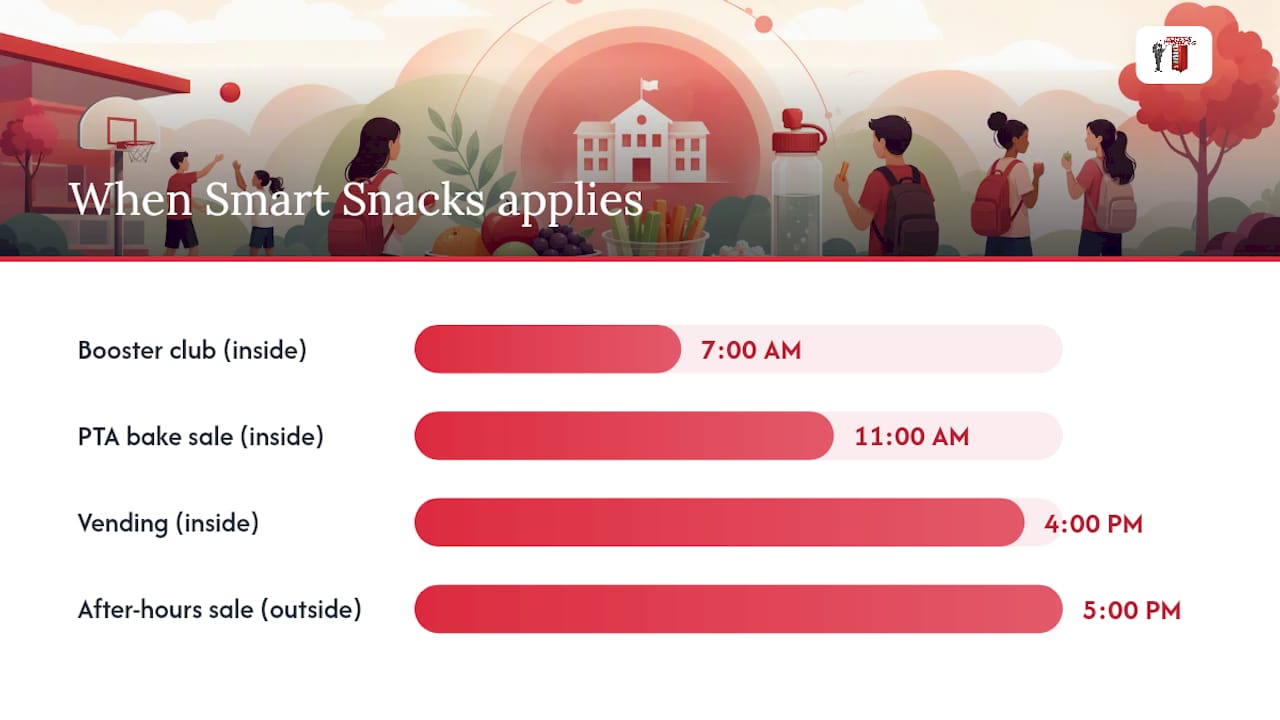
The school day under Smart Snacks is midnight before school through 30 minutes after the last bell. That window is broader than most people expect. An early-morning booster club table selling donuts at 7:00 AM falls inside it. A vending machine that stays active until 4:00 PM at a school that dismisses at 3:30 PM also falls inside it.
Covered venues on campus during that window:
- Vending machines (snack and beverage)
- À la carte cafeteria lines
- School stores and snack bars
- Fundraiser sales held on school grounds
Not covered by Smart Snacks:
- Sales that happen entirely after the 30-minute post-dismissal cutoff
- Off-campus events (away games, field trips)
- Foods provided as part of a reimbursable school meal
- School-meal leftovers sold à la carte carry a specific exception — USDA guidance clarifies the conditions, so verify before assuming they are automatically exempt
One practical scenario: a PTA bake sale set up in the gym lobby at 11:00 AM on a Tuesday is fully subject to Smart Snacks. The same bake sale held in the parking lot at 5:00 PM for a school play is not.
State agencies can authorize a limited number of exempt fundraisers per school year. If your state has not set that frequency, no fundraising exemptions are allowed at all. Check your state agency’s policy before you plan any non-compliant sale.
How do you check whether a product meets the standards?
The fastest reliable method is the Smart Snacks Product Calculator combined with a label check. USDA does not maintain an approved-products list, so every product must be verified independently.
- Identify the product category — Determine whether the item is a snack or an entrée using the USDA definition. Most vending items are snacks.
Pro Tip: Build a shared spreadsheet of pre-approved SKUs with calculator screenshots attached. Vendors restocking your machines can reference it directly, cutting re-verification time to near zero for established products.
For healthy beverage options specifically, portion size and fat content rules vary by grade band, so run beverages through the calculator separately from solid foods.
What resources make implementation practical?
The priority resources, in order of authority:
- A Guide to Smart Snacks in School
- Smart Snacks in Schools
- Federal Register: Nutrition standards for all foods sold in schools (Smart Snacks rule)
When setting up a school-level audit, work through each vending location and à la carte line systematically. Document every SKU currently sold, run each through the Product Calculator, flag failures, and replace them before the next restock. Regular restocking cycles are also the natural checkpoint for catching label changes that can flip a previously compliant product.
Key Takeaways
The Smart Snacks rule sets a federal nutrition floor for every food sold to students on campus during the school day, and the Smart Snacks Product Calculator is the single most reliable tool for verifying compliance before a product hits a vending machine or à la carte line.
| Point | Details |
|---|---|
| Legal basis | The Healthy, Hunger-Free Kids Act of 2010 directed USDA to set these standards; they took effect July 1, 2014. |
| School day scope | Midnight before school through 30 minutes after the last bell — earlier and later than most administrators assume. |
| Product verification | Run every SKU through the Smart Snacks Product Calculator and retain the result with a label photo for audits. |
| State exemptions | Check your state agency’s policy; if no exemption frequency is set, zero fundraiser exemptions are allowed. |
| Jeeves Vending | Jeeves Vending pre-vets product assortments for Smart Snacks compliance and provides documentation support for Dallas-area schools. |
Why Smart Snacks compliance is harder than it looks in practice
Most administrators assume Smart Snacks is a simple checklist. Run the numbers, swap out the chips, done. The part that actually trips up schools is the combination-food rule and the ingredient-first requirement, because they require reading labels rather than just scanning a nutrition panel.
A product can pass every numeric limit and still fail because the first ingredient is enriched flour instead of whole wheat. A vending operator who relies on calorie counts alone will approve items that a state auditor will flag. That gap between “looks healthy” and “actually compliant” is where most compliance problems live.
The fundraiser exemption issue is the other underestimated risk. PTAs often plan sales months in advance without checking whether their state has set an exemption frequency. When the answer is “no exemptions,” the bake sale either needs compliant products or needs to move off-campus and after hours. Neither option is obvious until someone reads the state policy.
The practical fix is documentation culture: every SKU approved, every calculator result saved, every label change flagged at restock. Schools that treat Smart Snacks as a one-time setup rather than an ongoing process are the ones that get caught when a manufacturer quietly reformulates a product.
Jeeves Vending takes the compliance work off your plate
Schools in the Dallas-Denton area that partner with Jeeves Vending get a vending program where Smart Snacks compliance is built into the product selection from day one, not bolted on after the fact. Every SKU in the machine has been vetted against USDA nutrient limits and ingredient-first rules, and Jeeves Vending maintains the documentation so your food service team does not have to run individual calculator checks for every restock.
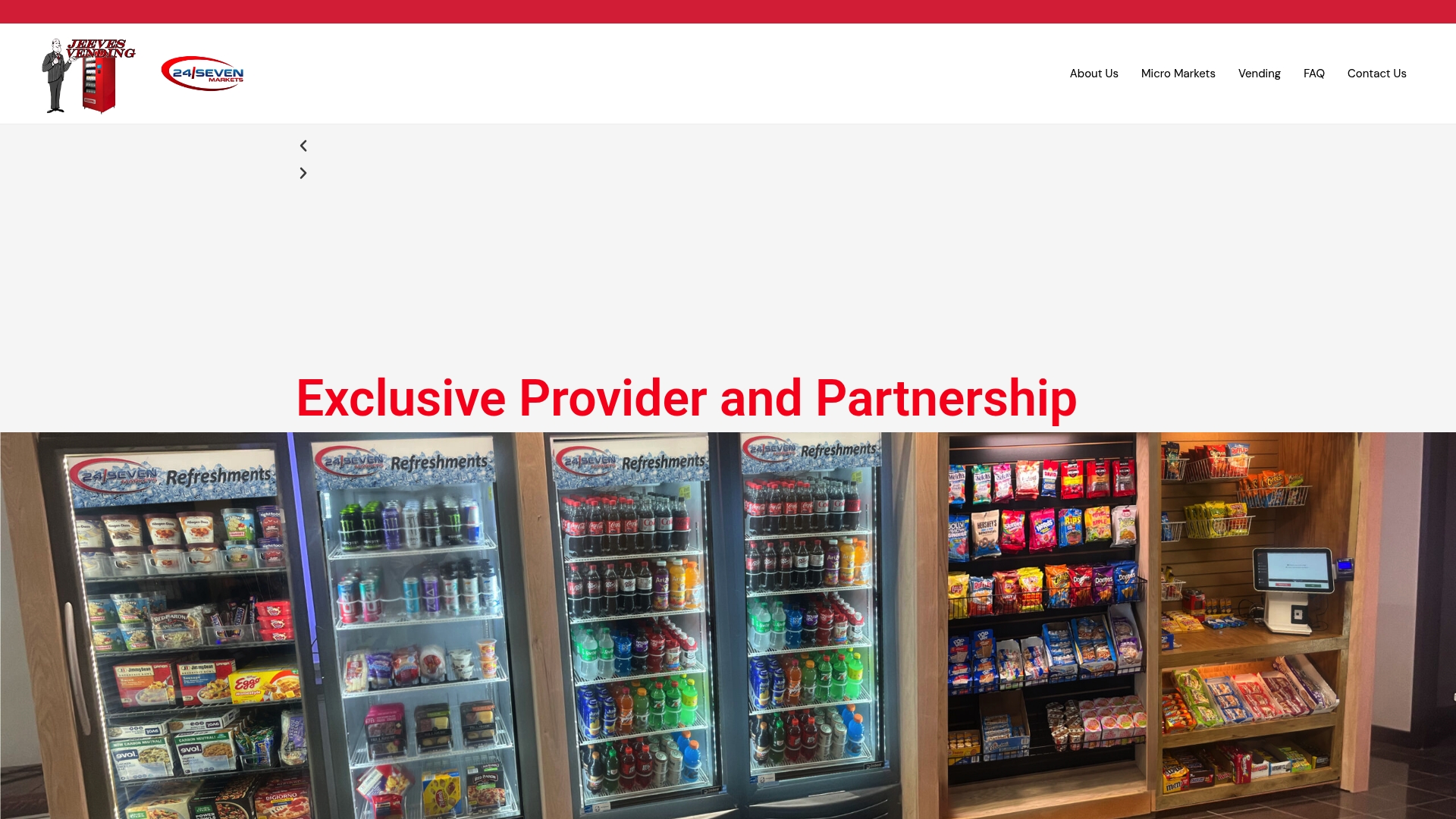
The installation is at no upfront cost to your school. Jeeves Vending handles equipment, stocking, maintenance, and label recordkeeping, while your administrators keep access to the compliance documentation they need for audits. For schools weighing vending versus a larger micro-market setup, both options are available with the same compliance-first approach.
Ready to see which Smart Snacks-compliant vending solutions fit your campus? Contact Jeeves Vending to request a no-cost compliance review and installation quote.
Useful sources and official references
| Resource | What it’s for |
|---|---|
| USDA FNS: A Guide to Smart Snacks in School | Primary explainer: definitions, nutrient criteria, scope, and examples |
| Smart Snacks Guidance PDF | Downloadable reference with numeric tables and the entrée definition |
| USDA FNS Smart Snacks landing page | Links to the Product Calculator and all current tools |
| Federal Register rule text | Official regulatory language and formal nutrition tables |
| Competitive Foods and Fundraisers issue brief | State exemption variability and fundraiser policy implications |
| CDC Healthy Schools: Smart Snacks | Public-health framing and confirmation of covered venues |
| FNS resources index | Training modules, Q&As, and downloadable tools for staff |
| USDA press release on Smart Snacks | Policy rationale and USDA’s flexibility-first implementation intent |
Save these links in your vendor contracts and wellness policy documentation. When a state auditor or parent asks for your compliance basis, pointing to USDA FNS and the Federal Register rule text is the answer that closes the conversation.