
An employee vending policy is a written set of rules covering which machines and locations it applies to, what products get stocked, how items are priced, and how calorie and contact information is displayed at the point of purchase. The core job of the policy is to set clear scope, meet labeling requirements, and nudge healthier choices without banning anything employees want. Start with the checklist below, then loop in your vending vendor before you finalize wording.
TL;DR:
- Operators with 20 or more vending machines nationwide must post calorie counts at purchase; smaller operators may opt in, and FDA rounding rules apply.
- Get written vendor commitments for healthier item placement, calorie data updates, subsidies, restocking, maintenance response times, and a named compliance contact before finalizing the policy.
- Pilot the policy in one building, use sales data and employee feedback to adjust the assortment, then review category sales, satisfaction, and complaints quarterly.
- Limit purchase data to operational needs, keep individual records from managers and performance reviews, and disclose any optional loyalty app collection and retention practices.
- Treat healthier vending as support for daily choices, not promised health care savings; RAND reports no clear cost return from many workplace wellness components.
Table of Contents
- Essential elements every vending policy checklist needs
- What the FDA calorie-labeling rule means for your breakroom
- Using vending choices to support wellness without banning snacks
- Contract terms to require from your vending vendor
- A simple rollout plan: pilot, feedback, and launch
- Announcing the policy and keeping it enforced
- Keeping vending usage data private and secure
- Handling employee feedback and suggestions on vending
- Making vending machines accessible to employees with disabilities
- Responding to vending machine malfunctions and safety issues
- Measuring whether the policy is actually working
- What most HR teams get wrong about vending policy
- Let Jeeves Vending handle the operational side for you
- FAQ
- Sources
Essential elements every vending policy checklist needs
A workable policy covers a short list of fixed points rather than vague intentions. Write each one down, assign an owner, and revisit it on a set schedule.
- Define which machines, break rooms, and buildings the policy covers, including satellite offices.
- State the goal as supporting choice and wellness, not restricting what employees can buy.
- Group products by category (chips, drinks, healthy, sweets, fresh foods, frozen, coffee) and assign placement rules, including a traffic-light example where GREEN items sit at eye level.
- Document pricing and any subsidy, noting who absorbs the discount and how it’s tracked.
- Require calorie counts and operator contact information visible at the point of purchase.
- Spell out vendor duties: restocking frequency, planogram updates, maintenance response time, and monthly sales reporting.
- Set a record-keeping and review cadence, typically quarterly, so the policy doesn’t go stale.
Pro Tip: Keep the policy concise. A shorter document gets read, referenced, and actually followed.
Teams drafting this from scratch can start from a one-page office vending policy template and adjust categories and pricing to fit their own breakroom layout.
What the FDA calorie-labeling rule means for your breakroom
Federal rules determine whether your organization needs formal calorie signage or can treat it as optional. Operators who own or operate 20 or more vending machines nationwide must display calorie counts at the point of purchase for foods where the Nutrition Facts label can’t be checked before buying, according to the FDA. Operators below that threshold can register voluntarily to be covered.
The 20-machine threshold determines who must comply, but any vendor can opt in voluntarily to support transparency with their clients, per the FDA’s compliance guidance.
The formatting rules are specific:
- Calories round to the nearest 5-calorie increment up to 50 calories, then the nearest 10 above that.
- The word “Calories” or “Cal” sits adjacent to the number, not on a separate sign.
- Electronic displays are allowed in place of printed stickers.
- Operator contact information must be posted so employees can ask questions about an item.
Action steps for HR: collect calorie data from your vendor before signage goes up, confirm placement at eye level near the selection buttons, and assign someone to check accuracy whenever the product mix changes.
Using vending choices to support wellness without banning snacks
The safest goal for a vending policy is better behavior and access, not a guaranteed cut in health care spending. RAND’s research on workplace wellness programs finds that employers frequently add healthier vending and similar lifestyle changes, but these components often don’t produce a clear return on investment for health care costs, even though they can shift daily habits, according to RAND. Set expectations accordingly.
- Use GREEN, YELLOW, and RED labels on shelf tags so employees can scan nutritional value at a glance, an approach detailed in the VENDING& healthier-vending toolkit.
- Price GREEN items competitively and place them at eye level or near the front of the selection.
- Run a short taste test or survey before finalizing the planogram, so the assortment reflects what people actually want.
- Track which labeled items sell best and adjust promotions monthly rather than guessing.
Contract terms to require from your vending vendor
Your policy is only as strong as the agreement backing it. Before signing, ask your vendor to commit to specific terms in writing rather than general promises.
- A minimum percentage of healthier items in the planogram, with placement rules for where GREEN-labeled products sit.
- Clear responsibility for supplying calorie data and printing or updating signage whenever products rotate.
- Pricing and subsidy mechanics in writing, including how price disputes or refunds get handled.
- Restocking frequency, a maintenance response window, and a named contact for compliance questions.
Pro Tip: Put the compliance contact’s name and phone number in the contract itself, not just on a business card. Turnover happens, and the document should outlast any one person.
A simple rollout plan: pilot, feedback, and launch
Rolling out a new policy across every breakroom at once invites confusion. A phased approach catches problems while they’re still small.
- Pick one building or floor and run a pilot, tracking sales data alongside a short employee survey.
- Collect feedback through surveys or a quick taste test, then adjust the assortment before expanding.
- Finalize the planogram and signage based on pilot results, and set an installation date with your vendor.
- Define a few metrics (sales mix, survey satisfaction, complaint volume) and schedule a review.
Announcing the policy and keeping it enforced
Employees respond better to a short, clear announcement than a long memo nobody reads. Cover the purpose, the effective date, pilot details if relevant, and exactly how to send feedback.
- Post the policy and calorie information in the breakroom itself, not only on the intranet.
- Check restock accuracy and signage condition on a set schedule, not only when someone complains.
- Review monthly sales reports against the planogram to confirm the vendor is holding up their end.
- Give employees one clear channel, a shared inbox or a suggestion box, to request item changes or flag problems.
Keeping vending usage data private and secure
Many modern machines and micro-markets use digital point-of-sale or kiosk systems that track purchases, sometimes tied to an employee badge or payment card. Your policy should state plainly what gets collected and who can see it.
Limit data collection to what’s operationally necessary: item sold, time of purchase, and payment confirmation. Avoid linking purchase history to individual employees for any purpose beyond fraud prevention or restocking accuracy, and say so in the policy. If your micro-market uses self-checkout with card payment, confirm with your vendor that transaction data is encrypted and that neither party retains purchase history longer than needed for billing and inventory.
Make clear who has access to sales reports, typically HR or facilities management, and that individual purchase records aren’t shared with managers or used in performance reviews. If employees use a loyalty or rewards app tied to the vending system, disclose what that app collects and whether it’s optional. A short data privacy paragraph in the policy, reviewed alongside your vendor’s own privacy practices, prevents confusion later and keeps the program focused on convenience rather than surveillance.
Handling employee feedback and suggestions on vending
A feedback channel only works if people know it exists and see it produce changes. Name a single point of contact, whether that’s HR, facilities, or a designated “breakroom lead,” and publish how to reach them near the machines and on the intranet page where the policy lives.
Set a simple process: log every suggestion, whether it’s a request for a specific snack or a complaint about stale inventory, and share a rough timeline for review (monthly is reasonable for most offices). Not every request gets fulfilled, particularly ones outside the vendor’s product categories, but acknowledging the request matters more than granting it.
Use pilot-stage surveys and ongoing suggestion logs together. The pilot survey establishes a baseline of what employees want before launch; the ongoing log catches shifts in preference over time, seasonal demand, or recurring complaints about a specific item or machine. Bring the top few recurring requests to your vendor during scheduled planogram reviews rather than asking for one-off changes, which keeps the relationship efficient and the assortment responsive.
Making vending machines accessible to employees with disabilities
Vending policy should account for physical and sensory access, not just product selection. Machines should have reachable control panels and coin or card slots at a height that works for wheelchair users, consistent with general accessible-design practice for public-facing equipment. Confirm with your vendor during installation that new machines meet these placement standards, and flag any older units that don’t.
For employees with visual impairments, audio or high-contrast displays on digital payment kiosks help confirm selections and pricing before purchase. If your micro-market uses a touchscreen checkout, ask your vendor whether an audio-assist mode is available.
Keep aisle space in front of machines clear and wide enough for a wheelchair or mobility aid to approach and turn. This is as much a facilities issue as a vending one, but it belongs in the policy’s scope section so responsibility is clear. Include a line in the policy inviting employees to flag accessibility barriers directly, separate from general feedback, so these requests get prioritized rather than filed alongside snack preferences.
Responding to vending machine malfunctions and safety issues
Every policy needs a short, visible answer to “what do I do if the machine eats my money or looks unsafe?” Post a phone number or QR code directly on each machine, linked to your vendor’s service line, so employees don’t have to track down HR for a jammed coin slot.
For safety issues, specifically a machine that’s tipping, sparking, or leaking refrigerant, instruct employees to stop using it immediately and report it the same way they’d report any facilities hazard: to building management or a safety line, not just the vending contact. Vendors typically respond fastest to mechanical jams and refund requests, but anything involving electrical or structural risk should route through your organization’s standard incident process first.
Keep a simple log of malfunction reports and resolution times. This does two things: it gives you leverage when discussing maintenance response windows at contract renewal, and it flags a machine that’s failing repeatedly and may need replacement rather than another repair visit.
Measuring whether the policy is actually working
A policy without metrics is just a document. Pick a small number of indicators you can track consistently rather than an elaborate scorecard nobody updates.
Sales mix by category (GREEN versus YELLOW versus RED, or however your labeling system groups items) shows whether healthier placement and pricing are shifting behavior. Compare this quarterly against your baseline pilot data. Employee satisfaction, gathered through a short annual or semi-annual survey, captures whether the assortment still matches what people want, since preferences shift. Complaint and feedback volume, tracked through your designated contact channel, flags recurring problems early, whether that’s a specific machine, a discontinued favorite, or a pricing complaint.
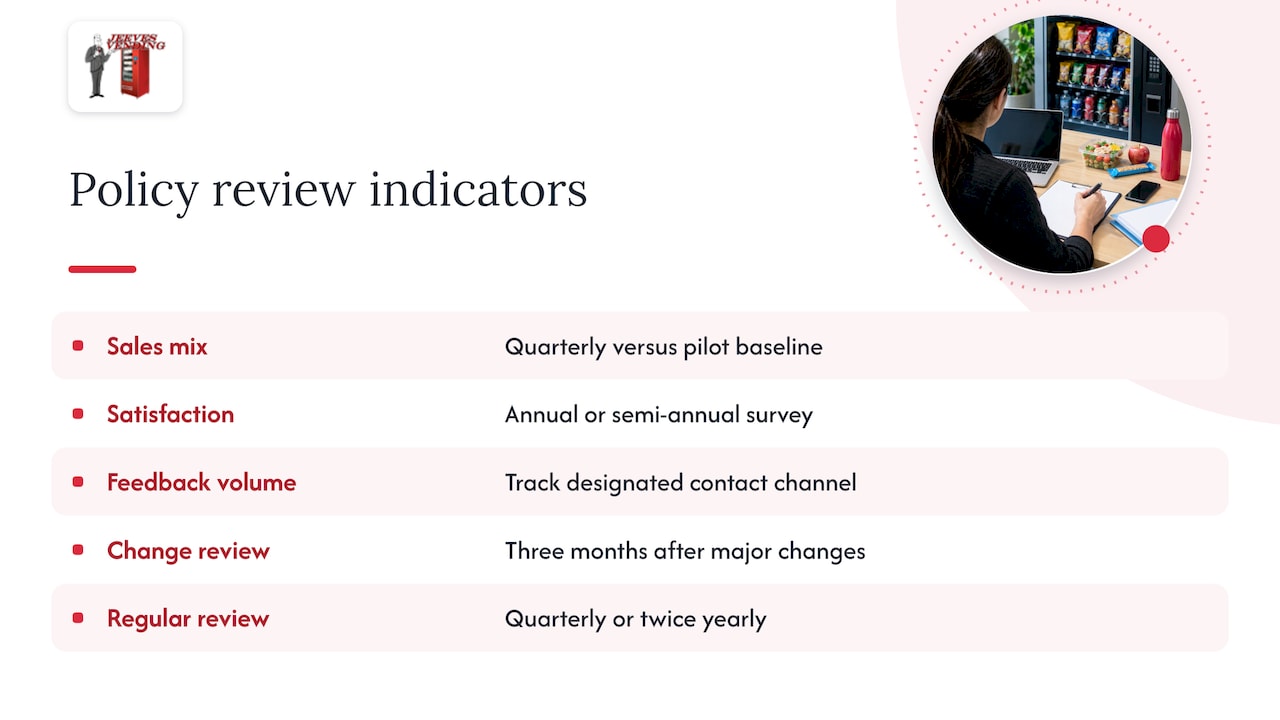
Review these three together at the three-month mark after any major change, then on whatever cadence your policy’s review section specifies, often quarterly or twice a year. If sales data shows GREEN items stalling despite competitive pricing, that’s a placement or visibility problem worth raising with your vendor before assuming employees simply don’t want healthier options.
What most HR teams get wrong about vending policy
The biggest mistake isn’t choosing the wrong snacks. It’s treating the policy as a one-time document instead of a living agreement that needs the same maintenance as the machines themselves.
Signage goes stale fastest: calorie labels don’t get updated when a vendor swaps products, and the compliance contact listed on the machine is someone who left the company two years ago. Planograms drift too, with GREEN items slowly pushed to the bottom row because nobody flagged it during a routine restock. Both problems are easy to fix if someone owns the regular check, and nearly impossible to fix if nobody does.
The other common gap is drafting policy in isolation from the vendor, then discovering the contract doesn’t actually support what the policy promises. Loop your vendor into the draft early, before wording is final, so the commitments on paper match what they can deliver.
— Gary
Let Jeeves Vending handle the operational side for you
Once your policy is written, the harder part is executing it consistently, and that’s where we come in. We install custom vending machines and micro-markets at no upfront cost and build planograms around your chosen categories.
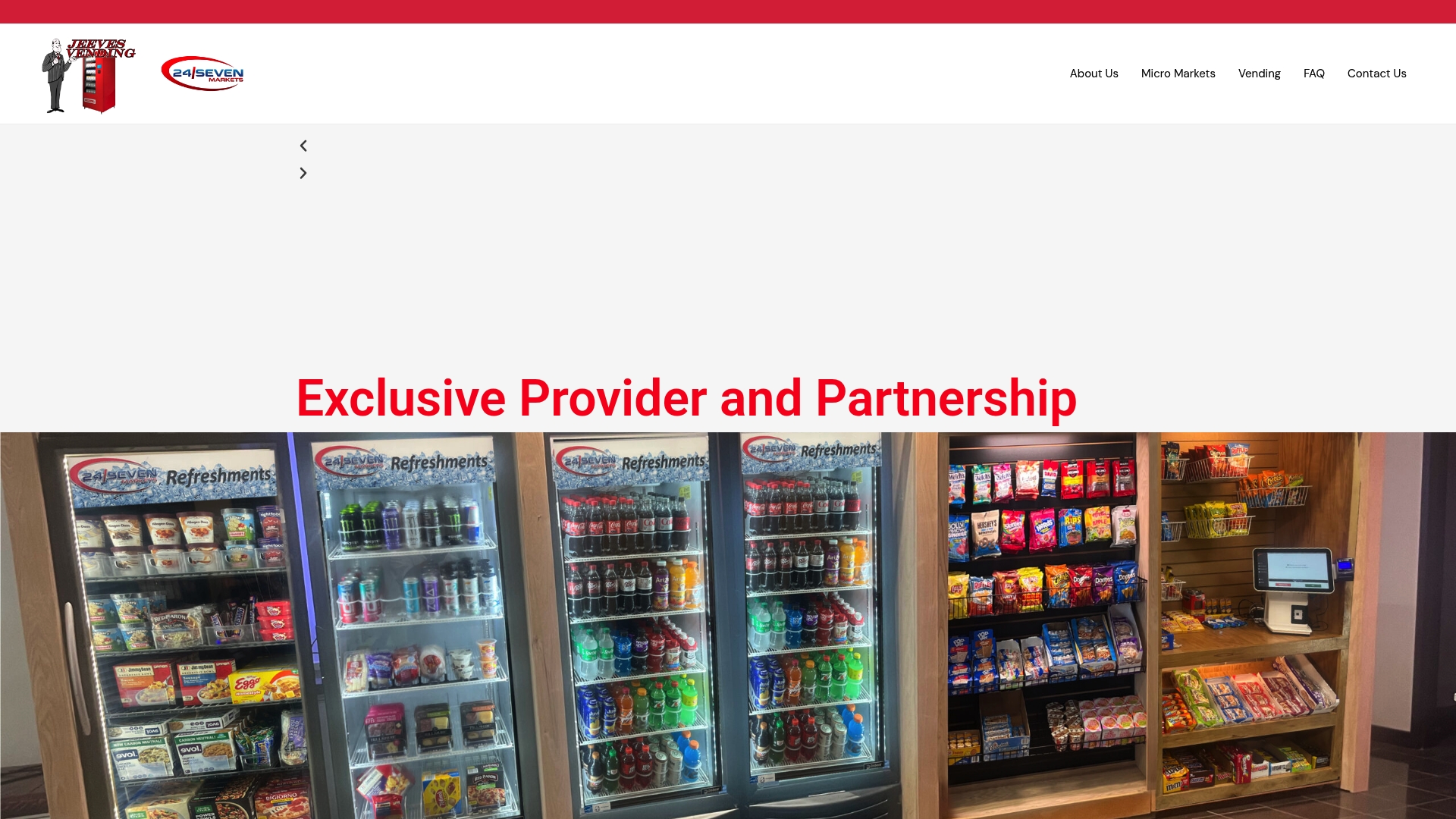
- We handle restocking, maintenance, and remote stock monitoring so your team isn’t chasing a jammed machine between meetings.
- We offer Free Full Service Vending Programs for Business Owners, covering installation and ongoing service.
- For healthier assortments, we can rotate in options like the protein-forward bars from Einstein Energy or hydration options like Nuka Love’s Thirst Trap alongside standard snacks and drinks.
- We support both traditional vending and self-checkout micro-markets, depending on your space and headcount.
If you’re ready to pilot a policy without managing the equipment yourself, reach out to get started and we’ll walk through what fits your breakroom.
FAQ
Do you need a license to own and operate vending machines?
Licensing requirements vary by state and locality, and often depend on what you’re selling (food, beverages, or regulated products like tobacco) rather than the machines themselves. Check your state’s department of revenue or health department for specific vending or food-service permit rules before installing machines.
Do vending machines count as retail?
Vending machines are generally treated as a form of retail food or merchandise sales for tax and regulatory purposes, since they sell goods directly to consumers. The specific classification and any sales tax obligations depend on your state and the product category being sold.
Are nicotine pouch vending machines legal?
Rules for nicotine pouch vending machines vary by state and locality. Check with the relevant authorities about age restrictions, supervision, permits, and product separation before placing these products in a machine. Rules vary significantly by state, so confirm local requirements before placing any nicotine products in a vending machine.
Can I buy a vending machine and put it in a school?
Vending machines placed in schools typically must follow additional nutritional standards for food and beverages sold during the school day, separate from general workplace vending rules. Review your district’s policy and relevant federal nutrition standards for school vending before purchasing or placing a machine, since product mix requirements differ from an office breakroom.