
You can end a vending contract by following its termination clause exactly: confirm the term and any automatic renewal, give written notice in the way and by the date the contract requires, keep the machine accessible until it is collected, and settle any money owed. Most problems come from missing a notice window or sending notice informally, not from the exit itself.
This guide is for the business that hosts the machine: an office, school, gym, hospital or warehouse. It walks through what to read first, how notice works, what early exit can cost, who removes the machine, and how to leave on good terms.
TL;DR
- Read the termination, term and renewal clauses before you contact the vendor. The notice deadline is usually what decides your options.
- Give written notice, in the form the contract names, and keep proof of delivery.
- Ending early may carry a fee, but a vendor’s uncured breach can allow you to exit without penalty. Document service problems as they happen.
- Keep the machine powered, accessible and unmoved until the operator collects it, and agree on who repairs removal damage.
- Next time, negotiate a short term, a clear exit and removal terms before you sign.
Table of Contents
- Read the contract before you do anything else
- How long vending contracts run and why renewals catch hosts
- The two ways out: without cause and for cause
- What early termination can cost
- Step-by-step: giving notice
- Machine removal, access and final accounts
- What to put in the next agreement
- Our perspective
- A no-cost program for your next vending setup
- FAQ
- Sources
Read the contract before you do anything else
Start with the clauses that govern the exit. Attorneys at Hogan & Pritchard advise reviewing the termination clause first: the required notice period, the permitted grounds, whether notice must be in writing, and whether a dispute-resolution step is mandatory. The same guidance suggests documenting your communications and reasons, settling outstanding payments, returning vendor property and complying with every termination clause.
Pull out five things and write them on one page:
- Start date and initial term. How long did you commit to?
- Renewal language. Does the agreement renew by itself, and for how long?
- Notice rules. How many days, in what form, to whom, at what address.
- Grounds for ending. Without cause, for cause, or both.
- Removal and money terms. Who takes out the machine, how fast, and what is owed at the end.
If you cannot find the signed copy, ask the operator for it in writing. If the stakes are high, such as a large fee or a disagreement about breach, have a business attorney in your state read it before you send anything.
How long vending contracts run and why renewals catch hosts
Terms vary widely, and many hosts only learn the length when they try to leave. One published example from an industry trade publication describes a three-year initial term that renews automatically for successive two-year periods unless either side gives written notice 60 days before the current term ends. It is only a sample, but it shows the pattern: the cheapest moment to leave is before the renewal date, and the window to do it can be narrow.
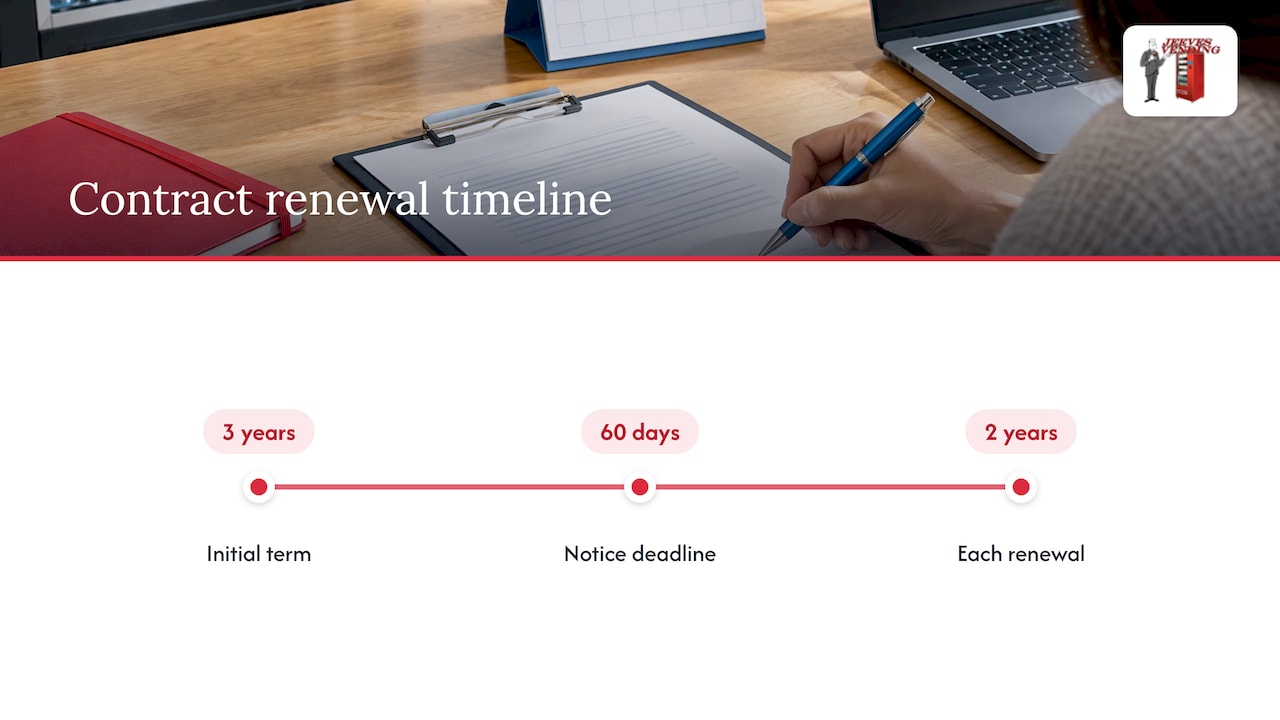
Put two dates in your calendar the day you sign or find the agreement: the end of the current term, and the last day to send notice. Set a reminder a few weeks ahead of the second one.
If you are comparing what a vending lease and a service agreement mean for your exit, the distinction matters. A lease generally transfers possession or control of equipment to you for payment. Wisconsin’s tax rules, for example, treat equipment provided with an operator who does more than maintain, inspect or set it up as a service rather than a lease or rental. That is a tax classification in one state, not a universal rule, but it points to the practical question: who owns and controls the machine? In a typical host arrangement the operator owns the equipment and you provide space and power, so your exit is about notice and removal. If you leased or financed a machine yourself, your exit is about the lease payments and the equipment’s return. Our overview of how vending service agreements work explains the usual structure.
The two ways out: without cause and for cause
Ending without cause
Many agreements include a termination-for-convenience clause. It lets a party end the contract without giving a reason, provided the agreed notice is observed. A U.S. municipal example, a Town of Malta, New York vending agreement, allows termination for convenience on 90 days’ notice. Other public agreements use 30 days. Leon County Schools’ policy, for instance, recommends termination for just cause on 30 days’ written notice. Expect anything from 30 to 90 days in practice, and count from the day the notice is received, not the day you write it, unless the contract says otherwise.
Ending for cause
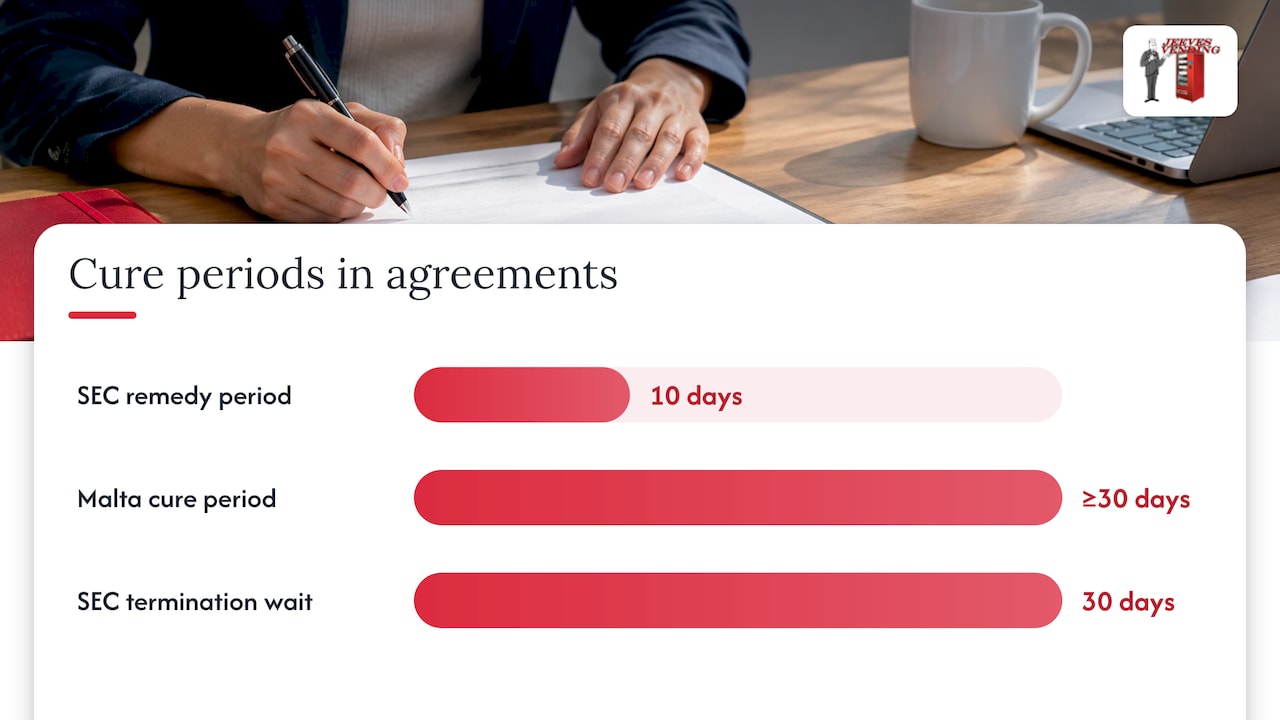
If the operator has failed to meet the contract, you may be able to leave sooner. The usual mechanism is a written notice that describes the default, followed by a cure period. The Malta agreement allows termination for an uncured material default after written notice describing the default and a cure period of at least 30 days. An SEC-filed food-services agreement uses a shorter fix: 10 days to remedy a breach, with termination available 30 days after default notice if the problem remains.
For this route, the paper trail is everything. Keep a log with dates:
- Empty machines, out-of-order machines and how long each stayed that way
- Missed or late service visits
- Expired or unsafe products
- Unpaid commissions, if your agreement includes them (Leon County’s policy treats late commission payments as potential just cause)
- Every email or call to the operator, and the response
Reasonable response times are worth spelling out when you sign. We cover what to look for in what response time to demand from a vending service.
What early termination can cost
Some vending contracts attach a fee to leaving before the term ends. The structures differ: a flat fee, a fee scaled to the time remaining, or payment tied to the rest of the term. Read the clause for the exact formula, then check whether it is tied to a machine the operator placed for you, because that is usually the justification for it.
A few practical points:
- A breach changes the math. If the operator has not performed and has not fixed it after proper notice, ask your attorney whether the fee clause even applies.
- Negotiate. Operators often prefer a quiet exit to a dispute. Offer a clear departure date, access for pickup and a reasonable window. Ask whether they will waive or reduce the fee in exchange.
- Mind your own obligations. Under the contract-law idea of mitigation, an injured party is expected to take reasonable steps to avoid further losses after learning of the other side’s failure to perform. Do not let a problem run for months and then claim all of it.
If the machine is also a safety concern, such as an electrical fault or a broken door, tell the operator in writing right away and review who carries the risk. Our guide to vending machine liability sets out how responsibility and insurance usually divide.
Step-by-step: giving notice
- Confirm who can sign. Notice should usually come from the person or entity named in the contract, such as the business owner, district or property manager.
- Check the delivery method. Some contracts require certified mail or a named email address. Informal texts and phone calls rarely count.
- State the basics. Identify the agreement by date and parties, say you are terminating under a specific clause, and give the effective date you calculate.
- Keep the reason short and factual. For a without-cause exit, you do not need one. For cause, describe the default and what you want fixed by when.
- Request a removal date in writing. Ask the operator to confirm the pickup schedule and the final accounting.
- Keep proof. Save the mailing receipt, delivery confirmation and a copy of the letter.
A short template works:
Re: Vending agreement dated [date] between [Host] and [Operator], location [address]. Under Section [number], [Host] gives notice of termination effective [date]. Please confirm in writing the date on which you will remove the equipment and provide a final statement of any amounts due.
If you are a school, a hospital or part of a larger group, follow any internal approval or procurement process too, since public bodies often have their own rules about contract changes.
Machine removal, access and final accounts
Removal is where good exits go quiet and bad ones turn into arguments. Settle these points in writing before the pickup date:
- Access. Keep the machine powered, reachable and in place until the operator collects it. Moving it yourself can create damage claims.
- Timeline. Contracts often set a window of about 10 to 15 business days after termination. If yours is silent, propose a date in your notice.
- Who pays. The operator normally covers removal and repairs any damage caused by it, such as floor marks or wall scrapes. Photograph the area before and after.
- Condition of the site. The SEC-filed agreement above requires restoring owner-furnished equipment and facilities to the condition they were received in, reasonable wear excepted. Apply the same idea to the space: leave it clean and unobstructed.
- Money. Ask for a final statement covering any commissions, deposits or fees, and pay or collect what is owed.
- Cashless equipment and data. Make sure card readers and any wired network or power connections are handled by the operator, not left in place.
Contracts across service trades spell out removal and site-clearing duties in a similar way, as in these commercial snow removal contract terms. The principle is the same: agree on responsibilities, timing and who does the work before the work starts.
When the machine is gone, send a short email confirming the date, the condition of the space and that the account is closed. Keep it with your contract file.
What to put in the next agreement
The easiest exit is the one you negotiated before signing. For your next vending or micro-market arrangement, ask for:
- A term you are comfortable with, and renewal that needs your active consent or a long, clearly stated notice window
- Termination without cause on a defined notice period, such as 30 to 90 days
- A cure period for service failures and a defined list of what counts as default
- A removal deadline and a statement that the operator pays for removal and repairs damage
- Clear commission or payment terms, if any, with dates
- Insurance and responsibility language for the equipment and the location
- Tax handling stated plainly. Our vending sales tax guide explains how the calculation works.
Warehouses and multi-shift sites should also settle restocking frequency and service hours; see how to negotiate a vending service contract for a warehouse. HR teams who set snack rules for staff can pair the contract with an employee vending policy so expectations about labels, products and complaints are written down in one place.
Our perspective
We are a family-owned vending company serving the Dallas-Denton region, and we think a vending agreement should never feel like a trap. The host business should know what it is signing, who services the machine and what happens if either side wants out.
That is why we build our programs around the host’s needs: the equipment, the stocking, the maintenance and the remote stock monitoring are handled by us, and the host does not pay for the machines or the service. Employees, students, members and visitors who buy from the machine are the ones who fund it.
When service is good, nobody goes looking for the termination clause. Our approach is to stay in close contact, keep machines full and fix problems quickly, and to treat a clear written agreement as part of that service. If you are a manager reading your current contract and want a fresh look at how it could work, we are glad to talk it through.
Gary
A no-cost program for your next vending setup
If you are leaving a contract because the machine is rarely stocked, the selection is stale or support is slow, you can replace it with something better matched to your people. We install and manage vending machines and custom micro-markets at no upfront cost to the host business, with snacks, drinks, coffee, healthy options and fresh food, digital POS and kiosk systems, and remote stock monitoring.
See our free full-service vending program to learn how it works for offices, schools, gyms, hospitals and warehouses.
You can also browse our fresh food and coffee options or start from our home page to describe your location.
FAQ
Can I cancel a vending contract early?
Often yes, but the contract decides how. Check the termination clause for notice periods, fees and whether cause is required. If the operator is in uncured breach after written notice, you may be able to leave without a penalty. A business attorney can confirm this for your state.
How much notice do I need to give?
It depends on your agreement. Public and sample agreements commonly use 30 days for cause and anywhere from 30 to 90 days without cause, and some auto-renewing contracts require notice 60 days before the term ends. Use the exact number in your contract and send notice in the form it names.
Who removes the vending machine after termination?
The operator typically removes it and repairs any damage the removal causes. Your part is to keep the machine powered, accessible and unmoved until it is collected. Put the pickup date in writing and photograph the space before and after.
What is the difference between a vending lease and a service agreement?
A lease generally gives you possession or control of the equipment for payment. A service agreement means the operator supplies, owns and services the machine, and you provide the space. Because the exit terms differ, read which type you signed before planning your notice.
Sources
- Avoiding litigation: Considerations when ending vendor contracts, Hogan & Pritchard
- Leon County Schools policy on vending machine contracts
- Town of Malta, New York vending agreement
- SEC-filed food-services agreement
- Mitigation of damages, Cornell Law School Wex
- The Hows, Whys and Substance of Service Contracts, Vending Market Watch
- Wisconsin Administrative Code Tax 11.29, Leases
- Commercial snow removal contract terms