If someone is hurt by a vending machine, or gets sick from something it sold, liability usually lands first on the operator who owns, stocks and services the machine. The business hosting the machine can still be pulled into a claim, which is why the contract and the certificate of insurance matter as much as the machine itself. This guide explains who is exposed to what, which coverage answers each risk, what it costs, and what a host can do to keep its own exposure low.
We wrote it for two readers: people running vending routes, and the office, school, gym, hospital and warehouse managers who are deciding whether to let a machine in.
TL;DR
- The operator carries most of the legal risk for a machine: defective products, machine failures, and injuries at the machine. Host businesses are rarely the main target, but they can be named in a lawsuit.
- A general liability policy with a $1,000,000 per occurrence limit is the usual baseline. Hosts commonly ask to be listed as an additional insured and to receive a certificate of insurance before any machine goes in.
- Tip-overs are the classic serious hazard. Anchoring, placement and routine inspections reduce the risk, and insurance does not replace them.
- If you are a host, put insurance, maintenance, incident reporting and removal terms in writing before installation.
Table of Contents
- Who is liable when a vending machine causes harm
- The tip-over risk, in numbers
- The coverage that answers each risk
- A host’s checklist before a machine goes in
- Operator duties that reduce claims
- Our perspective: liability is mostly about who runs the machine
- If you want a machine without carrying the equipment risk
- FAQ
- Sources
Who is liable when a vending machine causes harm
Liability follows control. The party that chooses the product, services the equipment and decides where it stands is the party a court looks at first.
Two legal ideas do most of the work:
- Product liability. Under strict products liability principles, the manufacturer, wholesaler and retailer can all be held responsible for harm caused by a defective product, regardless of how careful they were. An operator who sells a sandwich or a drink through a machine is the retailer in that chain.
- Premises and negligence claims. If a customer is hurt because a machine was poorly placed, left near a wet floor, or not secured, the claim is about unsafe conditions. That can involve both the operator who placed the machine and the property owner who allowed the spot.
In practice, a claim often names everyone with a connection to the machine: the operator, the manufacturer, and the host. Who ends up paying depends on the contract between them and on whose insurance responds.
What the operator is exposed to
An operator’s risks fall into a few groups:
- Food and drink safety. Spoiled, expired, mislabeled or contaminated items, especially perishable food from refrigerated machines.
- Injury at the machine. A hand caught in a delivery door, a sharp edge, an electrical fault, or a tip-over.
- Property damage. A leaking cooler that ruins a floor, or a machine that damages a wall or a doorway during delivery.
- Employee injuries. Stocking is physical work. OSHA’s general duty requirement means employers must provide a workplace free from recognized hazards, and failing to train staff on safe handling or lifting procedures has led to serious citations.
- Loss of the machine itself. Theft, vandalism and fire are equipment risks, not liability risks, but they sit in the same insurance conversation.
What the host is exposed to
A host does not sell the product, so its exposure is narrower. It is mostly about the building: slippery floors around the machine, machines blocking an exit path, cords across a walkway, and a machine placed where people crowd. A host that ignores a known hazard, such as a machine that visibly rocks, can be hit with a negligence argument.
The host’s best protection is contractual. We cover how agreements typically divide responsibility in how vending service agreements work.
The tip-over risk, in numbers
Tip-overs are the reason vending machines show up in odd safety statistics. The best-documented figure comes from federal data: the CPSC reported 37 deaths and 113 injuries between 1978 and 1995 linked to people rocking or tilting machines. That same year, seven soda machine manufacturers launched a warning label campaign in cooperation with the CPSC to warn that rocking or tilting a machine can kill or injure.
Today’s estimates are lower. One industry source puts it at roughly 2 to 4 deaths a year in the United States, often from machines weighing over 900 pounds. Modern machines are heavier, often anchored and designed to resist tipping, so incidents are now rare. Rare is not the same as never, and a single serious injury claim can exceed what a small route earns in years.
What that means for you:
- Anchor machines to the wall or floor where the site allows it.
- Keep warning labels intact and visible.
- Place machines on level, dry flooring away from high-traffic turns.
- Inspect on every service visit and write down what you see.
Routine inspections for hazards such as wet floors or poor placement are part of liability management, and a basic policy does not do that work for you.
The coverage that answers each risk
There is no single “vending machine liability policy.” Operators usually assemble a few coverages, often bundled.
| Coverage | What it answers | Who typically needs it |
|---|---|---|
| General liability | Third-party injury and property damage, such as a customer hurt at the machine | Every operator |
| Product liability | Illness or injury from items sold | Every operator, especially with fresh food |
| Commercial property or inland marine | Damage to or theft of the machine and stock | Anyone who owns equipment |
| Commercial auto | Route trucks and vans | Operators with vehicles |
| Workers’ compensation | Injured stockers and drivers | Operators with employees |
| Crime and cyber | Cash theft, card data and payment systems | Operators with cashless readers or large cash volumes |
Most sources on this topic agree on the core: general liability, product liability, and property or inland marine coverage for the equipment, often packaged in a Business Owner’s Policy.
What it costs
Prices vary by state, machine count, product mix and claims history, so treat these as ranges, not quotes.
- For a small operation, a $1,000,000 per occurrence, $2,000,000 aggregate general liability policy has a median cost of about $37 to $58 a month, or $442 to $707 a year when bundled in a BOP, usually with a $500 deductible.
- Costs climb with scale. One guide estimates $1,200 to $3,500 a year for a solo operator with about 10 machines, and far more for mid-size and established routes with trucks and employees.
The jump comes from vehicles, payroll and sheer machine count, not from the liability policy alone.
Why hosts ask for a certificate of insurance
Offices, gyms and airports generally require a certificate of insurance before allowing any machine. For operators, that makes insurance an entry requirement, not an optional extra.
The detail that matters most to a host is the additional insured endorsement. A general liability policy that names the host property as an additional insured extends protection to the host for lawsuits arising from the vending operation, and it is usually a contract prerequisite. Some property management groups also require higher limits than the standard $1,000,000.
A host’s checklist before a machine goes in
If you manage an office, school, hospital, gym or warehouse, you are not buying a machine, but you are choosing a partner whose mistakes could reach your building. Before you sign:
- Ask for the certificate of insurance. Check the limits, the policy dates and that your organization is named as an additional insured.
- Read the service agreement. Look for who maintains the machine, how fast problems are fixed, how incidents are reported, and how either side can end the arrangement. Our overview of what guarantees vending uptime shows what response commitments look like in practice.
- Walk the proposed spot. Our requirements for vending machine placement and space planning checks cover clearance, power, flooring and egress. Do not block a corridor or an exit path.
- Confirm anchoring. Ask whether the machine will be secured and who does it.
- Agree on incident reporting. Any injury, spill, leak or complaint should reach you within a set time, in writing.
- Check food handling. If perishable food is sold, ask who holds the local health permits and how expired items are pulled.
- Align with your own policies. HR and facilities teams should see how machines fit your rules on labels and contracts, which we explain in our employee vending policy guide.
For a wider look at what a clean setup involves, our office vending machine setup guide for HR teams walks through it from request to first restock.
For legal advice on a specific contract or an injury that has already happened, talk to a licensed attorney in your state. For policy questions, talk to a commercial insurance broker or agent who handles your state. The checklist above helps you ask better questions. It does not replace them.
Operator duties that reduce claims
Insurance pays after something goes wrong. Good operating habits make that less likely, and they also keep premiums reasonable.
Keep records
Write down service visits, expiration checks, temperature readings for cold machines and any incident. If a claim comes, dated records show you acted reasonably. Cash and sales records matter too: the IRS treats cash from vending machines as gross receipts that must be reported, and examiners may reconstruct income when deposits do not match. Our walkthrough of vending sales tax calculation covers the reporting side.
Maintain refrigeration properly
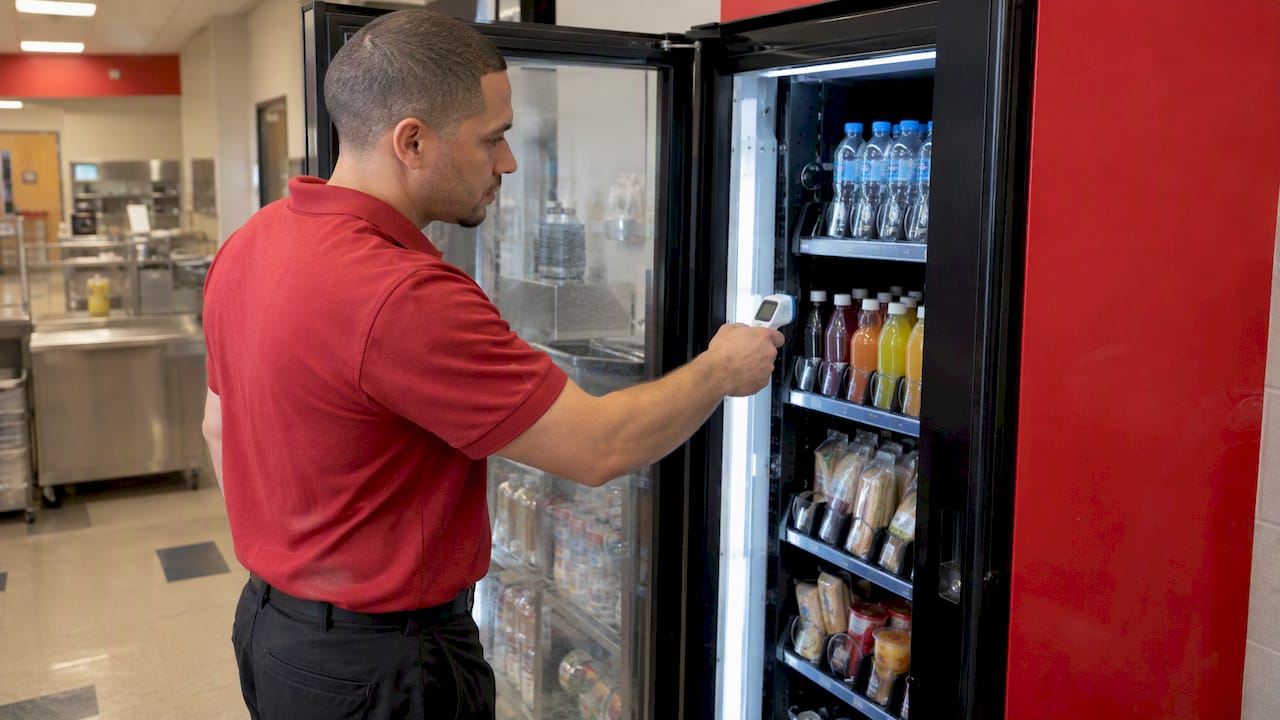
Cold machines are where food safety claims begin. A cooler that drifts out of temperature can spoil stock without anyone noticing. A commercial refrigeration maintenance checklist is a useful model for the routine tasks, such as cleaning, seals and temperature checks, that keep equipment running safely. Remote temperature and stock monitoring helps catch problems between visits.
Train your people
Stockers lift cases and move heavy machines. Written lifting procedures and basic training reduce injuries and protect you from the kind of citations OSHA describes.
Know your local rules
There is no single national vending license, and requirements vary by state and city. In Texas, for example, operators need a Sales and Use Tax Permit from the Comptroller, plus local health permits when selling perishable food. Some jurisdictions add per-machine occupation taxes. Schools add their own rules, which we summarize in a checklist for Texas school administrators.
Our perspective: liability is mostly about who runs the machine
We are a family-owned vending company serving the Dallas-Denton region, and the question we hear from managers is rarely “what does the policy say?” It is “what happens if something goes wrong, and will I be dealing with it?”
Our honest answer is that the best liability protection is an operator who is close to the machine. Machines that are monitored remotely, restocked on a schedule and fixed quickly generate fewer problems. A locally managed operator can walk your site, look at the floor, and move a machine that sits in a bad spot. That is also why we put placement review at the start of every installation instead of treating it as an afterthought.
We also think hosts should expect to ask hard questions. Ask any operator, including us, for the paperwork your site requires, and read the service agreement before anything is installed. A good partner will not be bothered by that. It saves both sides trouble later.
Our programs are set up so the host business does not pay for equipment or service. Revenue comes from what employees, students, visitors and members buy. That removes cost from the conversation, but it does not remove the need for clear terms, and we would not want you to skip them.
— Gary
If you want a machine without carrying the equipment risk
If you are a business owner who wants snacks, drinks, coffee, fresh food or a micro-market on site without buying equipment, our free full service vending program covers installation, stocking, maintenance and remote stock monitoring at no upfront cost to you. You can also browse our micro-markets or reach us through jeevesvending.com to talk through your site, your headcount and the paperwork you need to see.
FAQ
Who is liable if a vending machine hurts someone?
Usually the operator who owns and services the machine is the first party named, and the manufacturer can be too. The host can also be included if the injury relates to unsafe conditions on its property. The contract and each party’s insurance decide who ultimately pays.
What insurance do I need for a vending machine?
Most operators start with general liability and product liability, plus property or inland marine coverage for the equipment. Operators with vehicles or employees add commercial auto and workers’ compensation. A broker can tell you what your state and your host contracts require.
How much is a $1,000,000 liability policy for vending?
For small operations, one cost guide reports a median of $37 to $58 a month for a $1,000,000 per occurrence general liability policy bundled in a BOP. Your price depends on your state, machine count and claims history, so get quotes before budgeting.
How many people die from vending machines each year?
Estimates run from about 2 to 4 deaths a year in the United States, mostly from machines tipping onto people who rocked them. The CPSC documented 37 deaths between 1978 and 1995. Modern machines are heavier and often anchored, so incidents are now rare.
Do I have to pay taxes if I own a vending machine?
Yes. Cash collected is business income that must be reported to the IRS, and most states require a sales tax permit. In Texas, that means a Sales and Use Tax Permit through the Comptroller. Confirm local requirements with your state or a tax professional.
Sources
- Legal Information Institute: Products liability
- OSHA standard interpretation on the general duty requirement
- Wendor: How many people die from vending machines
- CPSC: Soda vending machine industry labeling campaign
- Felidae Conservation Fund: Vending machine accident estimates
- Digital Media Vending: Vending machine insurance guide
- Insureon: Vending machine insurance costs
- Get Business Coverage: Vending machine insurance
- IRS Publication 5495
- Wendor: Texas vending machine laws and permits