
Start with this mix and you can be live in 48 hours: protein shakes (ready-to-drink), protein bars, electrolyte drinks, bottled water, and one or two small accessories like shaker cups. That combination covers every phase of a member’s workout and hits the SKUs with the highest repeat-purchase rates in gym vending.
Three actions for the next 48 hours:
- Pick your machine type (combo unit for smaller gyms, separate cooler + snack machine for higher traffic)
- Enable cashless tap-to-pay before the machine goes live
- Commit to a 30-day pilot with weekly sell-through reviews before making any permanent SKU changes
Table of Contents
- Why gym vending product variety tips start with the member journey
- What to stock: the SKU playbook by category
- How many SKUs to start with, and what to charge
- Machine features and placement rules that protect your variety
- How to run a 30-day pilot and monitor what’s working
- Food safety for chilled and perishable vending items
- Revenue, margin, and payback: a worked example
- How to adapt your SKU mix by gym type
- Key Takeaways
- What actually works in the field
- Jeeves Vending brings this to Dallas gyms at no cost to you
- Useful sources and further reading
Why gym vending product variety tips start with the member journey
Random assortments fail in gyms for a simple reason: members arrive with a specific physiological need, not a general snack craving. A member walking in at 6 AM wants fast-digesting carbs and caffeine. The same person leaving an hour later wants protein and electrolytes. Stock the wrong thing at the wrong moment and they walk past the machine entirely.
Phase-aligned stocking consistently produces higher repeat purchases and lower spoilage than random convenience assortments. The behavioral logic is straightforward:
- Pre-workout: Members want energy fast. Simple carbs, caffeine, and light electrolytes. Think granola bars, energy gels, Celsius, and small coffee options.
- Mid-workout: Hydration is the only real need here. Bottled water and electrolyte drinks. Keep these stocked deep.
- Post-workout: Recovery drives the purchase. Protein shakes, protein bars, Greek yogurt (if you have refrigeration), and jerky.
Fitness-specific choices also let you price at a premium. A member who just finished a hard set will pay $4.50 for a Fairlife Core Power shake without hesitation. That same member would balk at $4.50 for a bag of chips. Perceived relevance is the pricing lever most operators never use.
Pro Tip: Map your machine’s column layout to the three phases. Put pre-workout items near the top rows (eye level on arrival), post-workout recovery items in the middle, and hydration at the bottom where it’s easy to grab on the way out.
What to stock: the SKU playbook by category
The categories below are ranked roughly by margin contribution and member demand. For each one, packaging and temperature notes matter as much as the product itself.
Ready-to-drink protein shakes
The single highest-margin category in gym vending. Operators report margins of 60–80% on products like Fairlife Core Power and Premier Protein. These require refrigeration, so a smart cooler or glass-door unit is non-negotiable. Stick to bottles of sizes that do not jam coil machines or slow throughput.
Protein bars
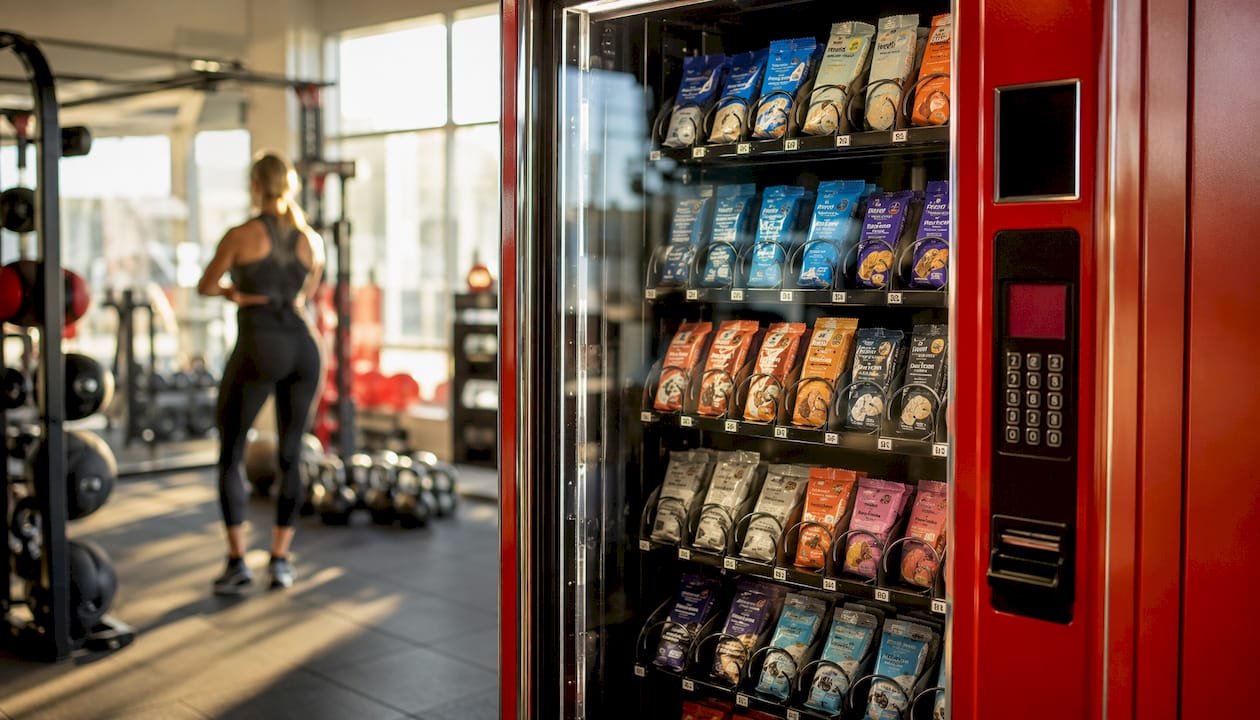
The workhorse SKU. Quest, RXBAR, and Clif Builder’s all move well in gym settings. Ambient temperature is fine, so these work in any snack machine. Choose bars with moderate calorie content and a substantial amount of protein. Avoid bars with chocolate coatings in summer months if your machine sits near a window — melted chocolate means returns and jammed coils. For more concrete product examples and packaging tips, the protein snacks for vending guide covers this in detail.
Electrolyte and sports drinks
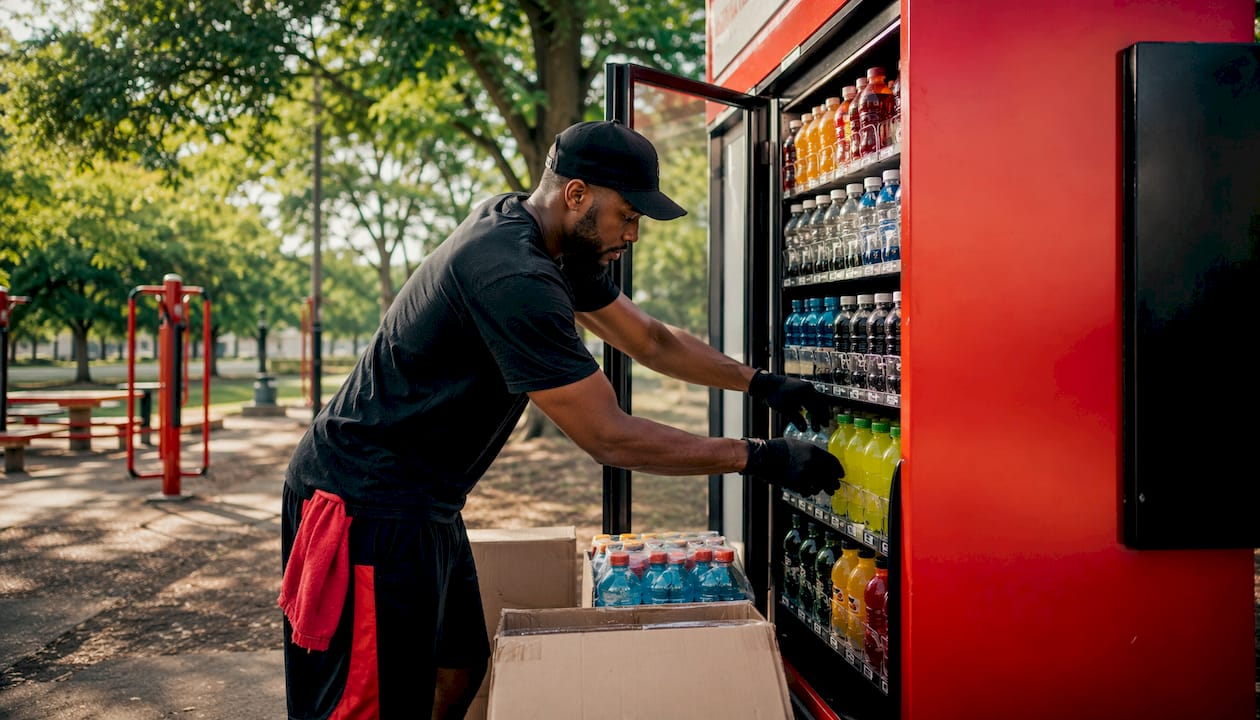
Liquid IV packets, Liquid IV sticks, Gatorade Zero, and BODYARMOR all perform well. Bottled electrolyte drinks need refrigeration; powder packets and single-serve sticks are ambient and take up minimal coil space. A hydration station vending setup that pairs bottled drinks with powder packets gives members options at two price points.
Bottled water
Bottled water typically brings margins of 10–20%, but members expect it. Treat water as a traffic driver, not a profit center. Stock it deep but don’t give it premium column space. A standard size bottle priced competitively keeps members from leaving frustrated.
Jerky, nuts, and dried fruit
Beef jerky has high margins and a long shelf life. Jack Link’s and Epic Bar formats both sell in gyms. Mixed nuts and trail mix work well for boutique and yoga-oriented facilities. Portion size matters: 1–2 oz single-serve packs fit standard coils without jamming.
Coffee and caffeinated options
Canned cold brew (Starbucks Doubleshot, La Colombe) and energy drinks (Celsius, Monster Zero) cover the pre-workout caffeine need. Celsius in particular moves fast in gym settings. Canned coffee is ambient; cold brew in glass bottles needs refrigeration.
Small accessories
Shaker cups, foam earplugs, resistance bands, and grip tape are low-volume but high-margin. A shaker cup purchased at low cost can retail at a considerably higher price with zero spoilage risk. These belong in one or two columns of a combo machine, not as the focus.
The “treat” slot
One column of a lower-guilt indulgence (dark chocolate, Bark Thins, or a small bag of pretzels) reduces the clinical feel of a purely functional machine. Members who feel the machine “gets them” come back more often.
Dietary and allergen notes: Stock at least one plant-based protein option (Orgain, Vega Sport) and one low-sugar bar (RXBAR, KIND Protein). Label allergens clearly on the machine face or via a QR code. Members with nut allergies or gluten sensitivities will notice and appreciate it.
How many SKUs to start with, and what to charge
Starter SKU counts by gym size
| Gym size | Daily active members | Recommended starter SKUs | Refill cadence |
|---|---|---|---|
| Boutique studios with fewer than 100 daily active members benefit from a smaller SKU selection and frequent restocking. | |||
| Mid-size gyms with moderate daily active members require a medium SKU selection and biweekly restocking. | |||
| High-traffic facilities with many daily active members need a larger SKU selection and frequent restocking, possibly triggered by sales data. |
Starting with fewer SKUs than you think you need is the right call. A boutique gym with 8 well-chosen SKUs will outsell a mid-size gym with 25 random ones. You can always add; pulling a slow seller after it expires costs you margin and time.
Pricing guidelines
- Bottled water: $1.50–$2.00
- Protein bars: $3.00–$4.50
- RTD protein shakes: $4.00–$5.50
- Electrolyte drinks: $2.50–$3.50
- Energy drinks / cold brew: $3.00–$4.00
- Accessories (shakers, earbuds): $6.00–$12.00
Many operators understock high-margin protein products and overweight bottled water. Water with low margin occupies the same column space as higher-margin protein shakes, highlighting the impact on pricing strategy. The math is obvious once you see it side by side.
SKU decision table: which categories to prioritize
| Member profile | Must-have categories | Secondary categories | Skip or limit |
|---|---|---|---|
| Performance / strength | RTD protein, electrolytes, jerky | Protein bars, cold brew | Plain chips, candy |
| Cardio / endurance | Electrolytes, water, energy gels | Granola bars, Celsius | Heavy protein bars |
| Boutique / yoga | Clean-label beverages, nuts, dried fruit | Low-sugar bars, cold brew | Jerky, heavy supplements |
| Mixed / general gym | Protein bars, RTD shakes, water, energy drinks | Accessories, treat slot | Excessive candy |
Machine features and placement rules that protect your variety
The non-negotiable features
Cashless tap-to-pay is the single feature that most directly affects conversion. Most gym members don’t carry cash. A machine without contactless payment loses a meaningful share of impulse purchases every day.
Beyond payment, the features that actually matter for variety:
- Multi-temperature or smart cooler capability: Lets you stock RTD shakes, Greek yogurt, and cold brew alongside ambient bars without spoilage risk. Smart cooler setups make perishable, high-margin SKUs viable where coil machines cannot.
- Remote telemetry: Low-stock alerts, SKU-level velocity reports, and sales dashboards let you restock before you run out and tune your assortment weekly without a physical visit.
- Combo unit vs. split setup: A combo machine (drinks + snacks in one unit) works well for boutique gyms with limited floor space. For higher-traffic facilities, a dedicated drink cooler plus a separate snack machine raises total SKU capacity and increases average spend per visit.
Placement zones that convert
Entrances and locker rooms are the two highest-converting placement zones. An entrance machine catches pre-workout intent; a locker room machine catches post-workout recovery purchases. Near water stations and at studio exits are secondary wins.
Quick placement rules:
- Machine face must be visible from 20+ feet away with no obstruction
- Allow sufficient clearance on the service side for restocking.
- Avoid placement near heavy equipment that vibrates (can affect refrigeration units)
- Confirm a dedicated 20-amp circuit is available before installation
How to run a 30-day pilot and monitor what’s working
The goal of the first 30 days is data, not perfection. Set your starting SKU mix, define your measurement cadence, and resist the urge to change anything before week two.
Operators who use telemetry and review results weekly see measurable revenue lifts by removing slow sellers and refocusing inventory quickly. The pilot gives you the baseline to make those calls with confidence.
KPIs to track
- Units sold per SKU (daily): Identifies your top 5 and bottom 5 performers within two weeks.
- Sell-through rate (weekly): Units sold ÷ units stocked. Below 50% in week one is a red flag for that SKU.
- Gross margin per SKU: (Sell price − cost) ÷ sell price. Track this alongside units sold, not instead of it.
- Out-of-stock events: Any SKU that hits zero before your scheduled restock is costing you sales.
- Revenue per active member: Total machine revenue ÷ average daily gym attendance. This is your true efficiency metric.
Simple A/B tests to run in weeks 2–4
Swap one underperforming SKU slot with a new candidate and run it for 7 days. Compare sell-through rates. Decision rule: if the new SKU doesn’t match or beat the one it replaced within 7 days, pull it. Don’t give a bad SKU three weeks to prove itself.
Other tests worth running: swap a candy slot for a low-sugar bar, test time-of-day pricing (a small discount on protein bars before 8 AM), and try one accessory SKU in a column that previously held a slow snack.
Analyzing sell-through weekly is the key differentiator between a profitable machine and one that accumulates expired stock. That’s not an exaggeration. Operators who skip this step end up restocking the same slow sellers out of habit.
Seasonal rotation matters too. Electrolyte drinks accelerate in summer; heartier recovery snacks like jerky and nut mixes gain velocity in winter. Build a quarterly SKU review into your calendar from day one.
Food safety for chilled and perishable vending items
Perishable items require refrigeration that maintains 40°F or below at all times. The USDA defines the danger zone as 40°F–140°F — any perishable item held in that range for more than two hours is a food safety risk.
Practical rules for operators:
- Temperature logs: Check and record refrigeration unit temperature at every restock visit. Smart coolers with telemetry can automate this.
- Use-by date rotation: First-in, first-out (FIFO) on every restock. Pull any item within 48 hours of its use-by date.
- Supplier invoices: Keep invoices for all perishable items for at least 90 days. If a health inspector visits, you need traceability.
- Local permits: Many US states and municipalities require a retail food handler permit or vending operator license for machines that sell perishable items. Check with your local health department before stocking Greek yogurt, fresh shakes, or any refrigerated prepared food.
- FDA Food Code compliance: The FDA Food Code provides the federal baseline for retail food handling. Your state health department may have additional requirements.
For ambient items (bars, jerky, nuts), the main risk is expiration, not temperature. A monthly shelf-life audit on slow-moving SKUs prevents expired product from sitting in a machine.
Revenue, margin, and payback: a worked example
The core formulas
- Daily revenue = units sold per day × average sell price
- Gross margin = (sell price − cost) ÷ sell price
- Monthly profit = daily revenue × 30 × blended gross margin
- Payback period = machine cost ÷ monthly profit
Worked example: mid-size gym, protein-heavy mix
| Metric | Assumption | Calculation |
|---|---|---|
| Daily revenue is calculated by multiplying units sold by average price. | ||
| Blended gross margin depends on product mix, varying by SKU type. | ||
| Daily gross profit is daily revenue multiplied by gross margin. | ||
| Monthly gross profit is daily gross profit times the number of days in a month. | ||
| Payback period is the ratio of machine cost to monthly gross profit. |
These figures are illustrative estimates based on reported operator ranges. Your actual numbers will vary by location, pricing, and SKU mix.
What moves the needle fastest
Location is the biggest variable. A machine placed at a gym entrance versus a back hallway can see 2–3x the daily unit volume. Restock frequency is second: a machine that runs out of protein shakes by Thursday loses Friday and Saturday sales, which are often peak days. Telemetry directly addresses this by alerting you before stockouts happen, not after.
How to adapt your SKU mix by gym type
One mix does not fit every facility. Here’s how to make targeted swaps based on your gym’s profile.
CrossFit box
Members train at high intensity and care about performance nutrition. Lead with electrolytes (Liquid IV, BODYARMOR), beef jerky, and RTD protein shakes. Accessories like chalk bags and wrist wraps can occupy one column. Skip candy entirely. If the box is unmanned after hours, a machine with a PIN-lock or lighting timer is worth considering.
Boutique yoga or Pilates studio
Clean-label is the priority here. Members respond to organic, low-sugar, and plant-based options. Coconut water, Vega Sport protein bars, KIND bars, and cold brew coffee outperform traditional sports drinks. Avoid heavy protein shakes and jerky. For more on tailoring assortments to wellness studios, the vending variety in fitness centers guide covers the nuances well.
Corporate gym or office fitness center
Members often grab something before or after work, so breakfast-adjacent items move well in the morning (granola bars, cold brew, protein bars) and recovery items in the evening. Accessories like earbuds and phone charger cables can work here in a way they wouldn’t in a pure performance gym. A staffed front desk means you can get away with a slightly more complex machine setup.
24-hour gym
Unmanned overnight hours mean you need a machine that handles itself. Telemetry is non-negotiable here. Stock items with longer shelf lives (bars, jerky, ambient drinks) more heavily than perishables. Vandal-resistant machines with secure payment terminals are worth the premium. A split-unit setup with a dedicated drink cooler often works better than a single combo unit at high-traffic 24-hour locations.
Key Takeaways
A profitable gym vending setup requires phase-aligned SKUs, cashless payment, telemetry-driven restocking, and a 30-day pilot to validate your mix before committing to it long-term.
| Point | Details |
|---|---|
| Start with the right mix | Protein shakes, protein bars, electrolyte drinks, water, and 1–2 accessories cover all three workout phases. |
| Prioritize high-margin SKUs | RTD protein shakes carry 60–80% margins; water typically runs 10–20%. Give premium column space accordingly. |
| Run a 30-day pilot | Track sell-through rate weekly and swap any SKU below 50% sell-through in week one. |
| Placement drives conversion | Entrances and locker rooms are the two highest-converting zones; visibility from 20+ feet is a minimum. |
| Jeeves Vending for Dallas gyms | Jeeves Vending installs and supports combo machines and smart coolers at no cost to gyms in the Dallas-Denton region. |
What actually works in the field
The conventional wisdom in gym vending is to stock “healthy options” and let the machine run. That framing misses the point entirely. The operators who consistently outperform aren’t the ones with the most virtuous product selection. They’re the ones who treat the machine like a retail floor: they know which SKUs are pulling their weight, they rotate based on data, and they place the machine where members are already stopping.
Placement and telemetry are key revenue drivers; even a well-curated SKU mix in a poor location may underperform compared to a mediocre mix in a high-traffic spot. And without telemetry, you’re restocking by memory and habit rather than by what the data actually shows. The operators who add remote monitoring to an existing machine almost always find at least two or three SKUs they would have kept indefinitely that were quietly dragging down monthly revenue.
The other thing most guides won’t tell you: don’t overthink the “healthy” angle. Members want options that match what they’re doing, not a lecture on nutrition. A protein shake and a bag of beef jerky are healthy choices for someone who just finished a deadlift session. A cold brew and a granola bar are the right call before a 6 AM spin class. Stock for the workout, not for a wellness brand image, and the sales will follow.
Jeeves Vending brings this to Dallas gyms at no cost to you
Gym owners in the Dallas-Denton region get the full setup from Jeeves Vending without paying for the machine upfront. That means combo units, AI smart coolers, and micro-market configurations installed, stocked, and maintained by a team that already knows what sells in fitness facilities. You get the revenue without the overhead of sourcing machines, managing restocks, or troubleshooting payment hardware.
Jeeves Vending’s smart cooler and combo machine options cover everything from a boutique studio that needs a single 20-SKU unit to a high-traffic 24-hour gym that needs a split cooler-plus-snack setup with telemetry. For facilities that have outgrown a single machine, micro-markets in Dallas offer open-shelf self-checkout with far more SKU capacity and a better member experience. Ready to see which setup fits your gym? Call Jeeves Vending and get a free consultation for your facility.
Useful sources and further reading
- USDA Danger Zone (40°F–140°F) — The federal baseline for safe perishable food handling; essential reading before stocking any refrigerated items.
- FDA Food Code — Federal retail food handling standards that apply to vending operators selling perishable products.
- Kendall Reagan Nutrition Center: Snacking for Workouts — Colorado State University’s evidence-based guide to pre- and post-workout nutrition; useful for validating your phase-aligned SKU choices.
- Gym Vending Machines: What to Stock, Where to Place, and How to Profit (VMFS) — Covers phase-aligned stocking, telemetry-driven restocking, and seasonal rotation in practical detail.
- Gym Vending Machine Guide: Profit, Placement, and Member Experience (Vending.com) — Placement strategy and conversion zone guidance for gym operators.
- Best Gym Vending Machine Products: Top-Sellers and ROI Guide (Cotton Candy Vending) — Margin data by product category and a breakdown of which SKUs deliver the fastest payback.
- Healthy Vending for NJ Gyms: What Actually Sells (Mixed Berry Vending) — Smart cooler case studies and the split-unit strategy for higher-traffic facilities.
- Best Vending Machine Products to Stock (VendBuddy) — Data-backed product list with margin benchmarks across categories including protein bars, energy drinks, and jerky.