A qualifying office typically pays $0 upfront for full-service vending through an operator-owned revenue-share program, while offices that buy their own equipment spend within a broad range depending on machine type and technology. Here’s what shapes those numbers:
- No-cost placement: available if your location meets an operator’s foot-traffic threshold
- Purchase route: new machines run $3,000–$6,000; used ones $1,200–$3,000; smart machines can top $15,000
- Recurring costs to plan for: electricity, card processing, restocking labor, and maintenance, generally $50–$150 per machine per month
Key Takeaways
Office vending costs range from $0 upfront for qualifying full-service placements to $12,000+ for purchased smart equipment, with monthly operating costs of $50–$150 per machine regardless of ownership model.
| Point | Details |
|---|---|
| Free placement is common | Offices with 40–75 steady employees often qualify for $0 upfront, full-service vending. |
| Purchase costs vary widely | New machines run $3,000–$6,000; used ones $1,200–$3,000; smart machines can exceed $15,000. |
| Budget $50–$150 monthly | Electricity, card processing, and maintenance add up per machine even in managed programs. |
| Commission rates shape margin | Location commissions run 0–25% of gross sales and directly affect net revenue. |
| Jeeves Vending offers no-cost placement | Jeeves Vending installs and manages machines and micro-markets at no upfront cost for qualifying Dallas-Denton offices. |
Table of Contents
- What Drives Office Vending Service Cost
- Purchase Price Ranges by Machine Type
- Which Ownership Model Fits Your Office
- Monthly Operating Costs and a Sample Budget
- How Fast Does a Vending Machine Pay for Itself
- Vending Machine vs. Micro-Market vs. Pantry Service
- Get a Free Vending Cost Assessment for Your Office
- Frequently Asked Questions
- Sources
What Drives Office Vending Service Cost
Total cost breaks into two buckets: what you pay once, and what you pay every month. Upfront costs only apply if you’re buying or leasing equipment. They cover the machine itself, delivery, installation, and sometimes minor electrical work if your breakroom outlet can’t handle a refrigerated unit. Under a full-service arrangement, an operator absorbs all of that.
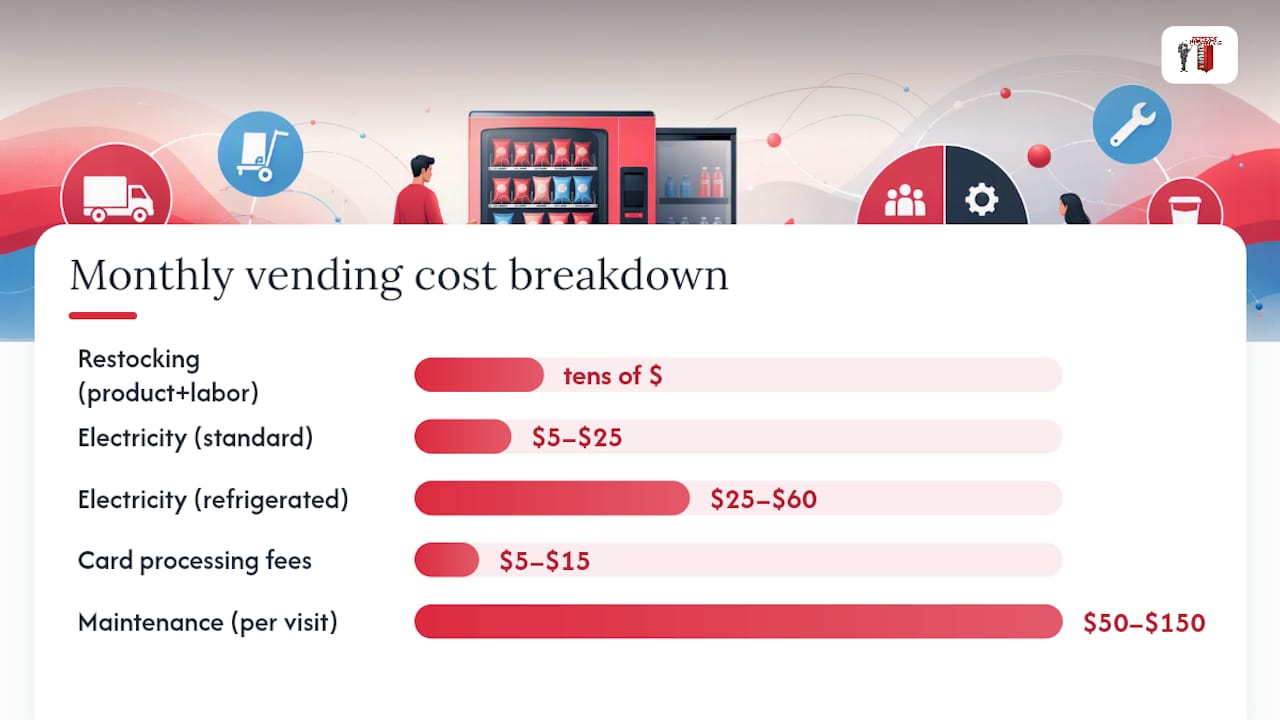
Recurring costs are the ones that stick around no matter who owns the machine. Electricity falls on the host business in nearly every model, typically $5–$25 a month for non-refrigerated units and $25–$60 for refrigerated ones. Restocking labor, card processing fees, and routine maintenance add up separately.
Watch for the fees vendors don’t lead with: minimum revenue guarantees that penalize low-traffic locations, deinstallation charges if you cancel early, and monthly software fees for remote inventory monitoring on smart machines. Ask about all three before signing anything.
| Cost Item | Typical Monthly Range | Who Usually Pays |
|---|---|---|
| Restocking (product + labor) | generally tens of dollars | Operator (full-service) |
| Electricity | $5–$25 (standard), $25–$60 (refrigerated) | Host business |
| Card processing fees | $5–$15 | Operator or shared |
| Maintenance/preventive service | $50–$150 per visit | Varies by contract type |
Purchase Price Ranges by Machine Type
If you’re buying outright instead of using a managed program, price depends heavily on category and tech level. New snack machines run $3,000–$5,000, drink machines $4,000–$6,000, and combo units land around $3,000–$5,500. Machines with touchscreens, cashless payment, and remote telemetry start near $3,000 and can exceed $15,000 for high-end configurations.
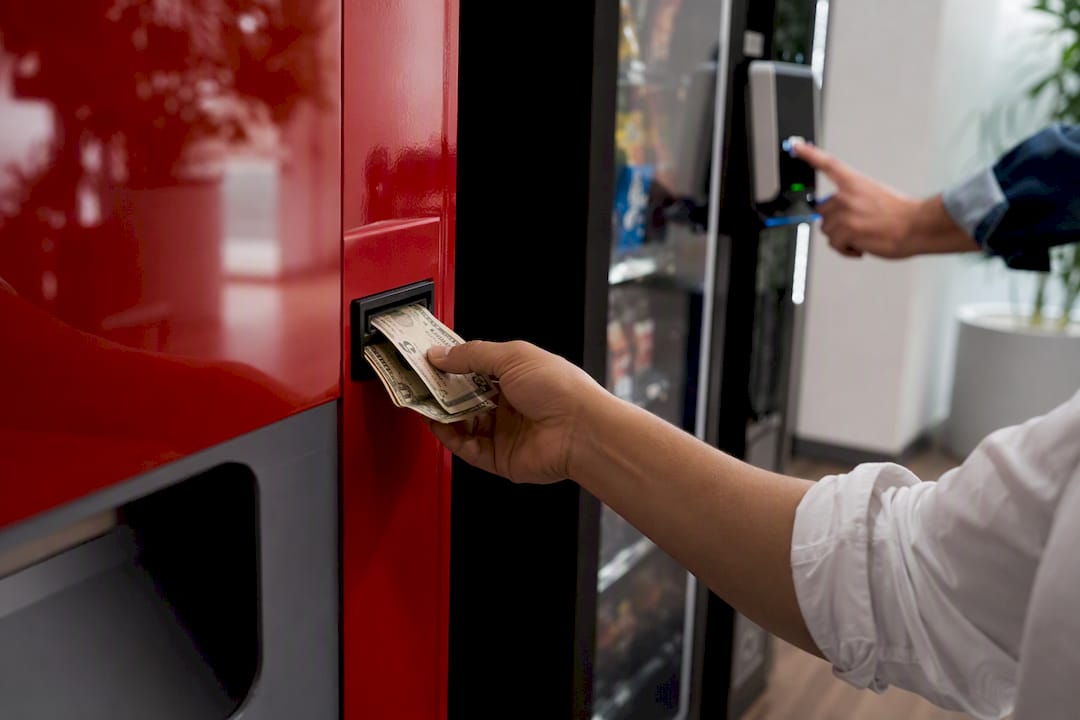
Used and refurbished machines cut upfront cost significantly, usually $1,200–$3,000, but they often carry shorter warranties (90 days to a year) and higher near-term repair risk since components are already worn.
| Machine Type | New Price Range | Used/Refurbished Range |
|---|---|---|
| Snack | $3,000–$5,000 | $1,200–$3,000 |
| Drink | $4,000–$6,000 | $1,200–$3,000 |
| Combo | $3,000–$5,500 | $1,200–$3,000 |
| Smart/touchscreen | $3,000–$15,000+ | Rarely available used |
| Coffee | $3,000–$6,000 | $1,200–$3,000 |
| Bulk/candy | $50–$150 | $50–$150 |
A smart cooler with AI-based inventory tracking sits at the upper end of that range, but it also cuts shrinkage and restocking guesswork, which matters more as your machine count grows.
Which Ownership Model Fits Your Office
Three arrangements cover almost every office vending decision:
- Operator-owned revenue-share (free placement): the vendor owns the machine, stocks it, and services it. You get $0 upfront and typically qualify with roughly 40 to 75 steady on-site employees or comparable foot traffic.
- Subsidized or partial-cost programs: you cover a portion of equipment or installation, often in exchange for more say over product selection.
- Purchase or lease-to-own: you carry the capital cost (or a $75–$300 monthly lease payment) but keep full control of pricing, vendors, and product mix.
Smaller offices under the qualification threshold usually land in the subsidized or purchase category by default. Larger offices with steady traffic have more leverage to negotiate a free, fully managed setup.
Pro Tip: Before signing, ask specifically about deinstallation fees and minimum-sales clauses. A vendor who won’t commit to removing a machine at no cost if sales underperform is telling you something about the rest of the contract.
Monthly Operating Costs and a Sample Budget
Here’s roughly what a single machine costs to run per month, separate from the purchase or lease payment:
- Restocking (product cost plus labor): typically tens of dollars
- Electricity: $5–$60 depending on refrigeration
- Card processing: $5–$15
- Maintenance and repair reserve: $50–$150 per service visit, more for compressor issues
- Shrinkage and spoilage allowance: 8–12% of product cost
A simple monthly profit-and-loss example for one moderately trafficked machine:
Commission rates run 0% to 25% of gross sales depending on your leverage and traffic. A high commission on a low-traffic machine can wipe out most of the margin, so run the math before agreeing to a rate that sounds standard.
How Fast Does a Vending Machine Pay for Itself
A well-placed machine typically grosses $300–$600 a month, with top locations exceeding $1,000. After costs and commissions, net revenues commonly fall in the low hundreds per month. On a $3,500 machine netting $300 a month, payback lands around 12 months.
That timeline shortens or stretches based on a few factors:
- Foot traffic and how captive the audience actually is (a warehouse breakroom behaves differently than a lobby)
- Price points and whether they match what similar offices charge
- Product mix, since healthier or premium items often carry better margins per unit
- Commission rate negotiated with the location
Vending Machine vs. Micro-Market vs. Pantry Service
A single vending machine is the lowest-footprint, lowest-cost option and works fine for smaller teams. A micro-market needs more space and higher upfront infrastructure, open shelving, a self-checkout kiosk, but it typically drives higher per-capita spend in offices with a genuinely captive audience.
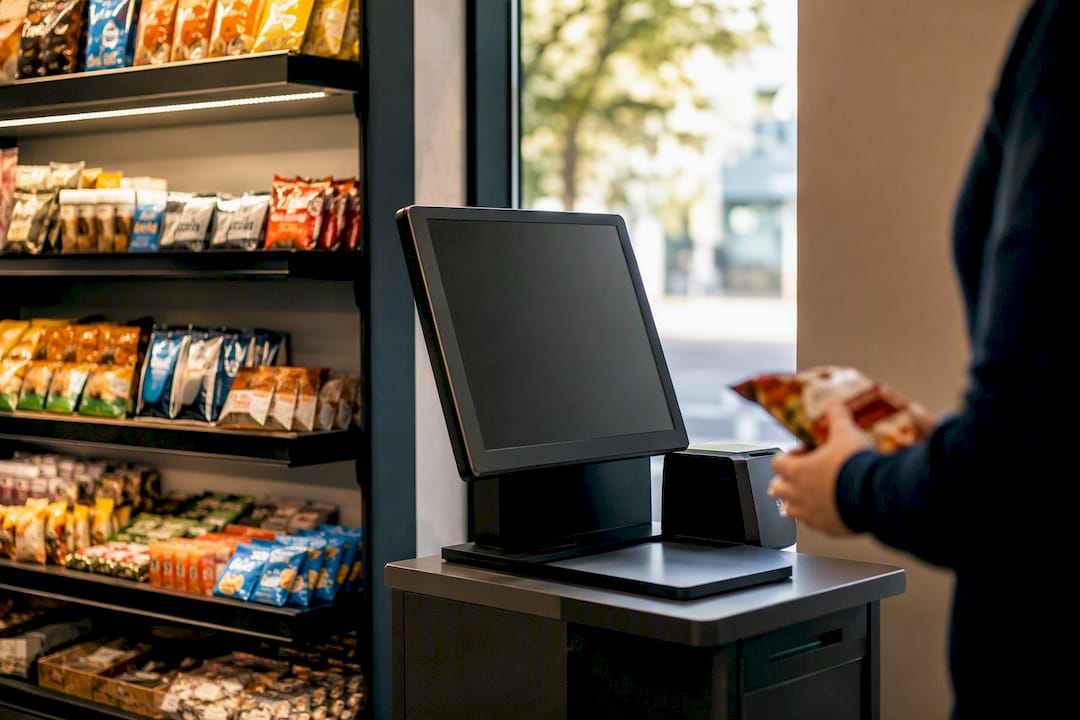
Pantry services sit in a different cost category entirely, running $2 to $14 per employee per month depending on service tier, with setup timelines of 1 to 2 weeks for basic pantries versus 3 to 6 weeks for full micro-market builds.
Quick decision guide:
- Under 40–50 employees: a single vending machine, likely still free if traffic qualifies
- 50–150 employees with a fixed break area: micro-market becomes worth the extra footprint
- Culture-focused offices prioritizing curated snacks: pantry service, even at higher per-employee cost
Where These Numbers Come From
These ranges reflect 2026 vendor pricing guides, operator proposals, and market cost surveys, not a single vendor’s list price. Actual costs vary by region, foot traffic, and negotiated commission.
An Operator’s Take on Vending Contracts
Most proposals I’ve seen bury the commission structure and skip the deinstallation terms entirely, which is exactly where offices get burned later.
Pro Tip: Get removal terms and any minimum-sales clause in writing before you sign. If a vendor hesitates, that’s your answer.
Get a Free Vending Cost Assessment for Your Office
Jeeves Vending installs and manages machines and micro-markets at no upfront cost to qualifying offices across the Dallas-Denton area, which means no equipment purchase, no lease payment, and no guessing at repair budgets. You still get modern touchscreen machines, remote stock monitoring, and a service team that handles restocking and maintenance without you lifting a finger.
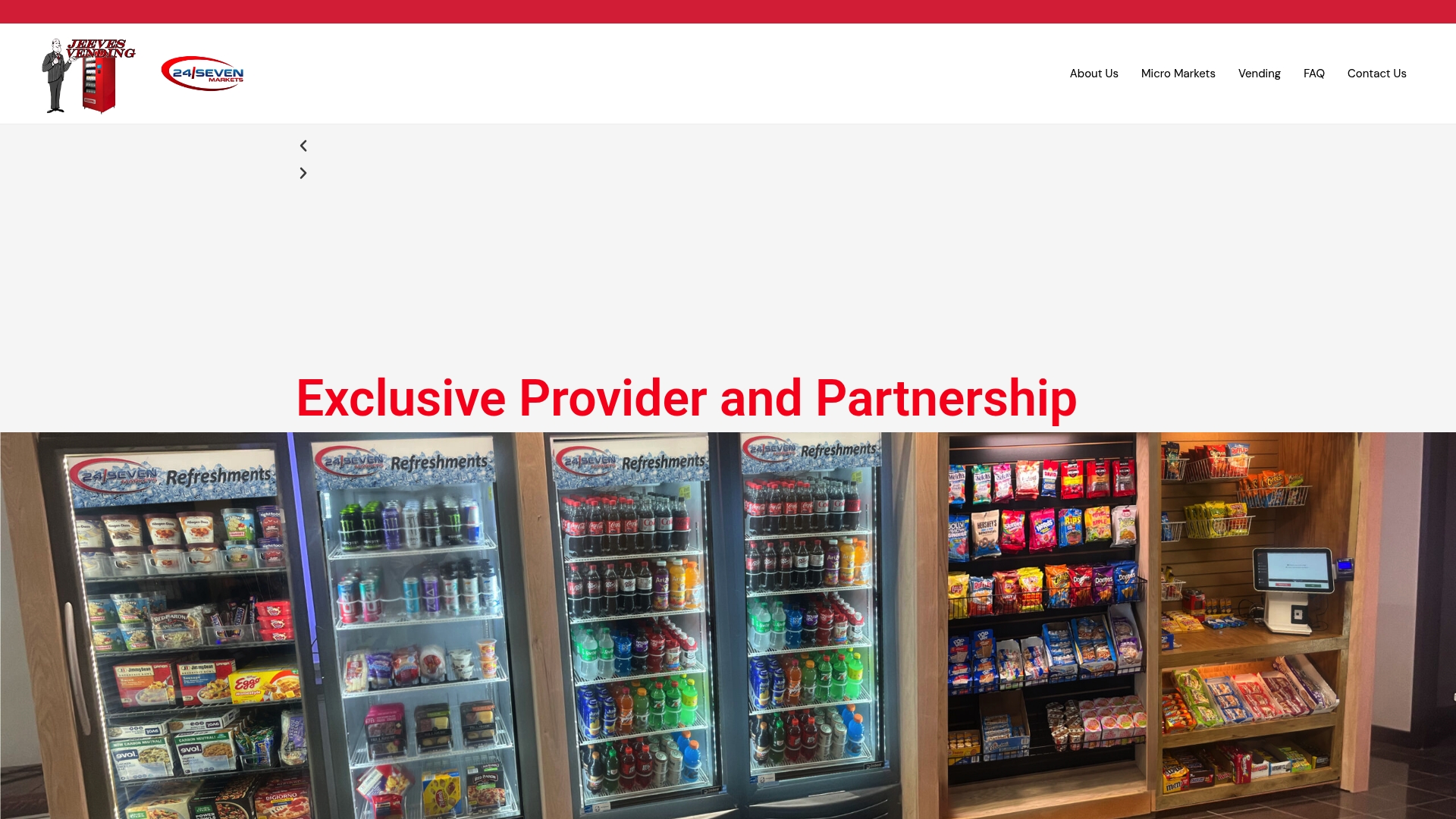
If your office has steady daily headcount, you likely qualify for the free full-service program. Check your placement requirements and request a quote to see what a no-cost setup would look like for your break room.
Frequently Asked Questions
How much does office vending service typically cost?
For qualifying offices, full-service vending costs $0 upfront, with the operator covering equipment, stocking, and maintenance in exchange for a share of sales. Offices that purchase equipment instead spend $1,200–$12,000+ depending on machine type.
Who pays for servicing and maintenance?
Under full-service or leased contracts, the vendor typically covers maintenance and repairs. If you own the machine outright, repair costs fall to you, ranging from $50–$150 for preventive visits to $200–$600+ for major issues like compressor failure.
Is running a vending machine actually profitable for the host business?
The host business itself doesn’t pay for or profit directly from most managed vending programs; revenue and risk sit with the operator. If you own the machine, profitability depends on foot traffic, pricing, and commission rates, with typical payback around 12 months on a $3,500 machine netting $300 monthly.
Does electricity cost fall on the office or the vendor?
Electricity almost always falls on the host business, typically $5–$25 monthly for standard machines and $25–$60 for refrigerated units.
Sources
- Vending Machine Cost in 2026: $1,200–$10,000+ | VendSoft
- Vending Machine Service Cost: 2026 Pricing Guide | Kwote Advisor
- How to Price Vending Machine Items – Operator Guide 2026 | VPlaced
- Plan budget for office pantry | Fooda