
Subsidized vending lets employers lower employees’ per-item costs, or hand out spending credits, through vending machines, micro-markets, or smart coolers. It works as a low-effort pilot program when paired with a clear budget and basic awareness of FDA calorie-labeling rules. Most companies start small, test one break room, and expand once usage data shows what employees actually want.
TL;DR:
- Choose fixed monthly credits or capped discounts to control spending; apply subsidies selectively to products such as fruit, water, or protein snacks.
- Traditional machines suit small offices, while micro markets fit medium or large teams; smart coolers suit spaces needing fresh food turnover.
- Run a pilot lasting six to eight weeks in one busy location, tracking usage, cost per redemption, and employee feedback before deciding whether to expand.
- Operators running 20 or more vending machines must display calories for items lacking a visible Nutrition Facts label; smaller operators may register voluntarily.
- Before signing, confirm automatic credit application, restocking schedules, fresh food handling, access to sales data, repair response times, and short trial or exit terms.
Table of Contents
- Program Models and Vending Formats for Employers
- Why Employers Offer Subsidized Vending
- Setting Up a Subsidized Vending Pilot Step by Step
- FDA Calorie-Labeling Rules for Vending Machines
- Estimating Costs and Building a Vending Budget
- A Checklist for Choosing a Vending Partner
- How Jeeves Vending Approaches Subsidized Vending Programs
- A Practical Take on Piloting Subsidized Vending
- Get a No-Cost Vending Pilot Started
- FAQ
- Sources
Program Models and Vending Formats for Employers
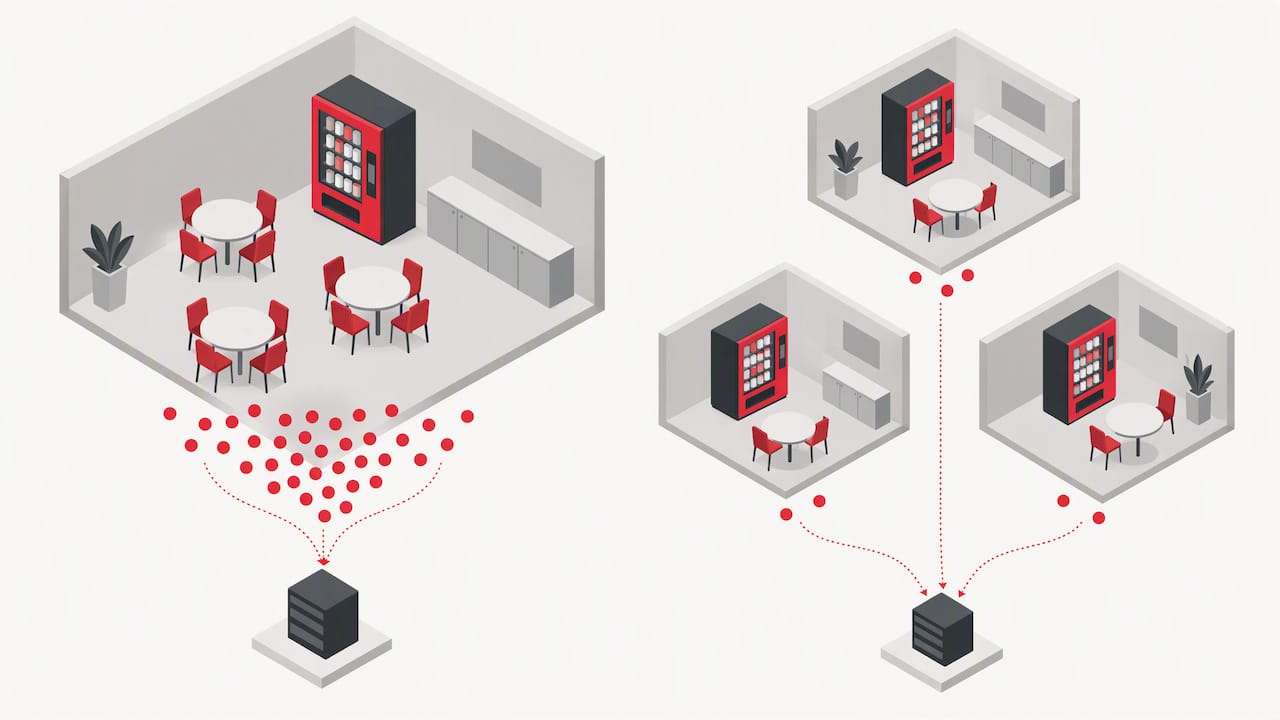
Subsidized vending comes in a few workable shapes, and picking the right one depends on headcount, budget, and how hands-on HR wants to be. A partial subsidy knocks a set amount off each purchase, so employees still pay something but less than retail. Per-employee monthly credits work like a stipend loaded onto a card or app, letting staff spend freely until the balance runs out. A fully employer-paid model removes cost from the employee side entirely, often reserved for smaller teams or as a short-term perk. Hybrid setups mix the two, subsidizing healthy items more heavily while leaving sweets and sodas at full price.
Format matters just as much as the subsidy math:
- Traditional vending machines suit small offices and break rooms with limited space and lower upfront complexity.
- Micro-markets, which use open shelving and self-checkout kiosks, fit medium to large teams that want more variety and a retail feel.
- Smart coolers with AI-based checkout work well for mixed-use spaces like gyms or hospitals where fresh food turnover matters.
Larger campuses often combine formats, running a micro-market in the main building and traditional machines in satellite locations.
Why Employers Offer Subsidized Vending
Employees notice when snacks and drinks cost less, and that goodwill tends to outlast the price of the program itself. Lower per-item pricing keeps people from leaving the building for a coffee run, and a stocked break room reads as a sign the employer pays attention to daily comfort, not just paychecks.
The business case holds up on both sides:
- Employees get convenience, lower costs, and a sense that the employer values their time.
- Employers see better morale, stronger retention, and fewer long offsite breaks that eat into productivity.
- Facilities teams gain a low-maintenance amenity that requires no internal staffing to run.
The vending and micro-market industry remains one of the largest segments of convenience services, and operators are increasingly blending vending with tech-enabled formats like micro-markets, according to the NAMA Foundation’s industry census. That shift toward combined formats gives employers more flexibility when choosing what fits their space. For a deeper look at how these amenities shape day-to-day morale, see our breakdown of vending’s role in workplace satisfaction.
Setting Up a Subsidized Vending Pilot Step by Step
Rolling out subsidized vending doesn’t require a committee or a long procurement cycle. A pilot can go live in a few weeks if the basics are handled in order.
- Survey the site. Check available space, power access, and security needs, then match that footprint to a vending machine, micro-market, or smart cooler.
- Decide subsidy mechanics. Choose between a per-item discount, a monthly credit pool, or a cap on how many subsidized items each employee can redeem.
- Set up payment and POS. Confirm how cashless payment and credits appear at checkout so employees see the discount applied automatically.
- Plan operations. Agree on restocking frequency, a maintenance response window, and how fresh or perishable items will rotate.
- Design the pilot. Pick a defined time window, usually 6 to 8 weeks, and track utilization, cost per redemption, and employee feedback before deciding whether to scale.
Our office vending machine setup guide for HR teams walks through the site-prep details in more depth.
Pro Tip: Run the pilot in a single high-traffic location first. One location gives cleaner data than spreading a small budget across three half-empty machines.
FDA Calorie-Labeling Rules for Vending Machines
Federal rules apply to vending once a company reaches a certain scale, and employers setting up a program should know where that line sits. Under FDA rules, operators who own or run 20 or more vending machines must provide calorie declarations for food items that don’t already show a Nutrition Facts label at the point of purchase. Operators with fewer than 20 machines can register voluntarily to comply, though it isn’t mandatory at that scale.
The Federal Register’s final rule spells out where that information has to appear and gives operators some flexibility:
- Calorie counts must sit close to the item or its selection button.
- Electronic displays satisfy the rule if calorie information shows before the purchase completes.
- Packaged foods that already carry a visible Nutrition Facts label are generally exempt from a separate vending declaration.
Employers don’t need to manage this directly. Asking the vending operator whether they’re covered, requesting compliant displays or signage, and keeping a record if voluntary registration was elected covers the practical side.
Estimating Costs and Building a Vending Budget
Cost depends heavily on the format chosen and how generous the subsidy is. Micro-markets generally run higher operating costs than a single vending machine because of the kiosk hardware and open shelving. Payment processing fees and the risk of spoilage on fresh items also factor into the math, especially for programs that lean toward healthier food options.
A few budgeting approaches keep costs predictable:
- Set a fixed monthly credit per employee rather than an open-ended discount.
- Cap the subsidized pool so spending can’t exceed a known ceiling.
- Apply the subsidy only to selected SKUs, like water, fruit, or protein snacks, instead of the full menu.
- Run a seasonal or quarterly pilot before committing to a year-round program.
POS analytics make this easier to fine-tune over time, since reporting shows which products actually get redeemed and which just sit on the shelf. Our guide on customizing a vending menu for staff covers how to match product mix to usage patterns.
A Checklist for Choosing a Vending Partner
Before signing on with any vending provider, a short checklist keeps the conversation focused on what actually matters operationally.
- Discount and credit capability. Confirm the system can apply per-item discounts or monthly credits automatically at checkout.
- Payment systems. Ask whether cashless payment, mobile apps, and card readers are standard or an add-on.
- Restocking cadence. Get a clear restocking schedule in writing, especially for fresh or perishable items.
- Data and reporting. Request access to sales and usage data so the program can be adjusted based on real numbers.
- Food safety handling. Confirm how perishable stock is rotated and discarded.
- Pilot terms. Ask about contract length, exit options, and whether a shorter trial period is available before a longer commitment.
Reasonable questions to raise with any provider include installation timelines, repair response windows, and whether sales data is accessible in real time or only through periodic reports.
How Jeeves Vending Approaches Subsidized Vending Programs
We provide state-of-the-art vending machines and custom micro-markets at no cost to businesses, covering everything from installation to ongoing restocking. Our free full-service vending program removes the upfront equipment cost that often stalls these projects before they start.
We focus on quality, variety, and personalized service, with a seamless installation process and continuous support once a machine or micro-market is live. For teams weighing formats, our micro-market solutions page outlines how self-checkout setups work in practice. Readers ready to move past planning can use the checklist above as a starting point for a site review request.
A Practical Take on Piloting Subsidized Vending
Start smaller than feels necessary. A single break room with a capped credit tells you more in eight weeks than a company-wide rollout tells you in eight months. Communicate the subsidy rules clearly, because confusion about how credits apply causes more complaints than the vending itself.
— Gary
Get a No-Cost Vending Pilot Started
We handle the equipment, installation, and stocking at no upfront cost, so the only real decision on your end is picking a location and a subsidy model. Whether that means a traditional machine, a micro-market, or an AI-driven smart cooler, we match the format to your space and employee count.
- Request a free site review through our full-service vending program page.
- Compare formats on our main services page before committing to a layout.
- Ask about fresh food and coffee options through our food vending page if your team leans toward healthier choices.
Reach out through our free program page to get a pilot scheduled and explore office catering ideas for complementary amenities.
FAQ
How many vending machines do you need to make $100,000?
There’s no published industry figure tying machine count directly to a specific revenue target, since results depend heavily on location traffic, pricing, and product mix. Operators typically scale machine count based on foot traffic data and sales per location rather than a fixed formula.
Can you get a vending machine for free?
Some providers, including our free full-service program, install machines and micro-markets at no cost to the host business, covering equipment, stocking, and maintenance. Revenue instead comes from the items employees or visitors purchase, not from fees charged to the business.
Do I need an LLC to run a vending machine?
Business structure requirements vary by state and by whether you’re operating machines yourself or hosting a provider’s equipment. Hosting a vending program as an employee benefit typically doesn’t require forming a separate business entity, though operating your own machines as a standalone business may involve different registration steps depending on local rules.
Are vending machines still profitable in 2026?
Industry data shows vending remains the largest segment of the convenience services industry, with operators increasingly layering in micro-markets and tech-enabled formats according to the NAMA Foundation census. Convenience services overall have been reported as a multibillion-dollar sector, with growth trending toward health-forward and cashless offerings, as covered by BusinessWire.
Do vending machines need calorie labels?
Operators who own or run 20 or more vending machines must provide calorie declarations for items that don’t already show a Nutrition Facts label, under FDA rules. Smaller operators can register voluntarily, but it isn’t required below that machine count.
Sources
- Food labeling: calorie labeling of articles of food in vending machines — FDA
- Food Labeling; Calorie Labeling of Articles of Food in Vending Machines — Federal Register (2014)
- New Census Reveals Shifts in Convenience Services Industry — NAMA Foundation
- New Census Shows Convenience Services Outpacing Much of Foodservice — BusinessWire