
Packaged vending products must declare the major food allergens on the manufacturer’s label, and vending operators must ensure those declarations are readable at the point of purchase or backed by clear adjacent signage. The core authorities that govern this are the FDA’s food allergen guidance, 21 CFR §101.8 vending rules, the FASTER Act, and FSIS for any meat, poultry, or egg-containing items. Operators who stock only intact, legibly labeled packaging and add signage when packaging can’t be inspected are following the accepted compliance path.
TL;DR:
- Most allergen issues in vending stem from route drivers failing to verify label updates, not deliberate mislabeling.
- Proper verification includes checking the ingredient list, matching supplier sheets, and removing unreadable products before restocking.
- The FDA mandates clear allergen declarations for the Big 9, but does not require vending machines to have additional labels if packaging is legible.
- For products under FSIS jurisdiction, full ingredient declarations are required, and unlisted allergens risk misbranding or adulteration.
- Adding bilingual signage and confirming allergen declarations with suppliers helps protect non-English-speaking customers and ensures compliance.
Table of Contents
- Fast compliance checklist for restocking and routes
- Federal labeling requirements that apply to vending products
- How to list allergens correctly on packaging and machine signage
- Exceptions and transitional issues for FSIS products and sesame
- Practical controls: supplier verification, SSOPs, and training
- Considerations for multilingual allergen labeling in diverse locations
- Allergen compliance in vending: an operator’s take
- How Jeeves Vending supports allergen labeling compliance
- Let Jeeves Vending handle the compliance groundwork for you
- FAQ
- Sources
Fast compliance checklist for restocking and routes
Most allergen problems in vending don’t come from bad intentions. They come from a route driver grabbing a case without checking whether the label changed since the last order. A short checklist at restock time closes that gap.
- Check the ingredient list and any “Contains” statement before loading a new SKU into a machine.
- Date-verify the supplier’s ingredient sheet against the physical package in hand.
- Pull or segregate items with torn, faded, or otherwise unreadable packaging, or missing sesame declarations.
- Apply a sticker or machine-adjacent sign, matched word-for-word to the manufacturer’s declaration, when packaging can’t be read before purchase.
- Log the supplier contact and ingredient-sheet version tied to each SKU so a question can be traced back fast.
None of this requires special equipment. It requires a habit, built into the restock route, that treats the label as part of the product rather than an afterthought.
Federal labeling requirements that apply to vending products
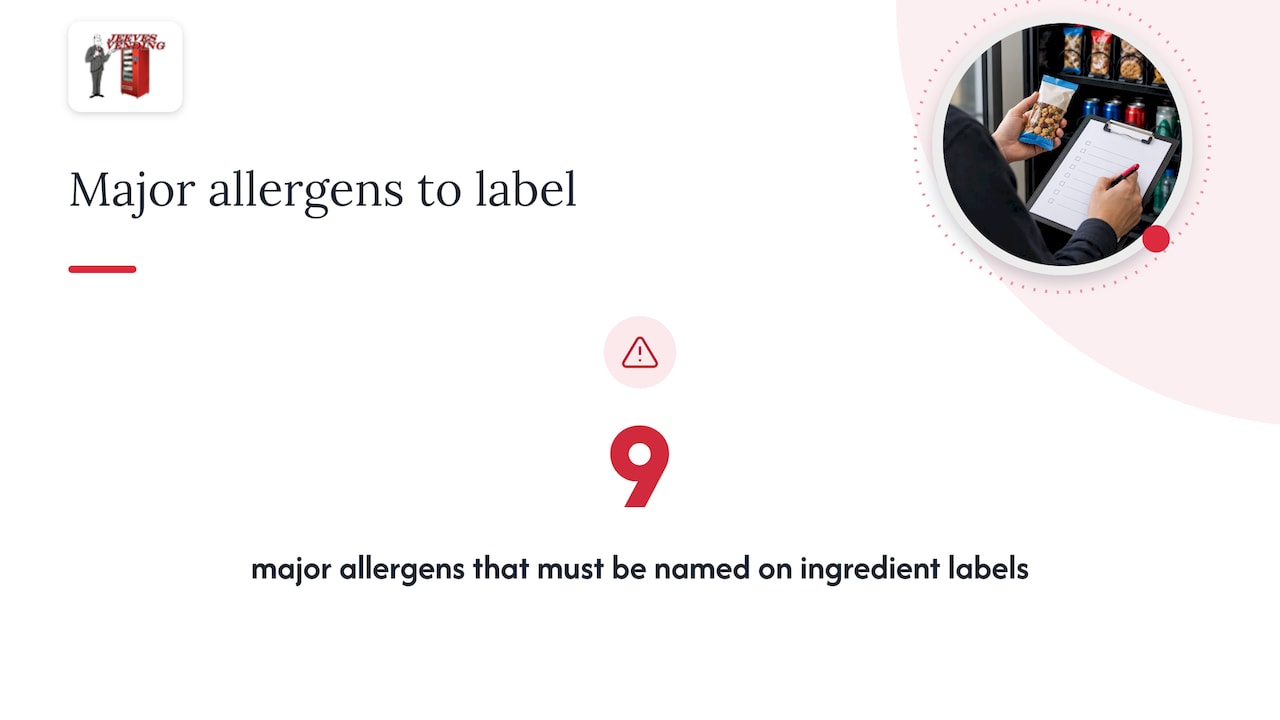
Allergen labeling in the United States runs through the Food, Drug, and Cosmetic Act as amended by the Food Allergen Labeling and Consumer Protection Act, with the FASTER Act adding a ninth allergen in 2023. The FDA’s Food Allergen Q&A Guidance recognizes nine major allergens, known informally as the Big 9: milk, eggs, fish, crustacean shellfish, tree nuts, wheat, peanuts, soybeans, and sesame. These nine account for the vast majority of serious allergic reactions in the country, which is why federal law requires each one to be named in the ingredient list or in a separate “Contains” statement next to it.
For vending specifically, there is no standalone federal rule demanding that operators slap allergen labels onto the machine itself when the product’s own packaging is intact and readable. The manufacturer’s label does the legal work. What operators are responsible for is visibility: making sure a shopper can actually see that label, or an accurate substitute, before buying. The FDA’s vending machine labeling page confirms vending falls under general retail labeling obligations, and 21 CFR §101.8 (written for calorie disclosures) offers the clearest practical model: information has to be clear and conspicuous, displayed on or near the machine, and may appear on an electronic display if it’s visible before the purchase is made.
One exception matters: FSIS, not the FDA, governs labeling for meat, poultry, and certain egg products, and its rules run on a parallel but separate track.
How to list allergens correctly on packaging and machine signage
A compliant “Contains” statement starts with the capitalized word “Contains,” followed by every major allergen present in the product, and it sits immediately after or right next to the ingredient list in the same font size used there. Manufacturers can instead declare allergens parenthetically inside the ingredient list itself, such as “lecithin (soy)” or “natural flavor (milk),” and that method satisfies federal law just as well as a separate statement does.
What doesn’t count toward compliance is voluntary advisory language like “may contain peanuts” or “processed in a facility that also handles tree nuts.” These precautionary phrases are optional risk disclosures, not substitutes for the mandatory declaration, and regulators have flagged that firms sometimes lean on them to paper over weak sanitation practices rather than fix the underlying cross-contact risk.
When packaging can’t be read before purchase, the safest operator move borrows directly from the vending calorie rule: confirm the exact wording from the supplier’s ingredient sheet, then reproduce that wording on a sticker or adjacent card without paraphrasing. Changing “Contains milk, soy” to something looser, like “may have dairy,” can shift the legal meaning of the declaration. Font size and placement should mirror what the calorie rule already demands: readable, close to the product, and visible before money changes hands.

Exceptions and transitional issues for FSIS products and sesame
Meat, poultry, and certain egg products fall under FSIS jurisdiction rather than the FDA’s, and FSIS requires a full ingredient declaration on these labels. An undeclared allergen on a meat snack or breakfast sandwich is treated as potential misbranding or adulteration, which makes supplier documentation for these specific SKUs worth prioritizing on any vending route that carries protein items.
Sesame adds its own wrinkle. Since it only became a mandatory declared allergen under the FASTER Act in 2023, older stock produced before that date may legally lack a sesame declaration even though it’s still sitting in a warehouse. Mixed inventory means mixed labels. The safe response is to verify directly with the manufacturer rather than assume, pull anything you can’t confirm, and avoid guessing at a “Contains” line you can’t source to an actual ingredient sheet.
Practical controls: supplier verification, SSOPs, and training
Preventing a mislabeled vending product usually comes down to four habits repeated consistently rather than one clever system.
- Require a signed, version-controlled ingredient sheet and a named contact for every SKU before it’s approved for a machine.
- Date-stamp incoming stock, segregate anything from a legacy label run, and log which label version is currently on the shelf.
- Write sanitation procedures that address cross-contact for high-risk items, and document cleaning the same way a food plant would under HACCP-style thinking.
- Train route technicians on a simple decision tree: if a label can’t be verified, remove the product, verify with the supplier, and only then replace it.
Pro Tip: Have technicians scan the SKU barcode and confirm the stored ingredient-sheet version before a new case goes into a machine. That single step creates an audit trail linking the physical product to a documented supplier declaration.
Sticker and signage programs work best when the wording is copied, not rewritten, and placed directly on or beside the product slot rather than buried on a general machine label. Where the budget allows, a digital display is a stronger option than a static sticker because it can be updated the moment a supplier changes an ingredient sheet, a solution the calorie-labeling rule already treats as acceptable when the information is visible before purchase. For sites with fresh food vending machines, where ingredients turn over faster and cross-contact risk runs higher, this kind of real-time update matters even more.
Considerations for multilingual allergen labeling in diverse locations
A vending fleet placed across schools, hospitals, warehouses, and office parks often serves populations where English isn’t every shopper’s first language, and an allergen declaration that only a portion of your buyers can read defeats its own purpose. Federal law sets the baseline in English, but nothing stops an operator from adding a second-language translation alongside the required statement, and sites with a large non-English-speaking workforce or student body often benefit from doing exactly that.
The rule for translated signage is the same as for English stickers: copy the manufacturer’s declared allergens precisely rather than paraphrasing, since a translation that drifts from the original wording can create confusion or a false sense of safety either way. A bilingual “Contains” card next to a snack slot, listing the same allergens in both languages, side by side, keeps the message consistent without touching the legal declaration on the package itself.
This is less about a federal mandate and more about matching your signage to who’s actually buying from the machine. A hospital cafeteria vending area, a school hallway, and a warehouse break room all have different language profiles, and operators managing multiple site types should expect to adjust signage language site by site rather than applying one template everywhere.
Allergen compliance in vending: an operator’s take
The conventional advice around vending allergen labeling treats it like a paperwork problem: get the right stickers, file the right forms, move on. That misses where the actual risk sits. Most allergen incidents in vending don’t come from a missing legal disclosure. They come from a route tech who doesn’t know a supplier changed a recipe, or a sticker that was copied by hand and drifted from the original wording.
The fix isn’t more signage. It’s treating the ingredient sheet as a living document that has to be checked against the physical product every single restock, not filed once and forgotten. Operators who build that habit into the route, rather than into a binder, are the ones who stay ahead of recalls and complaints rather than reacting to them.
— Gary
How Jeeves Vending supports allergen labeling compliance
We build these controls into our route rather than leaving them to chance. We coordinate with suppliers on ingredient documentation, monitor stock remotely, and have technicians check labels and signage at every restock as part of our standard workflow. When we start service at a new site, that review happens before the first machine goes live.
What we can’t yet point to is a documented set of client case studies or named credentials for this specific compliance process, since that material isn’t publicly listed. What we can say is that the same remote-monitoring and restock-check structure that keeps our machines stocked is the structure that keeps labels current.
Let Jeeves Vending handle the compliance groundwork for you
Vending allergen labeling is one more thing busy operators have to track, on top of restocking, maintenance, and supplier relationships, and we built our service so a host business doesn’t have to track it alone. We coordinate supplier ingredient checks, manage sticker and signage programs, and train route technicians on exactly the decision tree described above, all at no cost to the business hosting these vending solutions.
If you’re weighing a custom vending solution or micro-market for your office, school, gym, or hospital, we’re a practical next step: reach out through our site to talk through your location’s needs and see what a fully managed, allergen-aware vending program looks like for your team.
FAQ
What are the legal requirements for allergen labeling?
Manufacturers must declare each of the nine major food allergens in the ingredient list or in an adjacent “Contains” statement under federal law, as detailed in the FDA’s Food Allergen Q&A Guidance. Vending operators don’t create new labels themselves; their job is making sure the manufacturer’s declaration stays visible and legible before purchase.
How do I list allergens on a label?
Allergens go either inside the ingredient list using a parenthetical, like “lecithin (soy),” or in a separate “Contains” statement that starts with the capitalized word “Contains” and names every major allergen present. The statement must sit right next to the ingredient list in the same font size, per FDA guidance.
What are the current food labeling requirements?
The most recent major change remains sesame’s addition as the ninth major allergen under the FASTER Act, effective January 1, 2023. Operators should still watch for updates, since the FDA revised its Food Allergen Q&A Guidance as recently as January 2025 to clarify existing rules.
What are the 14 allergens that must be labeled?
Under current US federal law, only nine major allergens require mandatory declaration: milk, eggs, fish, Crustacean shellfish, tree nuts, wheat, peanuts, soybeans, and sesame, as confirmed by the FDA. The larger list of allergens is a different framework used outside the US and does not apply to US vending products.
Do meat and poultry vending items follow different allergen rules?
Yes. Meat, poultry, and certain egg products fall under FSIS rather than the FDA, and FSIS requires full ingredient declarations with undeclared allergens treated as potential misbranding. Operators stocking protein snacks or sandwiches should keep supplier documentation current for these items specifically.