
Vending lead time is the span between saying yes to a machine or micro market and the first sale. For a standard machine placed at a site that is ready, plan on roughly one to four weeks. Custom-built machines and full micro markets take longer, because equipment has to be configured, built or ordered, and delivered. Most of the variation comes from your site and your approvals, not from the machine.
TL;DR
- Placing a standard vending machine often takes 1 to 4 weeks, with approvals as the biggest variable.
- Permits or a new wall outlet can add 1 to 2 weeks on their own.
- Custom machines and micro markets run longer than standard placements, since equipment is configured or built to order.
- A confirmed outlet, clear floor space, delivery access and one named decision-maker are the best ways to shorten the schedule.
- With Jeeves Vending the equipment, install and stocking cost the host business nothing, so the timeline is the only thing you need to plan.
Table of Contents
- What “lead time” means in vending
- A realistic timeline for a standard vending machine
- Micro market installation timeline
- What slows a vending installation down
- Site requirements to confirm before delivery
- What happens on delivery day
- When will it be stocked and ready?
- How to shorten your own timeline
- Perspective: why a no-cost, managed install moves faster
- Start the process with Jeeves Vending
- FAQ
- Sources
What “lead time” means in vending
People use the phrase for three different clocks, and mixing them up is why quotes sound inconsistent.
- Decision lead time: from first conversation to a signed agreement. This depends on how many people at your property need to sign off.
- Equipment lead time: from order to the machine or market components arriving. A machine already in a warehouse moves quickly. A configured or custom unit waits on a production queue.
- Site lead time: from delivery to first sale. This covers positioning, power, payment activation, connectivity, stocking and test purchases.
When someone says “two weeks,” ask which clock they mean. A two-week equipment lead time sits on top of whatever approvals your building needs.
A realistic timeline for a standard vending machine
Placement of a new machine commonly takes one to four weeks. The same source points out that the longest variable is often finding and reaching the person who can approve the placement. When you are already the decision-maker and you have a spot picked out, you sit at the short end of that range.
Here is how those weeks typically break down for a standard machine.
| Stage | What happens | What speeds it up |
|---|---|---|
| Site conversation | Walk the space, talk through your headcount, shifts and tastes | Share staff numbers and shift times up front |
| Approvals | Property manager, landlord or district sign-off, any required permits | One named approver, documents ready |
| Equipment selection | Machine type and product mix chosen | Early answers on dietary needs and drink preferences |
| Site prep | Outlet, clearance, floor, delivery path confirmed | A facilities check before delivery day |
| Delivery and setup | Machine positioned, powered, payment and connectivity tested | Someone on site to open doors and sign |
| Stocking and launch | Product loaded, test purchases made, machine goes live | Announce the launch to staff or members |
If you want a closer look at the space questions, our vending space planning checks cover the three things property managers should verify before anyone schedules a truck.
Micro market installation timeline
A micro market is a different project from a single machine. It usually combines coolers, open shelving, a self-checkout kiosk and sometimes coffee equipment, so there are more components to specify, deliver and assemble. Expect it to take longer than a one-machine placement, and expect more of the schedule to hinge on your space: the layout, the electrical capacity and the network connection for the kiosk.
We do not publish a fixed number of weeks for a micro market, because the honest answer depends on the size of the market and the condition of the room. What we can tell you is where the time goes:
- Layout and design. The footprint, product zones and checkout position are settled first.
- Equipment ordering. Coolers, shelving and the kiosk have to be sourced and delivered.
- Power and connectivity. Each cooler needs power, and the kiosk needs a reliable connection for payments and remote stock monitoring.
- Build day. Assembly, merchandising and stocking, followed by test transactions.
- Launch. Staff or members are told it is open.
To avoid a stalled install day, run through our micro market setup checklist before the build is scheduled. If you are still comparing formats, why operators pair markets and coolers explains how the two work together.
What slows a vending installation down
The same few things cause most delays.
Approval chains
A machine in a leased office or a hospital wing may need sign-off from a property manager, a landlord, a compliance team or all three. Approvals are the most common reason a placement takes weeks instead of days. Name one person who owns the decision and ask them early what paperwork the building requires.
Permits and electrical work
Some locations need a vending permit, and some spots simply do not have an outlet nearby. Permits or a new outlet can add one to two weeks. Checking this before you pick a location costs nothing and saves the most time.
Equipment availability
A standard machine can often be sourced quickly. A machine configured to your product list, dimensions or branding depends on the configuration and the manufacturer’s current production queue. The principle is familiar from any made-to-order product: just as private label coffee lead time is driven by packaging and production schedules, a custom machine is paced by how full the build queue is when you order.
Changes after the order
Changing the product mix, the location or the number of units after equipment is ordered usually restarts part of the clock. Settle those questions during the site conversation.
Delivery access
A machine that cannot get through a doorway, up a step or across a lobby will not be installed on delivery day. Measure the route, not only the final spot.
Site requirements to confirm before delivery
A short facilities check prevents most install-day surprises. Typical items to confirm:
- Power: a grounded standard outlet within reach of the planned spot. Many machines run on common 110 to 120 volt household power, but confirm the exact requirement for the model with your installer.
- Clearance: space at the back and sides for airflow and service access.
- Floor: a level surface that can carry the weight of a loaded machine.
- Access: wide enough doors, an elevator if needed, and a clear path from the truck.
- Connectivity: cellular signal or Wi-Fi if the machine or kiosk takes cards and reports stock remotely.
- Location: a spot that fits how people move through the building. Our guide to vending placement and office workflow shows how to pick one, and the warehouse location guide covers shift-based sites.
For outdoor or exterior spots, see how managed installs with no cost placement work.
What happens on delivery day
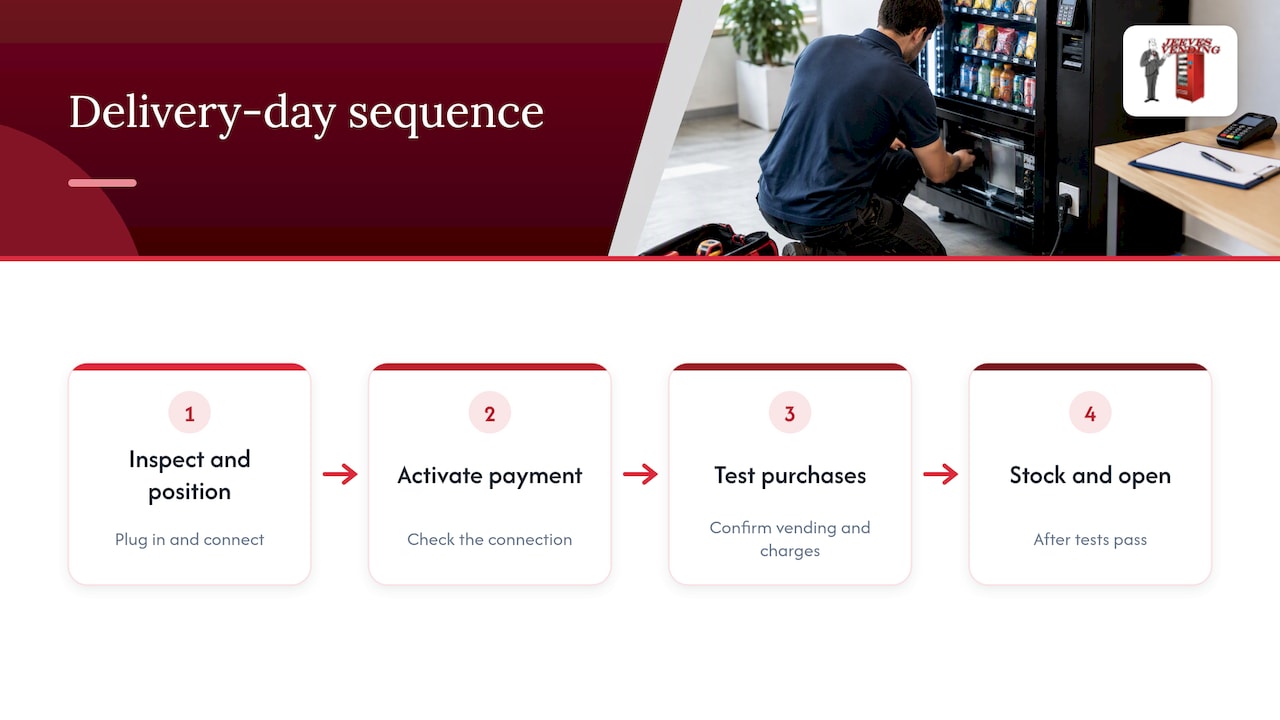
On the day, the machine is inspected, positioned, plugged in and connected. Payment is activated, the connection is checked, and test purchases confirm that the machine vends and charges correctly. Then it is stocked and opened.
Cashless payment is the part people forget to plan for. Card readers and kiosks need a working connection and a tested payment setup, which is why reading up on Square kiosk POS systems helps you understand what the checkout side of a micro market involves. With Jeeves Vending, the digital POS and kiosk hardware are part of the program we install and manage.
When will it be stocked and ready?
In a well-prepared install, stocking happens on the same visit as setup, so the machine can open as soon as test purchases pass. Where a machine is built to your product specification, the product list is usually the last thing to lock in, so decide it early. Healthy, fresh and frozen options need cold, working equipment before they can be loaded, and our fresh food vending options explain what that requires.
How to shorten your own timeline
A week or two is often recoverable on your side of the project. Do these in order:
- Choose the approver. One person, with authority, who answers within days.
- Pick two candidate spots. If one fails on power or access, the other is ready.
- Photograph and measure. Doorways, the outlet, the floor space and the route from the loading area.
- Know your audience. Headcount, shifts, dietary needs and any rules for schools or hospitals.
- Decide the product mix early. Especially for custom or healthy lines. Our guides on customizing a vending menu for staff and the office snack station checklist help with that.
- Schedule someone on site. For delivery, to open doors and sign.
- Ask for the schedule in writing. Dates for approvals, delivery, install and launch.
Perspective: why a no-cost, managed install moves faster
Most delays we see are not about machines. They are about a building that has not decided who says yes, or a spot that has no outlet.
That is why we start with the site, not the catalog. We look at your headcount, your shifts and your space, then recommend the machines or the micro market that fit, so there is less to change after anything is ordered. Because the equipment, the install, the stocking and the maintenance are handled by us at no cost to the host business, you are not running a procurement project. You are answering a few questions and clearing a path.
We are family-owned and locally managed, which means the person who walks your site is the person you can call afterward. Remote stock monitoring keeps the machine full once it is open, so the launch week is not the best the machine ever looks.
If you give us one approver, a power source and a clear route in, you have done most of what shortens the timeline.
Gary
Start the process with Jeeves Vending
If you manage an office, school, gym, hospital or warehouse in the Dallas-Denton region, we install and manage vending machines and custom micro markets at no upfront cost to your business, including restocking, maintenance and remote monitoring.
Tell us about your space and we will walk you through what a realistic schedule looks like for your site. Start with our free full service vending program or contact Jeeves Vending directly. If cost is your first question, installation cost is often $0 for facility managers.
FAQ
How long does it take to get a vending machine installed?
Placing a standard machine often takes one to four weeks, depending mostly on how fast approvals come through. Permits or a new outlet can add one to two weeks. Custom units and micro markets take longer.
Is a micro market slower to install than a vending machine?
Usually, yes. A micro market has more components, a kiosk and more power and network needs than a single machine. The timeline depends on the size of the market and the readiness of your space, so ask for a written schedule after a site visit.
Why would a custom vending machine take longer?
A custom machine is configured to your product specifications and then waits in the manufacturer’s production queue. Having product details and location information ready at the start keeps the early stages moving.
What do I need to have ready before delivery?
Have a working outlet near the spot, clearance around the machine, a floor that can carry the weight, and a clear path from the truck. For card payments, confirm connectivity. Someone should be on site to receive the delivery.
Does it cost anything to install a vending machine with Jeeves Vending?
Our programs are offered at no upfront cost to the host business. Revenue comes from product sales to employees, students, members or visitors, not from your budget.
Sources
- How Long Does It Take to Place a Vending Machine?
- Private Label Coffee Lead Time
- Square Kiosk POS Systems