
Vending sales are taxable in most states whenever the item sold would be taxable over a store counter, and the operator, not the host location, carries the registration and remittance duty. Some states carve out exemptions for low-price or unheated food items, and several apply special formulas instead of a flat retail rate. The practical fix is simple: get a seller’s permit, track receipts by machine, and use your state’s divisor or percentage formula to split gross receipts into taxable and exempt portions before you file.
TL;DR:
- Most states tax vending machine sales of items that would be taxable in-store, but exemptions may apply for low-priced or unheated foods.
- Payment method impacts taxable status, as low-cost food exemptions often apply only when machines accept cash exclusively.
- Calculating sales tax generally involves dividing gross receipts by a state-specific divisor that accounts for combined tax rates.
- Registering for a vending sales tax permit is mandatory, with filing frequency and reporting requirements varying by state and volume.
- Proper recordkeeping, including resale certificates and machine-by-machine logs, is crucial to pass audits and avoid costly mistakes.
Table of Contents
- What Vending Sales Are Taxable Under Sales Tax Rules?
- Do Price and Payment Method Change What’s Taxable?
- How Do You Calculate Sales Tax on Vending Machine Receipts?
- How Do You Register for a Vending Sales Tax Permit?
- How Do Sales Tax Rules for Vending Differ by State?
- What’s the Best Compliance Checklist for Vending Tax Audits?
- Do Sales Tax Holidays Apply to Vending Machine Sales?
- How Jeeves Vending Supports Sales Tax Recordkeeping for Hosts
- A Managed Vending Partnership That Simplifies the Paperwork
- Sources
What Vending Sales Are Taxable Under Sales Tax Rules?
The baseline rule carries over from retail: if the item would be taxed at a grocery store or gas station counter, it’s taxed coming out of a machine. Vending just adds its own layer of carve-outs on top of that baseline.
Most states exempt certain unheated, unprepared foods and some milk and juice products sold under a price threshold. Hot beverages and prepared foods lean the other direction. Coffee, soup, and anything heated at the point of sale tend to draw tax even when a cold version of the same product would not. Merchandise items, toiletries, phone chargers, toys in a vending display, are almost always fully taxable regardless of price.
When an item sits in a gray zone, three questions usually settle it:
- Is it sold heated or above room temperature at dispensing?
- Does it require an ingredient breakdown that matches your state’s “food product” definition?
- Is it packaged for immediate consumption versus multi-serving retail packaging?
New York’s Tax Bulletin ST-280 walks through these distinctions with specific product examples, and it’s worth keeping open while you audit your own planogram.
Do Price and Payment Method Change What’s Taxable?
Yes, and this is the rule most operators miss until an auditor flags it. Several states exempt low-cost food and beverage items below a set price, but that threshold shifts depending on whether the machine takes cash only or also accepts cards.
New York is the clearest example: items sold for a low threshold price through a cash-only machine can qualify for exemption, but that ceiling rises when the machine accepts any form of noncash payment, per Tax Bulletin ST-280. Add a card reader to a machine that used to run cash-only, and you may just have changed its tax profile.
That makes payment configuration a compliance decision, not just an equipment upgrade. Before swapping hardware or repricing a route, work through these steps:
- Check whether your state ties an exemption threshold to payment type.
- Set machine pricing intentionally around the threshold rather than by accident.
- Label or document each machine’s payment configuration for your own records.
How Do You Calculate Sales Tax on Vending Machine Receipts?
Vending machines almost never show tax as a separate line item. The price on the sticker is what the customer pays, tax included, so you have to work backward to find out how much of that gross receipt is actually taxable sale versus tax owed.
The standard reverse calculation is:
- Add 1 to your combined state and local tax rate to get your divisor (an 8% rate becomes 1.08).
- Divide total gross receipts by that divisor to isolate taxable sales.
- Subtract taxable sales from gross receipts to find the tax due.
This is the exact divisor logic New York lays out in Tax Bulletin ST-280.
Not every state uses this divisor model. California’s Publication 118 applies tax to a fixed percentage of gross receipts for certain cold food vending sales, sidestepping the item-by-item exemption question entirely. Virginia goes further and bases tax on the operator’s cost or manufactured price of the merchandise rather than what came out of the coin box, according to Virginia Tax’s vending guidance. Know which model your state uses before you build a spreadsheet around the wrong one.
How Do You Register for a Vending Sales Tax Permit?
Every state that taxes vending sales requires the operator to hold a seller’s permit before collecting or remitting anything, and that same permit typically lets you buy inventory tax-exempt for resale rather than paying tax twice on the same product. Registration happens through the state’s department of revenue or taxation, usually online, and one permit generally covers multiple machines across a route, though a handful of states add machine-specific requirements on top of that base registration.
Filing frequency depends on sales volume. Smaller routes often file quarterly, while higher-volume operators get bumped to monthly filing. Either way, most state returns ask you to report vending receipts as a distinct category, separate from any storefront or wholesale activity you also run.
Colorado stands out here. Beyond the standard permit, the state requires operators to add a non-physical location for each machine and obtain identification decals in specific circumstances, per the Colorado Department of Revenue’s vending guidance. That means your registration paperwork can multiply fast if you run a large route.
Before filing your first return, confirm:
- Which department handles vending registration in your state
- Whether your permit needs renewal on a set schedule
- What documentation the state expects alongside each return
Pro Tip: Set a recurring calendar reminder for filing deadlines the day you register. Vending revenue is easy to under-report simply because nobody remembers to check the vending line until the return is already late.
How Do Sales Tax Rules for Vending Differ by State?
State vending tax regulations diverge more than most operators expect, and the differences aren’t cosmetic. They change your bookkeeping method entirely.
- California taxes only a fixed percentage of gross receipts from certain cold food vending sales rather than the full price, per Publication 118. Track category-level receipts, not a blended total.
- New York uses price thresholds tied to payment method plus a divisor formula for backing out tax, detailed in Tax Bulletin ST-280.
- Virginia taxes merchandise vending based on the operator’s cost or manufactured price instead of retail receipts, according to Virginia Tax.
- Colorado requires a non-physical location entry and decals for individual machines under its vending guidance.
- Washington and Idaho apply their own percentage-of-gross or product-class rules; Idaho’s vending guidance shows how much these bases can vary from a neighboring state.
If you run machines across state lines, this isn’t a minor footnote. Crossing from Texas into a neighboring state’s territory, or adding a machine in a state where you already have nexus from other business activity, can trigger a completely different set of forms and calculation rules for that single location.
What’s the Best Compliance Checklist for Vending Tax Audits?
Audit trouble almost always traces back to the same handful of gaps: missing resale certificates, receipts that mix exempt and taxable sales with no way to separate them, and a bookkeeping method that doesn’t match the state’s actual basis (cost versus retail).
- Issue a resale certificate to suppliers when purchasing inventory, so you’re not paying tax twice on the same product.
- Keep machine-by-machine logs showing gross receipts, exempt-item counts, and payment-method breakdowns.
- Confirm which basis your state uses (retail price, cost, or percentage of gross) and apply it consistently across every filing period.
- File resale documentation and vending permits in one place so an auditor’s request doesn’t turn into a scavenger hunt.
The most common and costly mistake is applying a retail-based divisor in a state that actually taxes cost or a fixed percentage. It looks like careful bookkeeping until an auditor recalculates the whole period at the correct base.
Pro Tip: Keep supplier invoices and resale certificates filed by delivery date, not by supplier name. Auditors reconstruct periods chronologically, and matching your filing system to their process cuts review time dramatically.
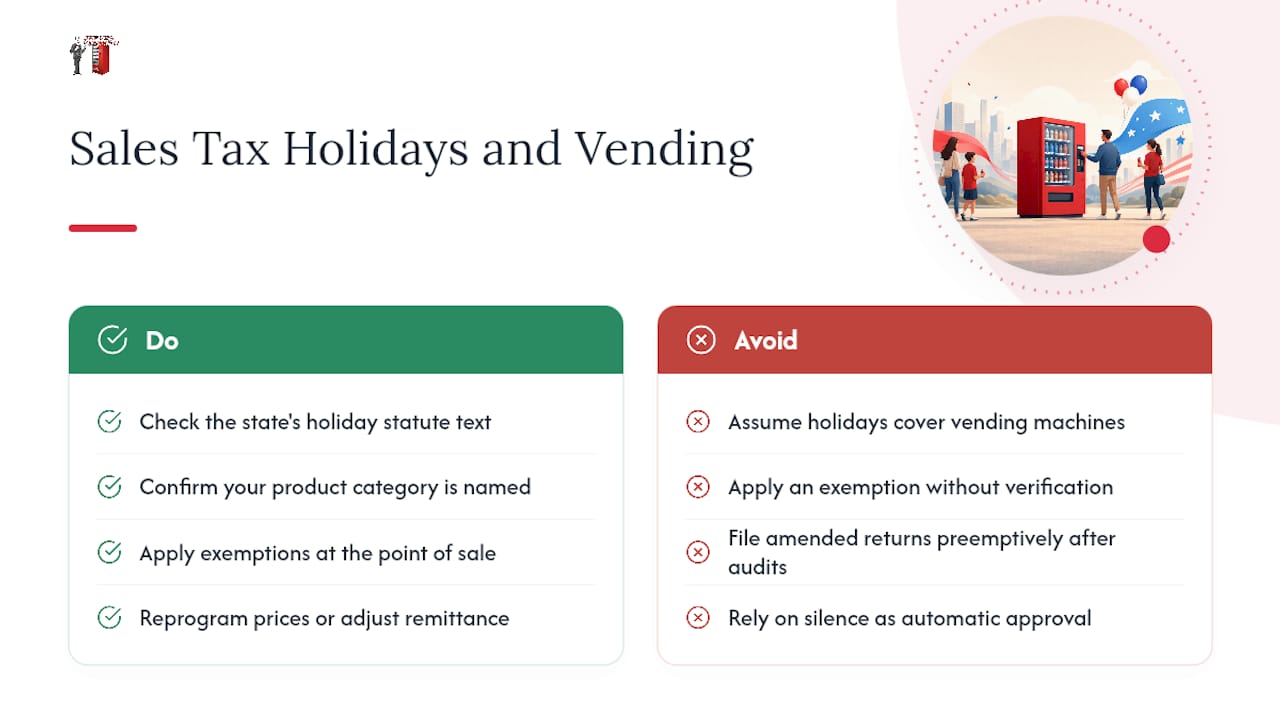
Do Sales Tax Holidays Apply to Vending Machine Sales?
Sales tax holidays create one of the more confusing corners of vending compliance, because most state holiday programs were written with storefront retail in mind, not coin-operated equipment. A back-to-school holiday exempting clothing or school supplies rarely maps cleanly onto a snack or beverage machine, since food and drink items are usually excluded from these holidays in the first place.
Where a vending route does intersect with a holiday, it typically happens with merchandise machines, electronics accessories, personal care items, or school supplies sold through a kiosk-style unit. If your state’s holiday exempts a category you sell, you generally need to apply that exemption at the point of sale during the holiday window, which for a vending machine means either reprogramming pricing temporarily or manually adjusting your tax remittance calculation for that period.
The bigger risk isn’t missing a holiday exemption. It’s applying one that doesn’t actually cover vending sales. Some operators assume a general merchandise holiday extends automatically to anything sold through a machine, and file an amended return only after an audit corrects the assumption. Before adjusting any pricing or remittance around a holiday, check the specific text of that state’s holiday statute for whether vending sales, or your product category, are named explicitly. Most holiday guidance documents list eligible and excluded categories in detail, and vending often isn’t mentioned at all, which typically means the standard year-round rule still applies.
How Jeeves Vending Supports Sales Tax Recordkeeping for Hosts
Jeeves Vending documents each machine’s location and can provide sales reports on request, which gives host businesses and operators a clean record to work from when tax season arrives. We also support resale-certificate workflows and encourage the recordkeeping habits, machine-by-machine logs, payment-method tracking, that make filing less painful.
None of that shifts the legal responsibility. Registration, collection, and remittance remain the operator’s job in every state we’ve covered here. What changes is how much manual reconstruction you have to do when the numbers don’t add up on their own.
— Gary
A Managed Vending Partnership That Simplifies the Paperwork
Running the numbers yourself every filing period gets old fast, especially once you’re managing machines across multiple locations with different price thresholds and payment configurations. A managed vending partnership can include consolidated inventory purchasing and machine-level sales reporting that make your own recordkeeping far less of a scramble.
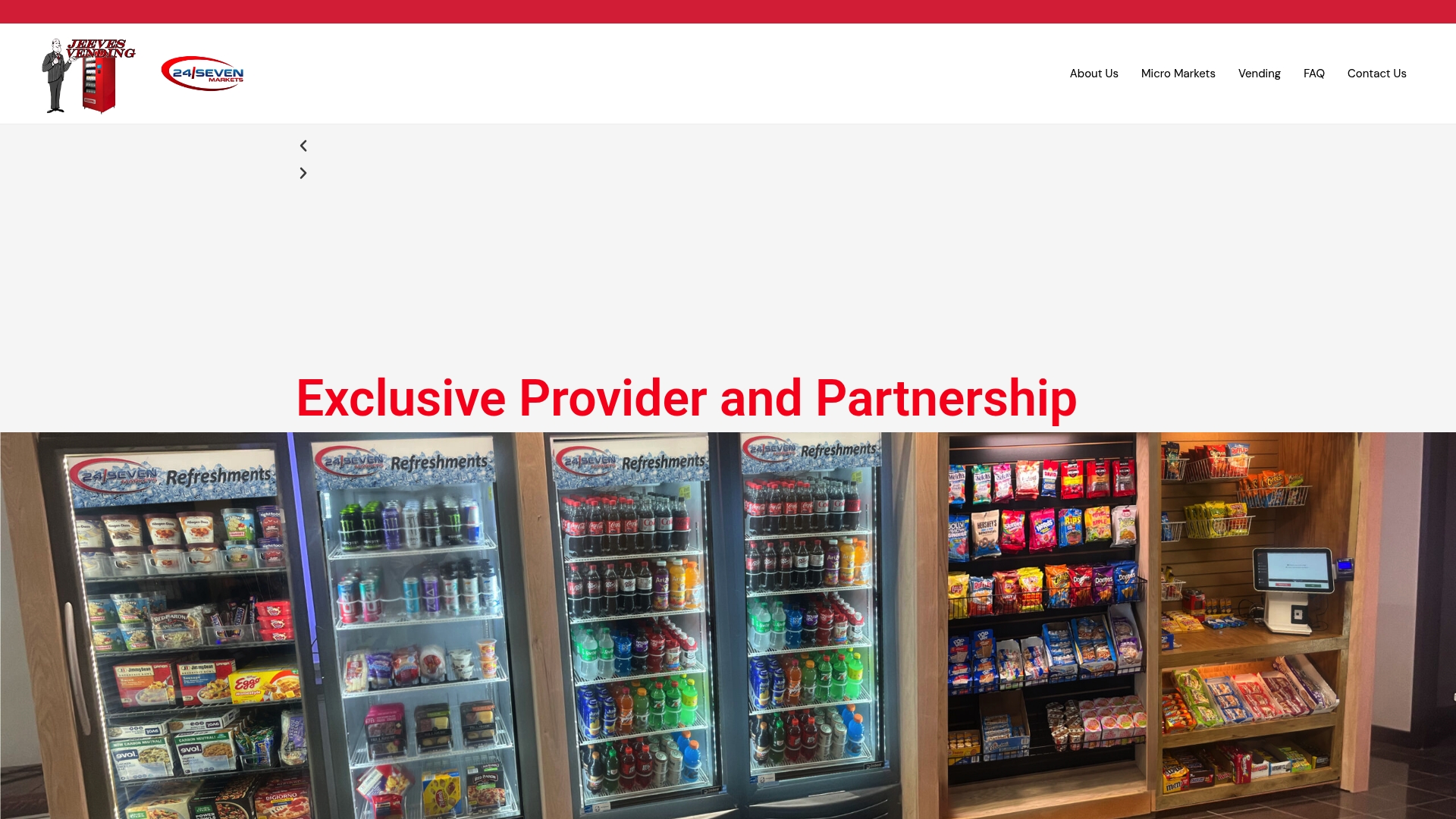
You still hold the tax responsibility as the operator, that doesn’t change. But when a partner is tracking receipts by machine and handing you clean reports instead of a shoebox of tape printouts, backing out tax and hitting filing deadlines gets a lot less stressful. If your current setup has you dreading every quarter, take a look at how the full-service vending program works, or check out the current lineup of smart vending machines to see what a better-documented setup actually looks like.
Sources
- Food and Beverages Sold from Vending Machines — Tax Bulletin ST-280
- Publication 118, Vending Machine Food Sales — California Department of Tax and Fee Administration
- Virginia Tax — Other sales and use tax (vending machine sales)
- Sales-use tax topics: vending machines — Colorado Department of Revenue