
The most effective way to prevent vending vandalism is to make a machine hard to misuse and easy to see: put it in a busy, well-lit spot, secure it to the building, use modern locks with audit trails, and monitor it so a problem is spotted in hours, not weeks. No single device does the job. Layers do. This guide walks through each layer for offices, schools, hospitals, gyms and warehouses, and explains who handles what when a machine is hosted at no cost to your business.
TL;DR
- Location does most of the work: busy, lit, visible spots beat hidden corners, alcoves and loading-dock edges.
- Use layered protection: anchoring, quality locks, cameras where policy allows, and remote monitoring that flags unusual events.
- Manage keys like assets: audit them at least once a year and rekey every three to five years.
- Never let anyone rock or tilt a machine. Tipping has caused deaths and serious injuries, so tip-over safety belongs in your plan.
- With a full-service program, the operator carries equipment, stocking and repairs, so you are not left with the bill or the cleanup.
Table of Contents
- Why some machines get targeted and others never do
- Start with placement, lighting and sightlines
- Secure the machine itself
- Add eyes: cameras, alarms and smart monitoring
- Adapt the plan to your setting
- What to do the day a machine is damaged
- A quarterly routine that keeps risk low
- Perspective
- Get a machine placed and managed for you
- FAQ
- Sources
Why some machines get targeted and others never do
Vandalism is rarely random. It follows opportunity: a machine nobody watches, an easy exit and a little anonymity. A peer-reviewed analysis of U.S. vending machine vandalism, drawn from operator surveys, found that machines on major roads and in commercial areas, hotels and apartments were more likely to be vandalized, and that concealment, anonymity and ease of escape raised the risk. The data is older, but the logic holds today: people damage things when they believe nobody will notice or care.
That gives you a simple checklist for any spot you are considering:
- Can people see it? A machine in plain view of a reception desk, a nurses’ station or a busy hallway gets informal supervision all day.
- Can someone linger unobserved? Recesses, stairwells and dead-end corridors invite loitering.
- Can someone leave fast? A machine next to an unattended exit is easier to hit and run.
- Is it after-hours accessible? Machines reachable when the building is empty carry more risk than those inside controlled areas.
Most of what follows is about changing those four answers.
Start with placement, lighting and sightlines
Crime Prevention Through Environmental Design (CPTED) is the approach many city safety offices use, and its principles map neatly onto vending. The City of Las Vegas CPTED handbook recommends removing or redesigning concealed areas such as alcoves and keeping clear sightlines. It also advises that lighting should eliminate shadows or glare that could hide a person and be coordinated with landscaping so fixtures stay unobstructed.
Translated into vending decisions:
- Put the machine where foot traffic already is. Break rooms, main corridors, lobbies and cafeterias beat remote corners.
- Face it toward people, not toward a wall. A user standing at the machine should be visible from a corridor or a work area.
- Light the spot. If the area is dim, add overhead lighting or choose a machine with bright interior or exterior lighting. Lit machines also look cared for, which discourages damage.
- Keep paths clear. Machines should never block walkways, exits, extinguishers or hydrants. Your building or facility manager has the final say on placement.
- Think about the weather. Outdoor machines face more exposure and more after-hours contact. Our guide to vending placement for facility managers covers when outdoor siting makes sense and what to check first.
Before signing off on a location, use the three checks in our vending space planning guide: power, access and clearances. Planning those up front also removes the temptation to improvise a hidden spot later.
Secure the machine itself
Once the location is right, the next layer is the equipment.
Anchoring and tip-over protection
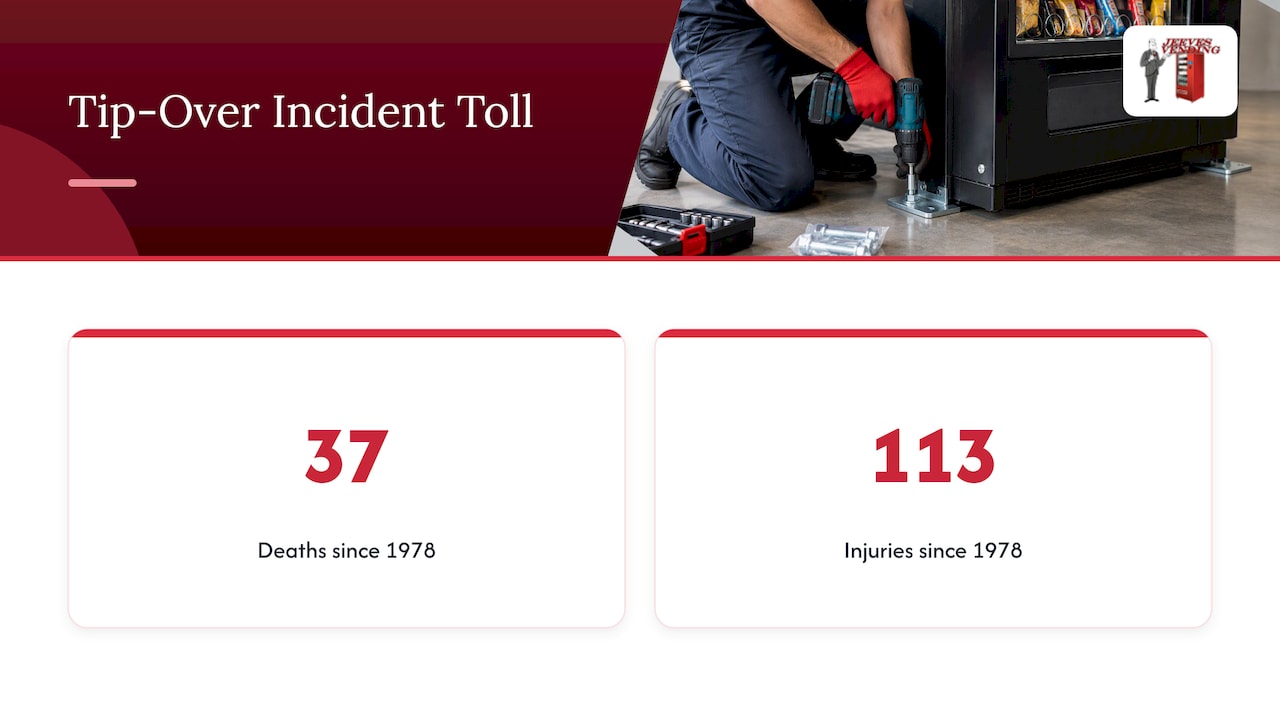
This is a safety issue before it is a security one. The U.S. Consumer Product Safety Commission reported at least 37 deaths and 113 injuries since 1978 from people rocking or tilting soda machines to get free product or money, which led manufacturers to add warning labels. A machine that is fixed or braced in place, positioned so it cannot easily be pulled forward, and labeled clearly is both harder to attack and safer for everyone nearby.
In schools and gyms, where horseplay is more likely, make anchoring and labels a non-negotiable part of installation. If you ever see someone shaking a machine, treat it as an urgent incident and tell staff to step in safely and call the operator.
Locks, keys and rekeying
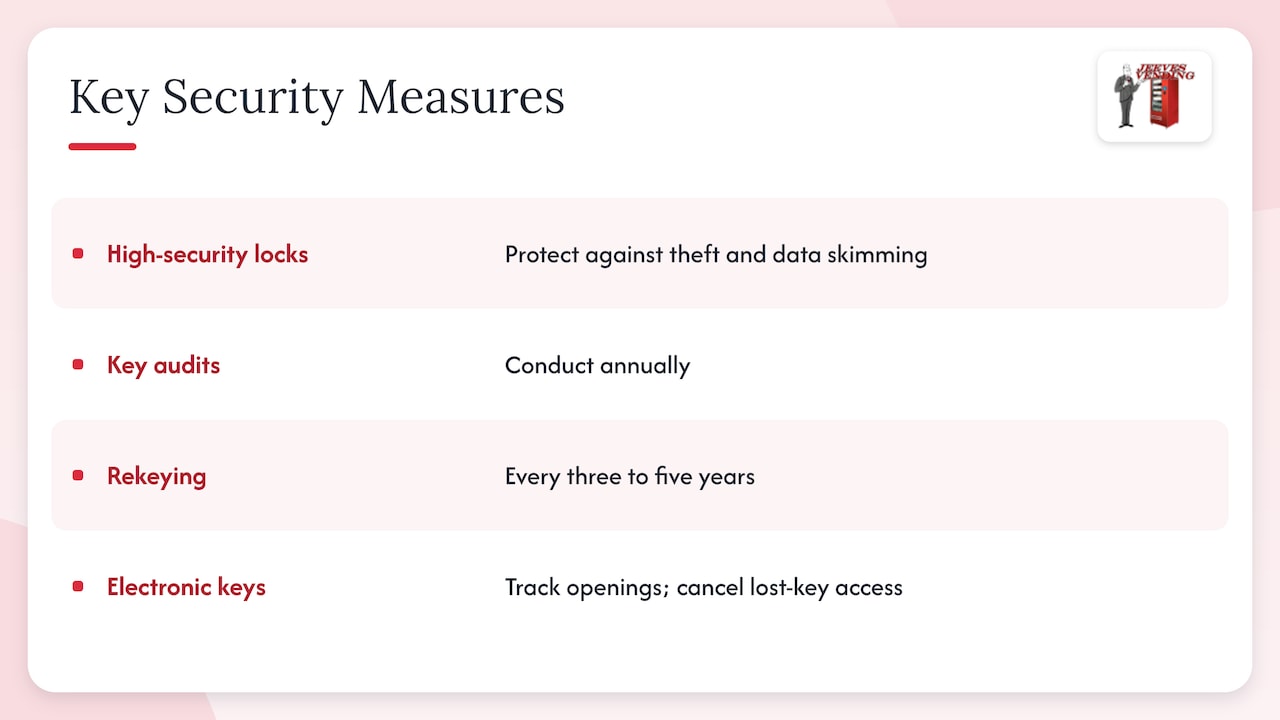
Weak locks are an open invitation. Industry guidance published in Vending Market Watch says high-security locking systems protect against product theft and data skimming, and recommends annual key audits and rekeying machines every three to five years. Who holds keys, who has copied them and who left the company last spring are the questions to ask.
Electronic or “intelligent” keys go further. A lock maker’s guide to securing vending describes audit trails that show who opened a machine and when, which also makes it simple to cancel access when a key is lost or an employee leaves. As a host, you do not need to manage this yourself. You do need to ask your operator how access is controlled.
Hardened equipment and cages
In high-risk spots, reinforced cabinets, tamper-resistant coin and bill areas, and security enclosures add friction. Another route is to reduce what is worth stealing: machines and micro-markets that run on cashless payment hold little or no cash. Our overview of payment security moves operators should lock down first explains how card readers and digital POS reduce cash exposure and card-data risk.
Add eyes: cameras, alarms and smart monitoring
Cameras and alarms do two jobs: they deter, and they document. Vending Market Watch notes that these tools work best when paired with clear visibility and, where possible, rapid response, and that access-control systems with audit trails improve accountability. A camera nobody reviews is decoration, so decide in advance who watches footage and who calls whom.
Smart monitoring adds a different kind of watchfulness. Telemetry and remote stock monitoring can show unusual door openings, sales that do not match inventory, or a machine that has gone offline. Our own machines and micro-markets use remote stock monitoring and digital POS, so the operator sees stock and sales patterns without waiting for a complaint. Unexplained gaps are a signal worth chasing early.
Check privacy and policy before you install anything
Camera rules vary by state and by setting. Audio recording is more restricted than video in many places, and cameras should never point where people expect privacy, such as restrooms, locker rooms or changing areas. Schools and hospitals usually have their own surveillance and records policies, so check with legal counsel, your HR team or your school district before adding recording equipment. Post signage so people know they are on camera. If your building already has cameras covering the area, ask your security lead to confirm that the machine falls within a view.
Adapt the plan to your setting
Every site has a different threat. Here is how the layers shift.
| Setting | Typical risk | What to prioritize |
|---|---|---|
| Office | Low vandalism, some after-hours access and key sharing | Break-room placement, locked service access, clear key control |
| School | Horseplay, tipping, damage between classes | Anchoring, visible hallway placement near staff, warning labels, clear conduct rules |
| Hospital | 24/7 access, vulnerable users, strict policies | Lit, staffed areas, cashless payment, coordination with facility security |
| Gym | Sweaty, rushed users, lockers and entryways nearby | Placement near front desk, durable cabinets, prompt refill and cleaning |
| Warehouse | Large, quiet spaces, shift changes, forklift traffic | Visible spot off traffic lanes, good lighting, anchoring |
For warehouses in particular, traffic lanes and shift patterns decide the right spot. Our warehouse vending location guide walks through it.
Offices
Offices rarely face deliberate destruction. The risk is quieter: a key left on a desk, a service door left unlatched, or a machine in a lobby accessible after hours. Put machines inside the break room or a shared area, and keep a short list of who is authorized to open them.
Schools
Students are the main users, so the best defense is design plus culture. Place machines in high-traffic, adult-supervised corridors, anchor them, and post a plain rule: shaking or rocking a machine is dangerous and will not produce free product. Talk about it in assemblies or orientation. Menu choices matter too, because healthier options and school-appropriate items keep machines aligned with district rules.
Hospitals
Hospitals run around the clock, so machines need to be accessible but never hidden. Choose well-lit, staffed or camera-covered zones. Cashless payment avoids cash handling in sensitive areas, and a clear line to facility security shortens response times.
Gyms
Gym machines handle steady traffic and frequent restocking needs. Place them within sight of the front desk, away from towel and locker bottlenecks, and make sure staff know how to report a jam or damage quickly.
Warehouses
Shift breaks create short bursts of heavy use and long stretches of nobody around. Choose a lit, visible area, not a back dock, and confirm that forklifts and pallet jacks have room to maneuver without hitting the machine.
What to do the day a machine is damaged
A written response plan keeps a bad day short.
- Make the area safe. Keep people away from broken glass, exposed wiring or a tilted cabinet. Do not try to stand a leaning machine back up alone.
- Contact the operator right away. Give the location, time found and what you can see. With a full-service program, repairs and restocking are the operator’s job.
- Preserve evidence. Photograph the damage and ask your security team to save relevant camera footage before it is overwritten.
- Report it if needed. Theft or serious damage may warrant a police report, and your property insurer may want one. Our guide to vending machine liability explains who is responsible and what coverage typically applies.
- Look for the pattern. Was it the same time of night, the same corridor or the same door? Repeated incidents point to a placement or lighting fix, not bad luck.
- Close the loop. If a key is missing, rekey. If a spot proves risky, move the machine.
A quarterly routine that keeps risk low
Security fails quietly through neglect. A short routine helps:
- Walk the area and check lighting, signage and blocked sightlines.
- Confirm the machine is still anchored and level, with no loose panels.
- Ask the operator for a key audit at least annually and a rekey every three to five years, in line with the industry guidance.
- Review any incident log for patterns.
- Check that cameras still point at the machine and that footage is being stored.
- Confirm that the machine is not blocking an exit, extinguisher or walkway.
Perspective
We have seen that most vandalism problems start before a machine is ever plugged in. They start with a spot picked for convenience, not visibility. Putting the machine where people naturally gather and can see it solves more than any gadget can.
Our approach is to treat the machine, the stocking and the service as one job. We plan placement with the host, use remote stock monitoring so we notice unusual activity early, and handle maintenance and restocking so a damaged machine is not the host’s problem to solve. We are family-owned and locally managed, which means a real person who knows your building picks up when something goes wrong.
If you want fewer surprises, ask any provider three questions: who decides placement, how do you know when something is wrong, and who fixes it. We built our service around good answers to all three.
Gary
Get a machine placed and managed for you
If you would rather not take on security planning, equipment and repairs yourself, our free full-service vending program is designed for exactly that. We install state-of-the-art machines or custom micro-markets at no upfront cost to your business, stock them, monitor them remotely and maintain them, across the Dallas-Denton region.
You can see how our modern vending machines and AI smart coolers work, or read why installation cost is often $0 for facility managers. When you are ready, tell us about your location and we will help you choose a spot that is visible, lit and practical. Start at jeevesvending.com.
FAQ
What is the single best way to prevent vending machine vandalism?
Choose the right location. Machines in busy, well-lit places that people can see from nearby work areas are less likely to be attacked, because concealment and anonymity are what vandals look for. Pair that with solid anchoring and quality locks for the best protection.
Should I put a camera on every vending machine?
Not necessarily. Cameras deter and document, but only if someone reviews the footage and can act on it. In many buildings, an existing camera that covers the machine area is enough. Check privacy and policy rules first, especially in schools and hospitals, and never point a camera at restrooms or locker areas.
How often should vending machine locks be rekeyed?
Industry guidance suggests auditing keys at least once a year and rekeying every three to five years. Rekey sooner if a key is lost or someone with access leaves under difficult circumstances. Ask your operator how keys are tracked.
Are outdoor vending machines more likely to be vandalized?
They can be, because they face more exposure and after-hours contact. Good lighting, clear sightlines, anchoring and a position near activity make a large difference. Some sites are better served by an indoor location.
Who pays for repairs if a machine on my property is damaged?
That depends on your agreement. With our full-service program, the equipment, stocking and maintenance are handled by us at no cost to the host business. Whatever provider you use, get responsibilities in writing and review the points in our liability guide.
Sources
- Buck et al., research on vending machine vandalism in the United States
- City of Las Vegas, CPTED handbook (2022)
- U.S. Consumer Product Safety Commission, vending machine labeling campaign
- Vending Market Watch, Security Trends (August 2020)
- Vending Market Watch, Stepping Up Security (August 2021)
- Securing Vending Systems guide (2022)