
Food service customer service for vending and micro-markets is the full vendor program covering installation, scheduled restocking, temperature monitoring, remote telemetry, POS support, and issue resolution — start by confirming SLA response times, remote-dashboard access, and perishables controls with any vendor you evaluate, including Jeeves Vending, against FDA food-safety temperature guidelines and Energy Star cooler specs.
Three checks to run before signing anything:
- SLA response time: Get the exact hours-to-respond and hours-to-fix commitments in writing, not just a verbal promise.
- Remote-dashboard access: Confirm you (not just the operator) can view stock levels, temperature logs, and fault alerts in real time.
- Perishables and temperature monitoring: Ask for a sample temperature-excursion report and the vendor’s spoilage-credit policy.
Pro Tip: Request a live demo of the telemetry dashboard and two client references from locations similar to yours before you sign. A vendor who hesitates on either is telling you something.
Key Takeaways
Excellent food service customer service for vending and micro-markets requires written SLA commitments, host-accessible telemetry, and a no-cost equipment model that keeps accountability with the operator, not the facility.
| Point | Details |
|---|---|
| SLA in writing | Require response-time and on-site-fix commitments in contract language before signing. |
| Host dashboard access | Confirm you can view stock, temperature, and fault data independently, not just through operator reports. |
| Restock tied to data | Scheduled restocking should adjust to actual consumption, not a fixed calendar. |
| Temperature compliance | Require daily temperature logs and a documented excursion-response protocol for all perishables. |
| Jeeves Vending | Provides no-cost vending and micro-market installations with telemetry and local on-site service across Dallas-Denton. |
Table of Contents
- What does good food service customer service actually look like?
- How connectivity and cashless payments improve uptime and reduce cost
- Operational questions to confirm with every prospective vendor
- What SLA terms and KPIs should you require in the contract?
- What do vending and micro-market contracts actually cost the host?
- What does a realistic rollout timeline look like?
- How should a vendor respond to common service problems?
- How Jeeves Vending meets these standards in the Dallas-Denton area
- What most facility managers underestimate about vendor service quality
- Jeeves Vending: no-cost food service for Dallas-area facilities
- Sources
What does good food service customer service actually look like?
The baseline is higher than most facility managers expect. A competent provider shows up with a written installation project plan that includes a site survey covering power capacity, internet connectivity, cooler exhaust clearance, and delivery path. Guessing on any of those four items causes delays and cost overruns.
Beyond install, the service elements that separate good from average:
- Predictable restock cadence: Scheduled visits tied to actual consumption data, not a fixed calendar that ignores demand spikes.
- Freshness controls: Documented rotation procedures, clear expiration labeling, and a defined spoilage-credit process for perishables.
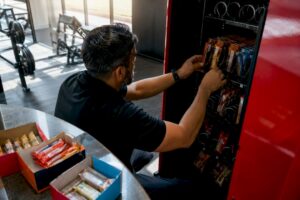
- Remote monitoring: Real-time alerts for low stock, temperature excursions, and machine faults — with the host having read access to the same data the operator sees.
- Responsive support: A named contact, a ticketing system, and an on-site SLA for hardware faults. “Call us if something breaks” is not a support model.
- Transparent reporting: Weekly sales-by-SKU reconciliation, shrinkage figures, and stockout counts — not just a monthly PDF summary.
Micro-market formats carry higher operating complexity than traditional vending: daily service needs, fresh-food waste risk, and shrinkage exposure that make tight service standards non-optional.
Pro Tip: Ask the vendor to walk you through their escalation path — what happens if a machine goes offline at 7 PM on a Friday. The answer tells you more than any brochure.
How connectivity and cashless payments improve uptime and reduce cost
Smart-vending connectivity supports cashless payment options, remote management, and proactive maintenance alerts that improve customer convenience and operational uptime. That combination matters because a machine that is offline or empty is a service failure, not a minor inconvenience.
Real-time telemetry enables predictive restocking and prekitting workflows that reduce service visit time and stockout-driven lost sales. Prekitting means the driver arrives with a machine-specific kit packed at the warehouse using live stock data, rather than loading a full van and guessing. Shorter visits, fewer errors, and less product waste.
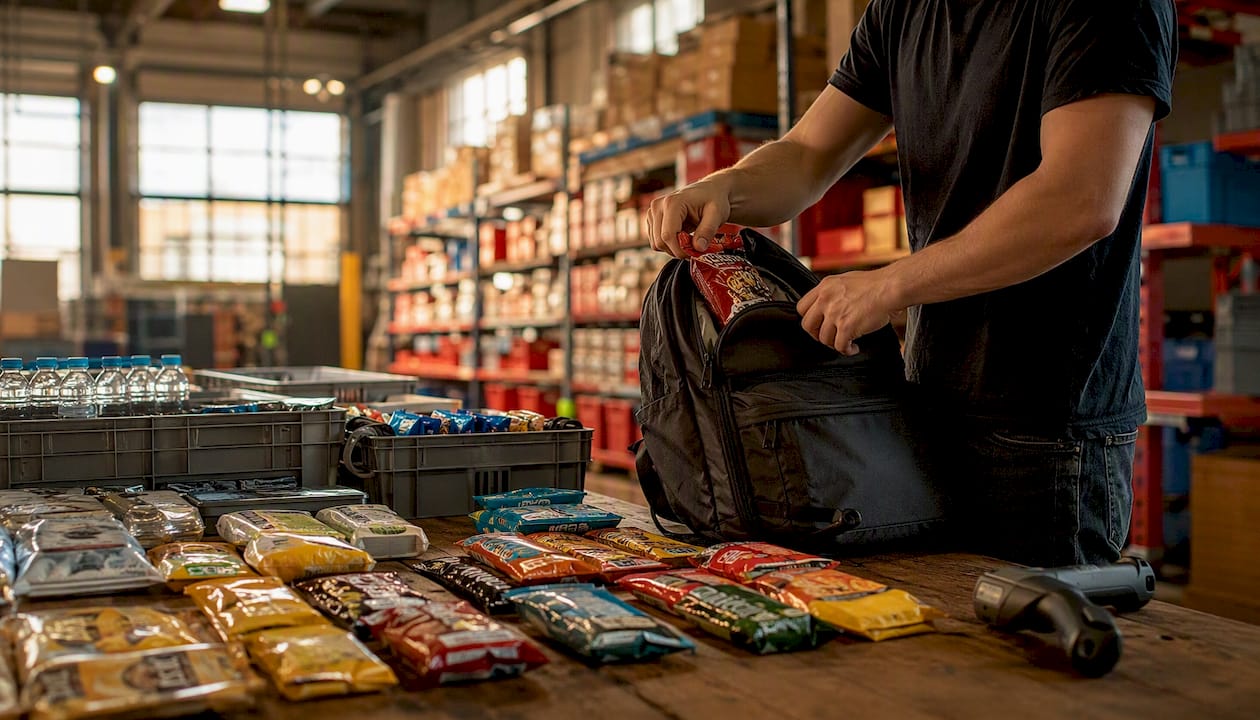
Telemetry platforms provide machine operational status, stock levels, sales by product and hour, and preventive-maintenance alerts — all of which scale operations and reduce lost sales from undetected stockouts.
What the host location should expect access to:
- Low-stock alerts by product slot
- Temperature excursion notifications with timestamps
- Machine-offline alerts and remote-reset capability
- Sales-by-SKU and hourly transaction data
- Preventive-maintenance flags before a fault becomes a failure
Modern kiosks support credit cards, NFC mobile wallets, and market cards. Camera- or weight-based audit tools reduce shrinkage in open micro-market formats.
Operational questions to confirm with every prospective vendor
Run these before the contract is drafted, not after.
Site and installation:
- What is the minimum power circuit required, and does our current panel support it?
- Does the equipment use ethernet, cellular backup, or both?
- What is the condenser clearance requirement, and does our proposed location meet it?
- What is the delivery path, and are there freight elevator or door-width constraints?
Stocking and perishables:
- Who manages product rotation, and what is the documented spoilage-reserve policy?
- How are expiration dates tracked — manually or via telemetry?
- What is the restock frequency, and how is it adjusted for demand changes?
Security and theft:
- Is camera coverage included, and who retains footage?
- What is the audit workflow when shrinkage exceeds a threshold?
- How are refund requests processed for failed vend or billing errors?
Reporting and access:
- What dashboard access does the host receive, and at what role level?
- How frequently are reconciliation reports delivered?
One-line scripts that get direct answers fast: “What is your written SLA for on-site response to a hardware fault?” and “Can you show me a sample temperature-excursion report from a current client?”
What SLA terms and KPIs should you require in the contract?
SLA phrasing to request verbatim: “Vendor will respond remotely within four hours of a machine-offline or temperature-excursion alert, and will dispatch on-site technician within two business days of a confirmed hardware fault.”
Daily stock alerts, weekly sales-by-SKU reconciliation, and a monthly performance summary covering uptime, shrinkage, and stockout rate are the minimum reporting package worth accepting. Anything less makes it impossible to hold the vendor accountable.
What do vending and micro-market contracts actually cost the host?
Three models dominate the market:
Operator-owned, no-cost program: The operator supplies equipment, handles installation, stocks inventory, and earns revenue from product sales. The host pays nothing for equipment or service. This is the most common arrangement for qualifying workplaces. Contract terms typically include exclusivity, a minimum traffic threshold, and auto-renewal language.
Subsidized model: The operator discounts equipment or service fees in exchange for a guaranteed minimum purchase volume or a longer contract term. The host pays a reduced upfront cost but carries more risk if volume falls short.
Host-purchase model: The host buys equipment outright. A typical micro-market installation runs in the mid-five-figure range, requiring budgeting for kiosk, refrigeration, installation labor, internet backup, and initial inventory. The host then contracts separately for stocking and maintenance services.
Recurring cost lines to confirm regardless of model:
- Card processing fees (typically passed through at cost or as a fixed percentage)
- Software or telemetry subscription fees
- Spoilage reserve or shrinkage cap
- Driver labor or service-visit fees if not bundled
Red flags in contract language:
- Vague SLA with no defined response time or remedy
- Removal or deinstallation fees that exceed one month’s revenue
- Exclusivity clauses with no carve-out for other food services
- Auto-renewal windows shorter than 60 days’ notice
- Reporting access restricted to the operator only
What does a realistic rollout timeline look like?
- Site survey (Week 1–2): Power audit, internet assessment, cooler clearance measurement, delivery path confirmation.
- Equipment procurement (Week 2–4): Order placement, lead time varies by equipment type and customization.
- Installation and configuration (Week 4–6): Physical install, network connection, telemetry setup, POS configuration.
- Test and pilot (Week 6–7): Stock a partial load, run payment tests, confirm temperature logs and alerts are live.
- Launch and training (Week 7–8): Full stock load, staff communication, signage placement.
Site-prep checklist before the installer arrives:
- Dedicated 20-amp circuit (or per equipment spec) within reach of the placement zone
- Ethernet drop or confirmed cellular signal strength at the location
- Minimum 6 inches of condenser clearance on all sides for refrigerated units
- Staging area for delivery and unboxing
- Signage space for payment instructions and contact information
- Sanitation supplies and a designated cleaning schedule
Micro-market installs require careful planning for airflow, internet backup (such as a 5G hotspot), and installation extras like anchor bolts and surge protection. Budget for those line items before the contract is signed, not after.
How should a vendor respond to common service problems?
| Issue | Expected vendor response | Escalation trigger |
|---|---|---|
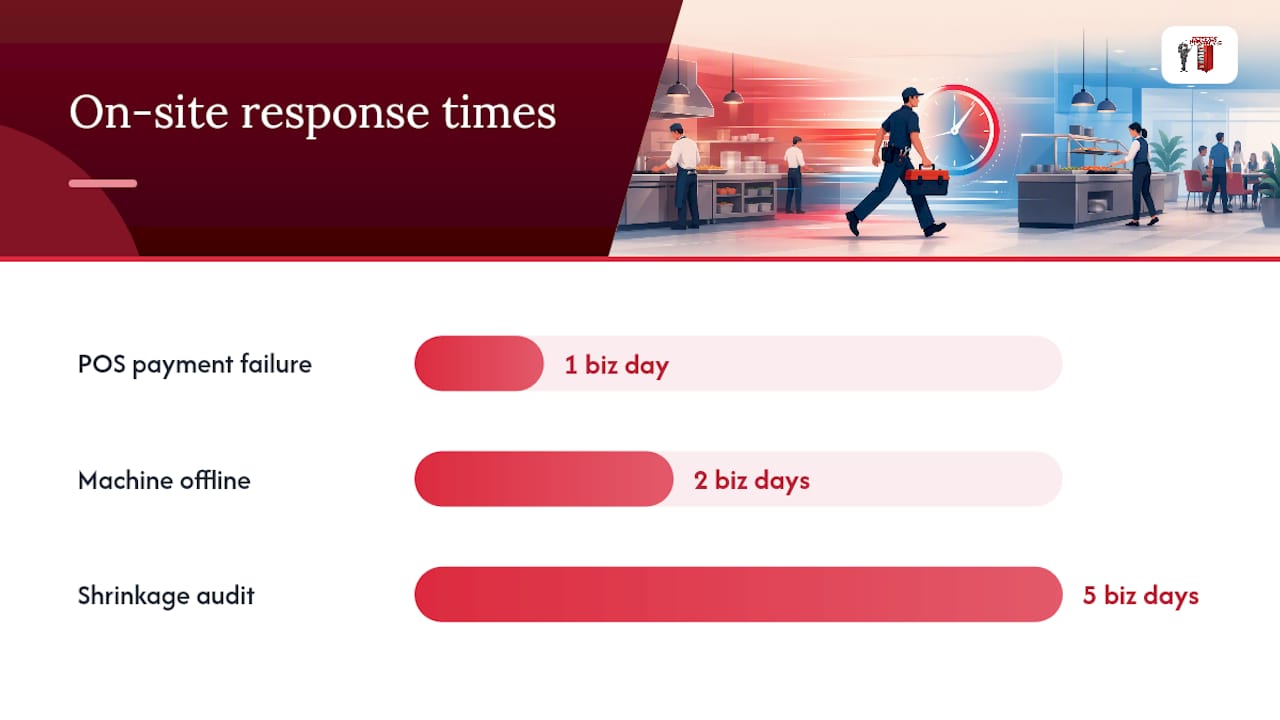
| Machine offline | Remote triage within 4 hours; on-site within 2 business days | Second offline event |
| Temperature excursion | Remote alert acknowledgment within 2 hours; product pull if unresolved in 4 hours | Any excursion above FDA threshold |
| Stockout (high-velocity SKU) | Unscheduled restock within hours | Three or more stockouts in one week |
| Shrinkage above threshold | Inventory audit within 5 business days; camera cross-check | Repeated threshold breach |
| POS or payment failure | Remote reset attempt within 2 hours; on-site within 1 business day | Failure affecting more than 20% of transactions |
After any repeated incident, demand a written root-cause analysis and a corrective action plan. A planogram change, increased visit frequency, or equipment swap are all legitimate remedies. A verbal apology is not.
Pro Tip: Build a service-credit clause into the contract: if uptime falls below the agreed percentage in any calendar month, the vendor credits the equivalent lost revenue against the next period’s reconciliation.
When to escalate to contract-level remedies: three or more SLA breaches in a rolling 90-day period, a temperature excursion that results in a food-safety incident, or a shrinkage rate that exceeds the contracted cap for two consecutive months.
How Jeeves Vending meets these standards in the Dallas-Denton area
Jeeves Vending provides vending machines and micro-markets at no cost to qualifying host locations across the Dallas-Denton region, covering equipment, installation, stocking, and ongoing maintenance under a single operator-managed program.
Key service features aligned to the checklist above:
- No-cost equipment placement with no upfront capital required from the host
- Remote stock monitoring and telemetry with host-accessible dashboard
- Scheduled restocking adjusted to actual consumption data
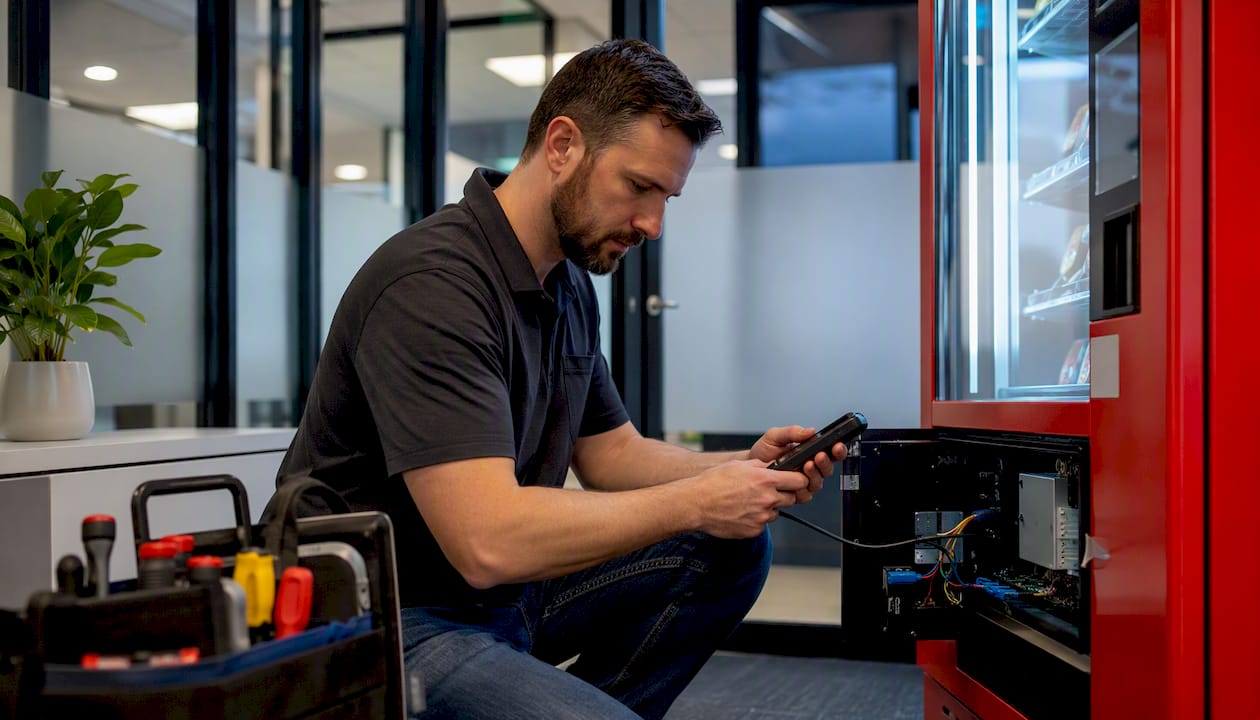
- Local on-site response capability for hardware faults and service issues
- Smart AI-enabled coolers with cashless payment support including NFC and mobile wallets
- Tailored product mix covering snacks, beverages, coffee, and healthy options for offices, schools, gyms, and hospitals
Request a site survey, a sample SLA, and a live telemetry demo directly at Jeevesvending.
What most facility managers underestimate about vendor service quality
The gap between a vendor’s sales pitch and their actual service delivery usually shows up in one place: reporting access. Most operators will promise real-time monitoring. Fewer will hand the host location a live dashboard login before the contract is signed.
That distinction matters more than equipment brand or product variety. A facility manager who can see stock levels, temperature logs, and transaction data independently has leverage. One who relies on the operator’s monthly summary has none. The telemetry and reporting requirements in this guide are not nice extras — they are the mechanism by which you hold any vendor accountable after the honeymoon period ends.
Contracts that restrict reporting access to the operator are not protecting proprietary data. They are protecting the operator from accountability. Push back on that clause every time.
Jeeves Vending: no-cost food service for Dallas-area facilities
Zero equipment cost, local staffing, and a telemetry-backed service model — that is the concrete difference Jeeves Vending offers compared to operators who charge installation fees or lock hosts into opaque reporting arrangements.
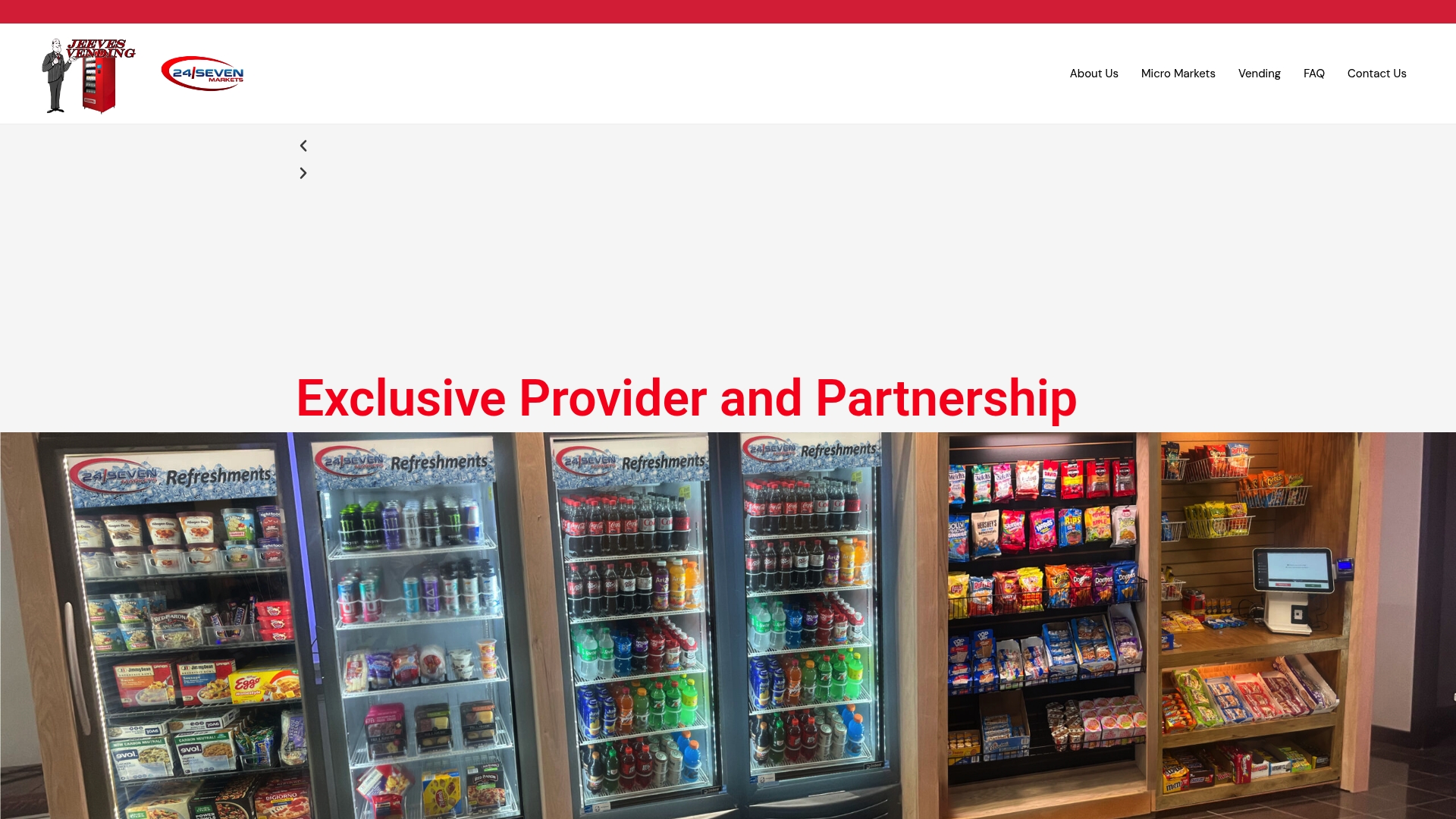
For facility managers and HR teams in the Dallas-Denton area, Jeeves Vending installs and manages smart vending machines and full micro-markets at no cost to the host. You get cashless payment support, remote stock monitoring, scheduled restocking, and a local team that can respond on-site when something goes wrong. No capital outlay, no hidden software fees, and no reporting blackout.
The program fits offices, schools, gyms, hospitals, and warehouses. Product selection is tailored to your population, and the menu can be adjusted as consumption data comes in.
Schedule a site survey or request a demo to see the telemetry dashboard and confirm your location qualifies.
Sources
- How to Achieve Smart Stock Control with Real-Time Telemetry | Televend
- Micro Markets in 2026: Cost, Equipment & Profitability Guide
- Micro Markets vs. Vending Machines: 2026 Operator ROI Guide
- Telemetry for unattended businesses: what it is and why it changes operations | Blog – Frekuent
- Enhancing convenience with smart vending machines