
A hospital staff micro market gives round-the-clock employees a self-service food option that beats vending in variety and beats a cafeteria in labor cost. It typically runs on about 16 hours a week of restocking labor. Staff who buy food at work more than 60% do weekly tend to eat worse when healthy options aren’t visible or affordable. If your night shift has nowhere decent to eat, a pilot micro market or a site assessment is the logical next step.
TL;DR:
- A micro market can open 24/7 with around 150 to 200 SKUs, providing healthier meal and snack options that are often unavailable during night shifts.
- Placement near high-traffic units and inside accessible corridors significantly increases staff adoption and utilization of the micro market.
- Installing a micro market typically requires just 16 hours of weekly restocking labor, with minimal space and security considerations, and no upfront equipment costs.
- AI-powered checkout and badge payment systems remove friction, resulting in increased sales up to 110% and smoother operation during busy shift changes.
- Regular staff feedback and pilot testing are essential for optimizing SKU mix, boosting healthy item sales, and ensuring the market becomes a valued part of hospital staff routines.
Table of Contents
- What separates a micro market from vending or a 24-hour cafeteria
- Why 24/7 access changes outcomes for staff and the hospital
- Space, security, and staffing requirements before you commit
- Self-checkout, badge payment, and inventory alerts that keep it running
- Building a menu that works across every shift
- What a hospital micro market costs to run and what it returns
- A rollout checklist facility teams can follow
- How Jeeves Vending supports hospital deployments
- Common pitfalls and quick wins for hospital micro markets
- Getting a micro market into your hospital
- Sources
- FAQ
What separates a micro market from vending or a 24-hour cafeteria
A micro market is an open, self-service retail space: refrigerated cases, open shelving for grab-and-go items, and a self-checkout kiosk instead of a cashier. It sits somewhere between a vending machine and a cafeteria without the drawbacks of either.
Vending machines are limited to what fits in a coil or a small cooler slot, so fresh sandwiches, salads, and larger meals are usually out. A cafeteria staffed overnight solves the variety problem but adds payroll for hours when foot traffic is thin. A micro market keeps the variety of a small store, managed remotely between visits, without a cashier on-site.
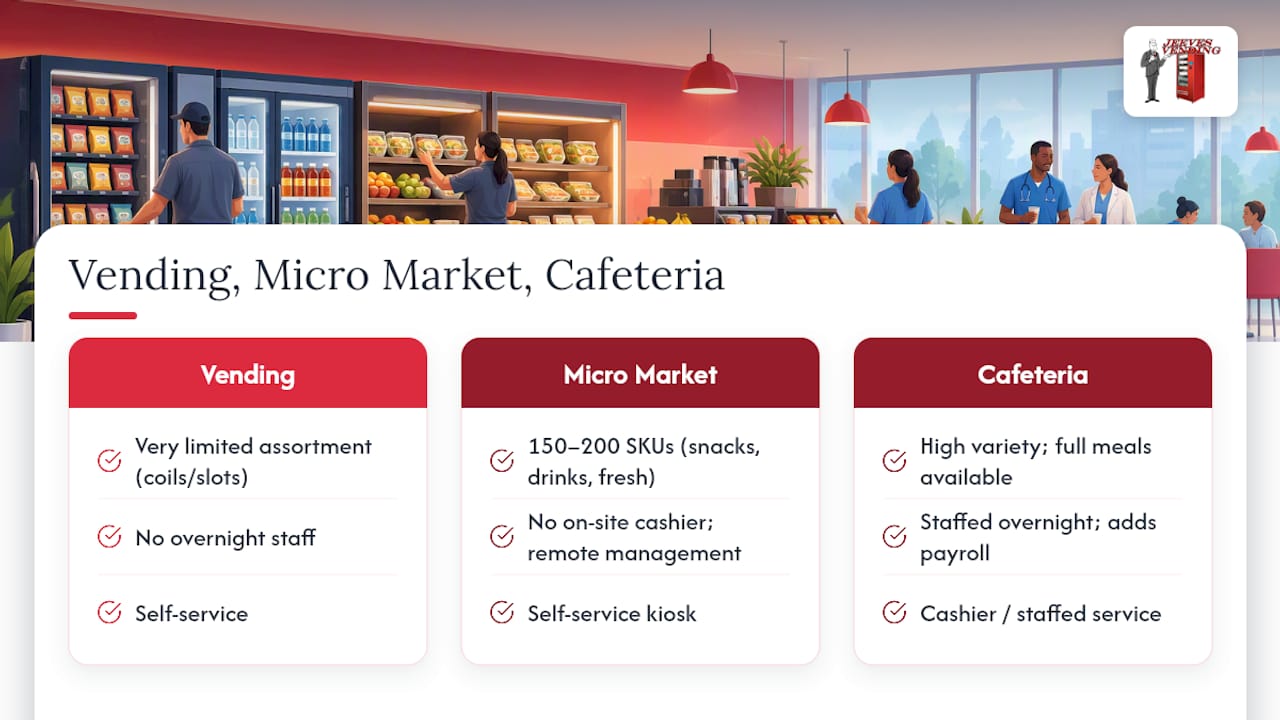
Most hospital-scale markets run 150 to 200 SKUs across snacks, drinks, and fresh food, fitting into a footprint of roughly one break room wall: a kiosk stand, one or two open shelving units, and a cooler or two depending on how much perishable inventory the menu carries.
Why 24/7 access changes outcomes for staff and the hospital
Night-shift and rotating-shift staff face a real gap: cafeterias close, nearby restaurants close, and vending is often the only option left. Research on healthcare workers found that frequent work-based food purchases are tied to weaker overall diet and to higher odds of drinking sugar-sweetened beverages regularly.
More than 60% of healthcare staff buy food or drinks at work in a typical week, and those who purchase often report worse diet quality, with an odds ratio of 2.45 for weekly sugar-sweetened beverage consumption among frequent purchasers.
Beyond diet, a market near the unit cuts the time a nurse spends walking to a distant cafeteria and back, which matters on a 12-hour shift with a short break window. That convenience shows up in staff satisfaction, and satisfied staff tend to stay longer, which matters for retention in a field already stretched thin. Visitors and patients’ families benefit from the same access, and a well-run market can also contribute modest revenue on top of the wellness case, though most hospitals treat that as a secondary benefit rather than the primary reason to install one.
Space, security, and staffing requirements before you commit
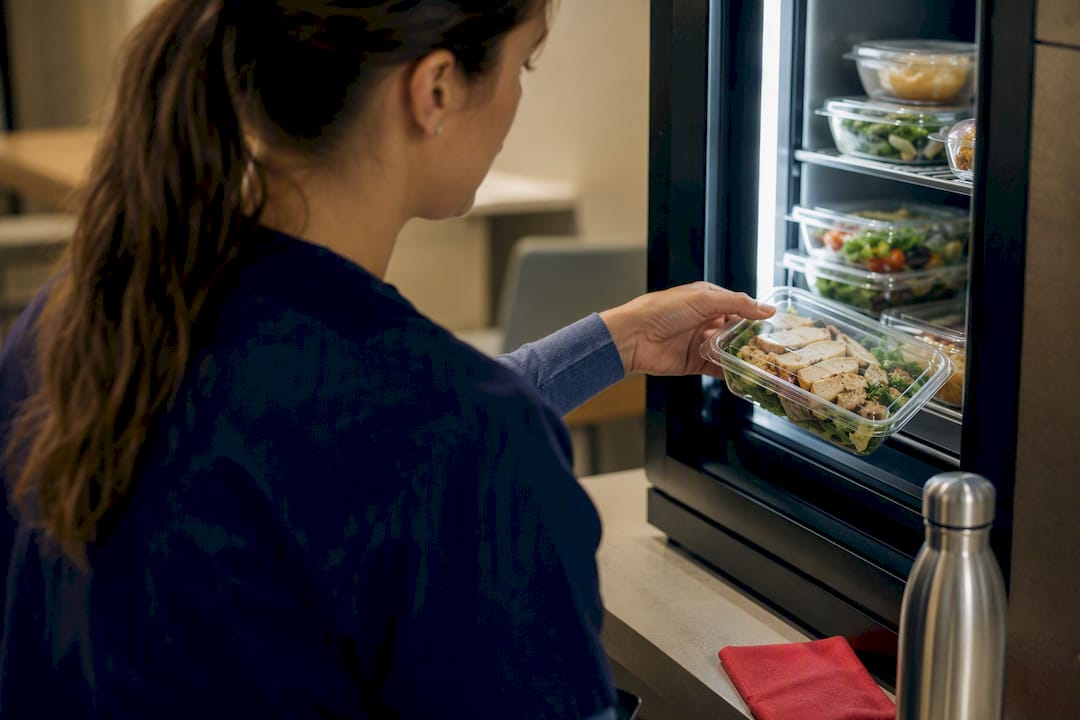
Placement drives adoption more than almost anything else. A market tucked into an underused staff lounge, positioned adjacent to a closed cafeteria, or set inside a badge-access corridor near high-traffic units will outperform one placed somewhere staff rarely pass.
- Footprint: plan for a kiosk stand, one to two shelving units, and refrigerated cases, generally the space of a large break room wall.
- Security: badge access and camera coverage are standard for unattended retail in a clinical building.
- Cleaning and infection control: kiosk touchpoints, cooler handles, and microwave interiors need a written cleaning schedule owned by the facility’s food-safety team.
- Labor: restocking and light maintenance run about 16 hours a week for an unattended market, far below staffing a service counter around the clock.
- Compliance: permits, insurance, and food-safety sign-off stay with the facility, even when a vendor supplies and services the equipment.
Pro Tip: Walk the proposed site during a night shift before signing anything. Foot traffic patterns after 11 p.m. rarely match daytime assumptions.
Self-checkout, badge payment, and inventory alerts that keep it running
Unattended operation only works if checkout is fast and payment is frictionless. Kiosk and barcode scanning is the baseline, but AI-based checkout that recognizes items without individual scanning removes the last bit of friction and speeds up busy shift-change windows.
- Checkout speed: AI checkout systems process a full basket in seconds, faster than manual barcode scanning at a self-checkout kiosk.
- Payment friction: badge-based payment or payroll deduction solves the common problem of staff leaving wallets and phones in lockers during a shift.
- Inventory telemetry: remote stock monitoring flags low SKUs before they go empty, which keeps restock trips efficient instead of reactive.
- Data governance: any badge or payroll integration should have a clear policy on what purchase data is stored and who can see it.
One hospital case documented the effect directly: after Candler Hospital’s Smart Byte Market added AI checkout and badge payment integration, sales rose as much as 110% compared with the pre-remodel period. That kind of jump reflects removed friction, not just novelty, since usage climbed steadily rather than spiking and fading.
Building a menu that works across every shift
A market open to three shifts needs a SKU mix that works at 3 a.m. as well as noon. That means balancing perishable meals, grab-and-go items, healthier snacks, and beverages within a total assortment of 150 to 200 SKUs.
- Set a target mix: roughly a third fresh or perishable, a third packaged snacks, and a third beverages and grab-and-go.
- Label clearly: allergen information, visible pricing, and a simple call-out marker for lower-calorie or higher-protein items.
- Use pricing to nudge behavior: modest discounts on water or fruit versus soda can shift purchases without cutting revenue.
- Collect staff feedback regularly and adjust the mix instead of guessing at what sells.
- Schedule perishables for restock right before shift changes to cut waste and keep fresh items actually fresh for night staff.
Special-diet accommodations, vegetarian, gluten-free, or low-sodium options, matter more in a hospital than almost any other workplace, given the staff’s own health literacy and the patient population nearby.
What a hospital micro market costs to run and what it returns
Most vendor-managed markets install equipment at no upfront cost to the hospital, with revenue coming from what staff and visitors spend, not from the facility’s budget. A hospital-managed alternative shifts more control to the facility but adds internal labor and inventory oversight.
A small hospital micro market reported average weekly sales near $700 shortly after opening, with roughly 16 labor-hours a week covering restocking and upkeep. That labor figure is the number to compare against staffing a 24-hour cafeteria counter, and it’s usually the deciding factor for facilities with tight staffing budgets.
Track a short list of KPIs rather than everything available: weekly sales, average items per visit, the share of sales from healthier items, and uptake by shift. Whether the market is a staff benefit or a genuine revenue line depends on those numbers after a few months, not on assumptions made before installation.
A rollout checklist facility teams can follow
Before signing a vendor agreement, confirm the basics on-site: power access, wifi for the kiosk and telemetry, the physical footprint, waste removal, refrigeration capacity, and who owns the cleaning schedule.
- Ask vendors directly who owns food-safety compliance for the equipment versus the facility.
- Confirm restock frequency and whether the facility or the vendor controls SKU selection.
- Get an uptime service-level agreement in writing, along with a reporting cadence for sales and inventory.
- Run a pilot of 30 to 90 days in a single unit before expanding, and define success criteria upfront: adoption rate, items per visit, and healthy-item share.
- Communicate the rollout to staff ahead of launch, since a market nobody knows about will underperform regardless of placement.
Pro Tip: Survey staff at day 30 of a pilot, not just at the end. Early feedback catches SKU mix problems before they become a habit of skipping the market entirely.
How Jeeves Vending supports hospital deployments
Jeeves Vending installs custom micro markets at no equipment cost to the host hospital, with self-checkout kiosks and an assortment typically in the 150 to 200 SKU range covering snacks, drinks, fresh food, and healthier options. The company handles site assessment, installation, ongoing stock management, and reporting, so facility teams aren’t managing restocking logistics themselves.
Service extends across schools, offices, gyms, and hospitals, with placement and SKU mix tailored to each site’s traffic patterns and shift schedule. For a facility evaluating whether a market fits a given unit, that assessment step is where placement, footprint, and refrigeration needs get worked out before any equipment goes in.
Common pitfalls and quick wins for hospital micro markets
The mistakes I see most often are placement chosen for convenience of the vendor rather than staff traffic, payment friction nobody tested with actual badges, understocked perishables that go empty by 2 a.m., and a launch with no staff communication at all.
The fixes are cheap by comparison: integrate badge payment before launch, label healthy items clearly on day one, and run the first deployment in a single unit before rolling it hospital-wide.
— Gary
Getting a micro market into your hospital
Jeeves Vending installs and manages custom micro markets at no equipment cost to your hospital, with self-checkout kiosks and a SKU mix built around your shift patterns rather than a generic template.
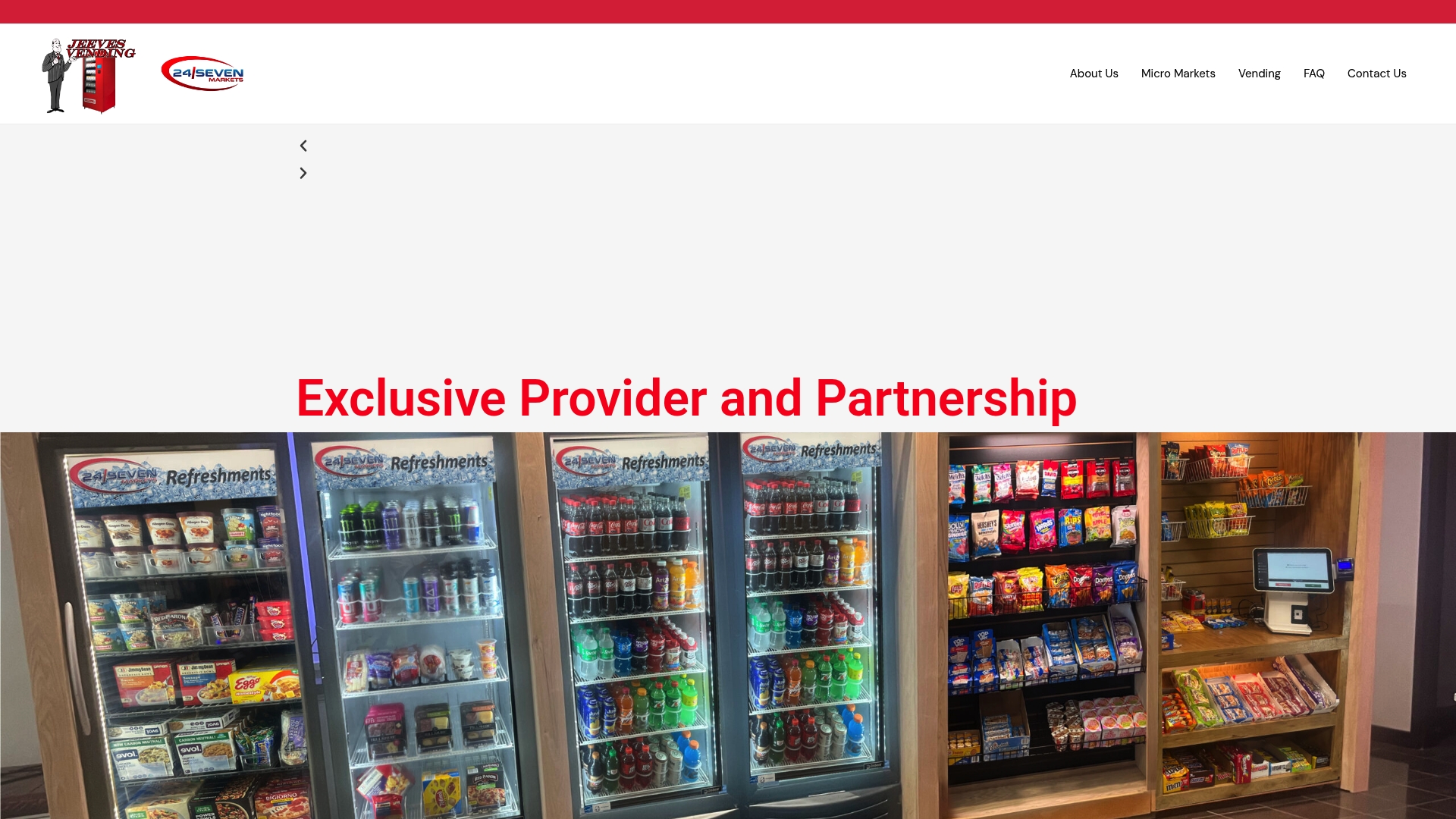
A typical next step is a site assessment covering placement, power, refrigeration, and expected traffic by shift, followed by a pilot before any hospital-wide commitment.
- Ask about the Free Full Service Vending Program if your facility wants a broader vending and market combination.
- Compare fresh food and coffee options on the food vending machines page before finalizing your menu plan.
Sources
- Work site food purchases among healthcare staff: Relationship with healthy eating and opportunities for intervention
- Texas hospital adds 24/7 automated option for staff, guests
- Candler hospital boosts sales 110% with 24/7 availability through Mashgin
FAQ
Can you give me an example of a micro market?
A hospital micro market typically looks like a small open retail area with refrigerated cases, shelving for snacks and drinks, and a self-checkout kiosk instead of a cashier. One documented example is a hospital site that reported weekly sales near $700 shortly after opening, staffed by roughly 16 hours a week of restocking labor.
How do I get my vending machine in a hospital?
Facilities typically start by requesting a site assessment from a vending or micro market provider, who evaluates placement, power, and traffic before installing equipment. Jeeves Vending offers this process through its micro markets page, with installation and equipment provided at no upfront cost to the hospital.
Why are so many hospitals laying off employees?
Staffing decisions at hospitals depend on budget pressures, patient volume, and regional factors specific to each facility, and there’s no single cause that applies broadly. This article does not have data on hospital staffing reductions and can’t speak to that trend.
What are the 5 key performance indicators in a hospital?
Hospital KPIs vary by department, and definitions differ across sources, but for a staff micro market specifically, useful measures include weekly sales, items per visit, the share of healthy-item purchases, and shift-based uptake rates. Broader hospital-wide KPIs are outside the scope of what this guide covers.