
If you manage a workplace with 50 or more people on-site, a modern full-service vending and micro-market partner is the right call, and the fastest way to find out what that looks like for your building is to request a free walkthrough and quote. Look for a provider offering cashless payment, cloud-based telemetry, and open-door micro-market formats at no upfront cost to your business, since that combination now defines what “modern vending” actually means. Jeeves Vending builds its program around exactly that model, pairing no-cost equipment installs with remote inventory monitoring so machines rarely sit empty. The rest of this guide walks through what to ask, what to expect, and how to tell a serious operator from one that’s just installed a machine and walked away.
Key Takeaways
A reliable vending or micro-market partner combines no-upfront-cost equipment, cashless payment support, and real-time telemetry to keep machines stocked and service accountable.
| Point | Details |
|---|---|
| Match format to traffic | Choose open-door micro-markets for 60+ daily users; standard vending fits smaller break rooms. |
| Demand telemetry in writing | Require documented SLA response times, not verbal promises, before signing any contract. |
| Ask about total cost upfront | Confirm whether card processing fees, emergency repairs, and custom items carry extra charges. |
| Verify with real references | Call two or three similar-sized sites rather than relying on written testimonials alone. |
| Start with Jeeves Vending | Request a free walkthrough and quote for no-upfront-cost vending or micro-market installation. |
Table of Contents
- What Monumental Vending Services Actually Include
- What Technology Should a Modern Vending Machine Have?
- Should You Choose an Open-Door Micro-Market Instead?
- How Does Installation And Ongoing Service Work?
- Which Industries and Facilities Use These Services?
- What Do Vending and Micro-Market Contracts Cost?
- How Do You Request a Quote or Schedule a Demo?
- What Trust Signals Separate a Reliable Vending Partner From the Rest?
- What Should You Expect From Customer Support and SLAs?
- Why We Recommend Modern Vending and Micro-Markets
- Ready to Upgrade Your Break Room? Here’s How to Start
- Frequently Asked Questions
- Sources
What Monumental Vending Services Actually Include
Monumental vending is the shift toward larger-capacity machines, wider assortments, and micro-market formats that behave more like a mini convenience store than a coin-slot snack box. Before you sign anything, you need to know which service category actually fits your building’s traffic and layout.
Traditional snack and beverage vending covers standalone or paired machines stocked with chips, candy, soda, and bottled drinks. Refrigerated combo machines add cold sandwiches, salads, and dairy alongside packaged snacks in one unit, which works well in break rooms with limited floor space. Micro-markets go further: an open-door setup with coolers, shelving, and a self-checkout kiosk that lets employees browse and pay the way they would at a small store. Pantry-as-a-service programs stock a shared kitchen area with coffee, creamer, snacks, and paper goods on a recurring restock schedule, often billed to the employer rather than paid per item. Coffee and hot-beverage programs range from single-serve pod brewers to full bean-to-cup machines with telemetry that flags when a hopper runs low.
A full-service operator typically handles more than most facility managers expect, and a good proposal should spell out this division clearly:
- Operator provides: equipment, installation, product selection and merchandising, cashless payment processing, restocking labor, maintenance, repair, and usage reporting.
- Host provides: floor space, standard electrical outlets, and reasonable access during agreed delivery windows.
- Operator manages: promotional rotations, healthy-option ratios, and seasonal product swaps based on sales data.
- Host decides: general location within the building, hours of access, and any dietary or allergen restrictions for the site.
If a proposal is vague about who’s responsible for restocking frequency or reporting, that’s worth flagging before you sign anything. You can review how these formats differ in more detail through this vending machine explanation.
What Technology Should a Modern Vending Machine Have?
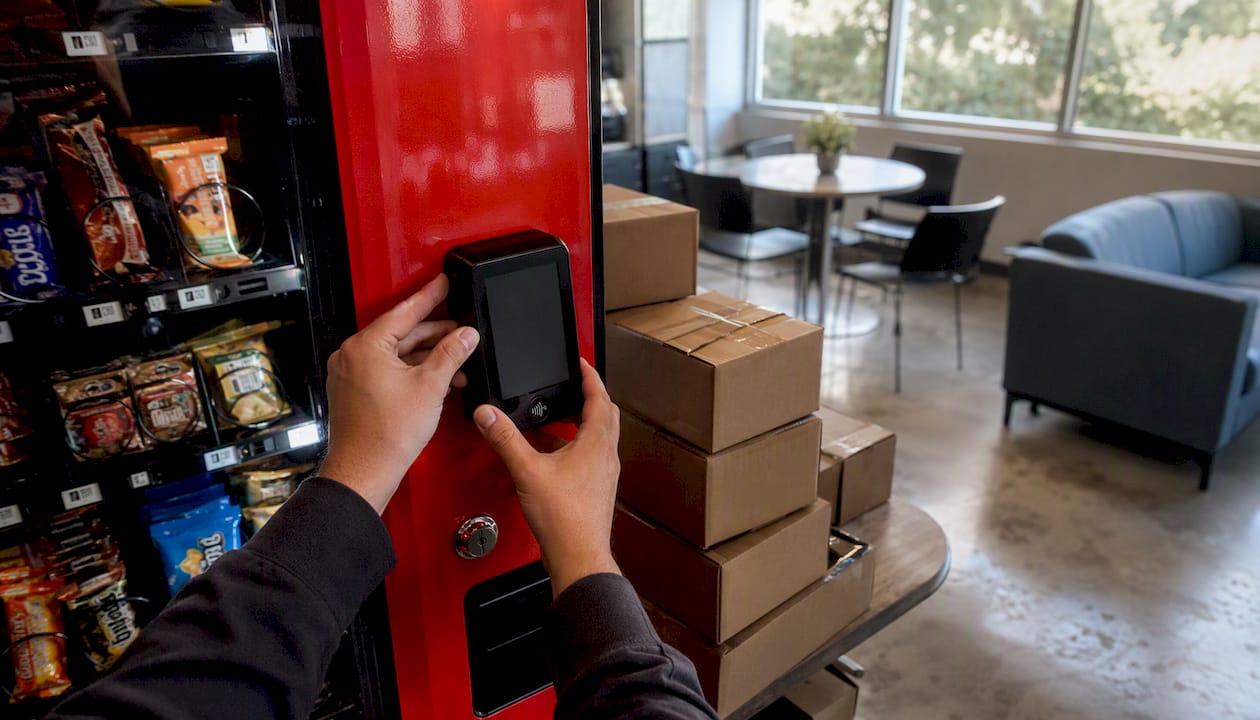
Cashless payment support is no longer optional. Machines that accept tap-to-pay cards, Apple Pay, and Google Pay consistently outsell coin-and-bill-only units because they remove the single biggest purchase friction: not having exact change. NFC readers also cut the labor and security risk tied to physical coin collection, which matters more once you’re managing multiple machines across a campus.
Remote monitoring, sometimes called telemetry, is the second piece that separates a modern operator from a legacy one. A machine equipped with cellular or Wi-Fi telemetry reports its inventory levels and mechanical health back to the operator in real time. That means a route driver knows a machine is running low on the popular items before an employee ever hits an empty selection button, and a technician gets an alert if a compressor or coin mechanism starts failing. DMVI’s modular M-Series platforms pair this kind of cloud telemetry with touchscreen merchandising and cashless payments in configurations built for high-traffic sites like hospitals and corporate campuses.
Touchscreen kiosks add a layer most buyers don’t think to ask about: on-screen promotions and product highlights that function like a tiny digital storefront. Operators can push limited-time offers or highlight a new healthy snack line without touching the machine physically, which tends to lift basket size compared to a static planogram.
- Cashless/NFC compatibility (Apple Pay, Google Pay, tap cards)
- Cloud-based telemetry for inventory and machine-health alerts
- Touchscreen interface for merchandising and promotions
- Remote software updates without a technician visit
- Usage and sales reporting dashboards for the host
Pro Tip: When you request a proposal, ask the vendor to put uptime and response-time commitments in writing. A reasonable standard is a same-business-day or next-business-day response for a non-functioning machine, and 24-to-48-hour resolution for stocking issues flagged by telemetry.
Large-format automated retail isn’t limited to snack machines, either. Walmart’s grocery pickup kiosk pilot let customers scan a code and retrieve a packed order in about a minute, and the company later expanded its tower rollout to dozens of additional locations. That’s a useful signal for facility managers: refrigeration, telemetry, and fast pickup UX scale well together, and the same principles show up in enterprise smart coolers built for corporate campuses and stadiums, like the Smart Cooler 1200, which combines AI-driven product recognition with roughly 828-bottle capacity and cashless payment support.
Should You Choose an Open-Door Micro-Market Instead?
An open-door micro-market drops the locked cabinet entirely. Employees walk in, pick up whatever they want from open shelves and coolers, and pay at a self-checkout kiosk using a card, phone, or app. It feels closer to a small convenience store than a vending wall, and the shift in experience matters more than it sounds.
- Traditional vending: limited slots, fixed pricing per column, purchase happens at the machine face.
- Micro-market: open shelving, wider assortment including fresh food, checkout happens at a central kiosk.
- Traditional vending: best for smaller break rooms or lower foot traffic.
- Micro-market: best for mid-to-high traffic sites where employees want more variety and fresher options.
Micro-markets make the most sense once a site has enough daily traffic to justify the larger footprint, usually buildings with a moderate to high number of employees on-site regularly. They also fit naturally into employer wellness programs, since the open format makes it easier to merchandise fresh fruit, salads, and lower-sugar snacks alongside the usual chips and candy.
The tradeoff is operational complexity. A micro-market needs a broader restocking cadence, sometimes multiple visits per week instead of one, and a checkout system with loss-prevention safeguards since there’s no locked cabinet limiting access. Most operators address this with camera-based checkout verification and clear signage rather than heavy-handed monitoring, which keeps the self-service feel intact. You can see how this plays out day to day in this guide on how micro-markets work in offices.
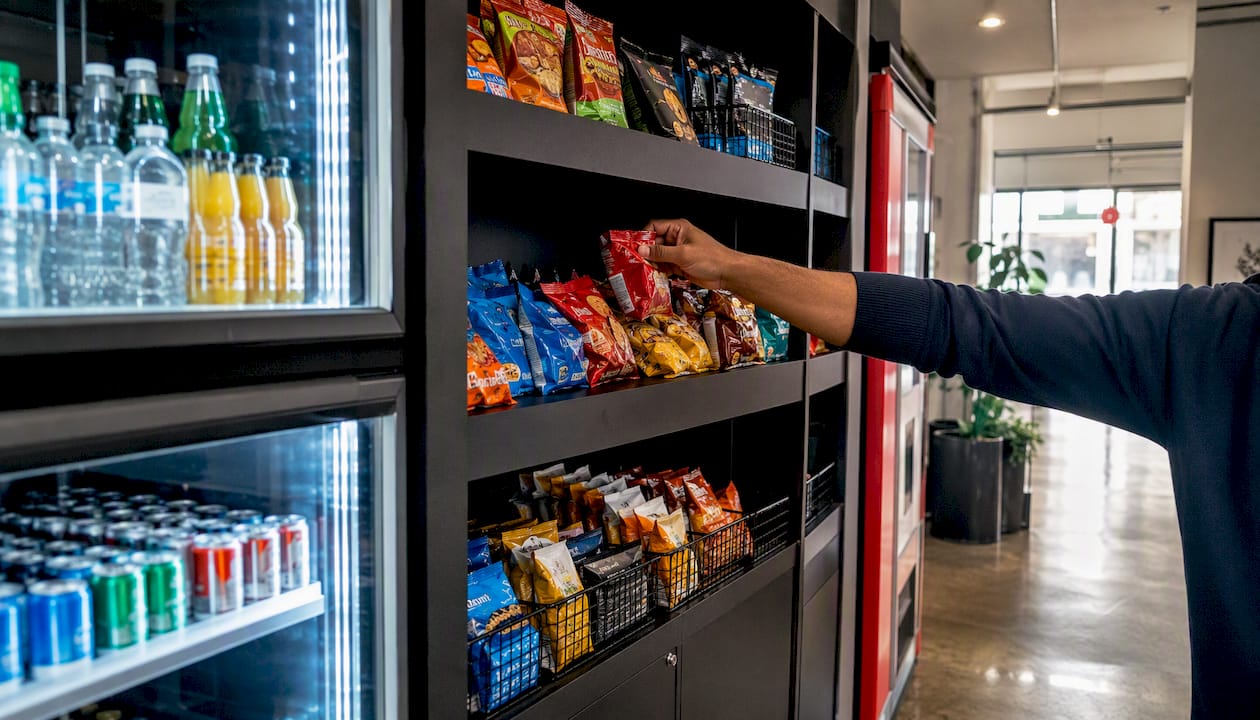
Pro Tip: Place the micro-market kiosk near a high-visibility, high-traffic path, like the route between the elevator bank and the main break room, rather than tucking it into a back corner. Visibility drives adoption faster than product selection does in the first few months.
How Does Installation And Ongoing Service Work?
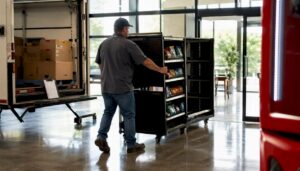
Installation for a standard vending machine or combo unit usually takes one visit, often under two hours once the site survey is done, provided a standard 110-volt outlet and roughly six feet of floor clearance are already available. Micro-market installs take longer, typically a half-day to a full day, since they involve shelving, refrigeration units, and kiosk setup.
- Site survey and proposal: the operator reviews floor plans, foot traffic, and power access, then recommends a format.
- Equipment delivery and setup: machines or micro-market fixtures are installed and connected to power and, if needed, Wi-Fi.
- Initial stocking: the operator loads a starting product mix based on the site’s employee demographics.
- Telemetry activation: remote monitoring goes live so restocking and maintenance are data-driven from day one.
- Ongoing service: restocking and maintenance continue on a schedule adjusted by real sales data.
Restocking cadence isn’t one-size-fits-all. High-traffic sites often need visits two to three times per week, while smaller break rooms might only need weekly service. Telemetry data lets the operator adjust that cadence over time instead of guessing, which cuts down on both empty machines and wasted trips.
Before your install date, have these ready:
- Certificate of insurance if your building management requires vendor documentation.
- A designated point of contact for delivery access and scheduling.
- Confirmation of electrical outlet location and any ADA clearance requirements.
- Agreed delivery windows that don’t conflict with building security protocols.
Full details on space and power prerequisites are covered in these requirements for vending machine placement.
Which Industries and Facilities Use These Services?
Vending and micro-market programs show up across a wide range of site types, but the specific needs shift depending on the sector.
- Corporate offices: value variety and healthy-option ratios that support wellness initiatives.
- K–12 schools and colleges: need nutrition labeling compliance and age-appropriate product selections.
- Hospitals and clinics: require 24/7 access since staff work around the clock, plus fast repair response.
- Government buildings: often need vendor insurance documentation and security clearance for delivery staff.
- Warehouses and industrial sites: see high SKU churn and benefit from durable, high-capacity machines.
- Fitness centers: lean toward protein-forward snacks, sports drinks, and quick-grab recovery items.
Jeeves Vending structures its no-upfront-cost equipment model and tailored product assortments around exactly this range of site types, adjusting the mix and service cadence to match what each sector actually needs rather than applying one template everywhere.
What Do Vending and Micro-Market Contracts Cost?
Most vending and micro-market arrangements use one of four pricing structures, and understanding the difference matters more than comparing headline numbers.
The commission model is the most common for full-service programs: the operator installs equipment at no cost to the host business, and revenue comes entirely from product sales to employees. A rental or lease model charges the host a flat monthly fee for equipment regardless of sales volume. A purchase-plus-service model has the host buy the machine outright and pay separately for stocking and maintenance. Hybrid arrangements blend a lower monthly fee with a smaller revenue share.
What’s typically included versus billed separately varies more than most proposals make clear:
- Installation and initial stocking are usually included at no cost under commission models.
- Card processing fees are often absorbed by the operator, but some pass a small percentage back to pricing.
- Routine maintenance is standard; emergency repairs outside business hours sometimes carry a surcharge.
- Custom product requests beyond the standard catalog may increase per-item pricing slightly.
Before comparing proposals side by side, ask each vendor these questions:
- Is there any upfront cost for equipment, installation, or removal?
- What’s the minimum contract term, and what does early cancellation cost?
- What SLA response time is guaranteed for a broken machine versus a low-stock alert?
- How often will I receive sales and inventory reports, and in what format?
- Are card processing fees built into pricing, or billed separately to the host?
You can compare Jeeves Vending’s no-upfront-cost, full-service program against any lease or purchase quote you receive to see where the real costs land.
How Do You Request a Quote or Schedule a Demo?
Getting a proposal moving is faster than most facility managers expect, but a few details up front will speed things up considerably. Before reaching out, gather:
- Approximate floor space available (dimensions, not just square footage).
- Confirmation of a nearby standard electrical outlet.
- Estimated daily employee or visitor traffic.
- Building hours of operation and any after-hours access restrictions.
- Any security or badge-access rules delivery drivers will need to follow.
A typical evaluation timeline runs two to four weeks from initial inquiry to a scheduled demo, followed by a short pilot period, often 30 to 60 days, before committing to a full rollout. During the demo or pilot, expect the operator to test an initial product mix, confirm telemetry is reporting correctly, and collect informal employee feedback on selection and pricing before locking in a permanent assortment.
Once you’re ready, the fastest next step is requesting a quote directly through Jeeves Vending’s contact page.
What Trust Signals Separate a Reliable Vending Partner From the Rest?
A handful of proof points tend to separate operators who deliver consistently from those who install a machine and disappear for months. Look for documented SLA response times in writing, not just a verbal promise, published telemetry and monitoring features rather than vague “modern technology” language, and a no-upfront-cost structure that puts the financial risk on the operator instead of your business.
That’s the practical filter worth applying before signing anything: a written case study is a start, but a phone call with a real facility manager at a comparable site tells you more in five minutes than a glossy proposal tells you in five pages. A solid case-study summary a vendor should be able to produce on request looks something like this: site type and headcount, equipment installed, restocking cadence adjustments made after the first 90 days, and any measurable change in employee satisfaction or usage. If a vendor can’t produce something close to that level of detail, that’s worth noting.
What Should You Expect From Customer Support and SLAs?
Response time commitments are the clearest indicator of how a vendor actually operates day to day, more telling than any brochure claim about “premium service.” A dependable operator puts specific numbers in the contract: same-business-day acknowledgment of a reported issue, and a defined window, often 24 to 48 hours, for resolving a non-functioning machine or a card reader that’s stopped accepting payments.
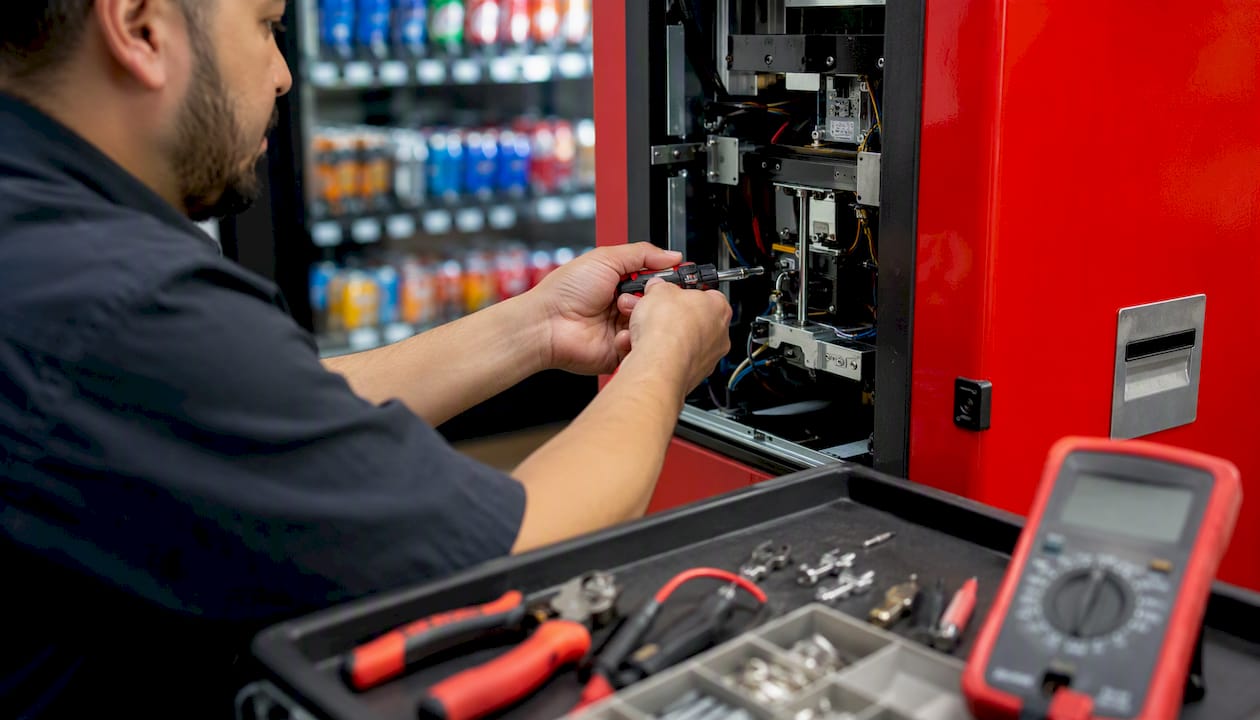
Support channels matter almost as much as speed. You want a direct phone line or dedicated account contact, not just a generic support email that routes through multiple people before reaching someone who can dispatch a technician. Ask specifically how issues get escalated: does a low-stock alert from telemetry trigger an automatic restock visit, or does someone have to notice it manually and schedule one? The answer tells you whether the operator’s systems are actually doing the work or just generating reports nobody acts on.
Reporting frequency should also be spelled out. Monthly sales and inventory summaries are standard, but a vendor with real-time telemetry should be able to give you inventory visibility whenever you ask, not just on a fixed reporting cycle.
Why We Recommend Modern Vending and Micro-Markets
I’ve watched enough facility managers get burned by vendors who install a machine, disappear for six weeks, and then act surprised when the popular snacks have been sold out the entire time. The technology gap between a legacy vending route and a modern, telemetry-driven operation isn’t cosmetic. It’s the difference between a machine that tells someone it’s running low before an employee complains, and one that sits empty until a driver happens to notice on their next scheduled stop.
What convinces me most isn’t the touchscreen or the tap-to-pay reader, though both matter. It’s the accountability those tools create. When a vendor’s system logs every restock, every service call, and every sales trend automatically, there’s no room for the vague excuses that used to be standard in this industry. For readers who want to see that model in action without wading through a dozen proposals, Jeeves Vending is a solid place to start.
Ready to Upgrade Your Break Room? Here’s How to Start
Jeeves Vending installs modern vending machines and custom micro-markets at no upfront cost to your business, which means the financial risk of a slow-selling machine or an underused micro-market sits with us, not you.
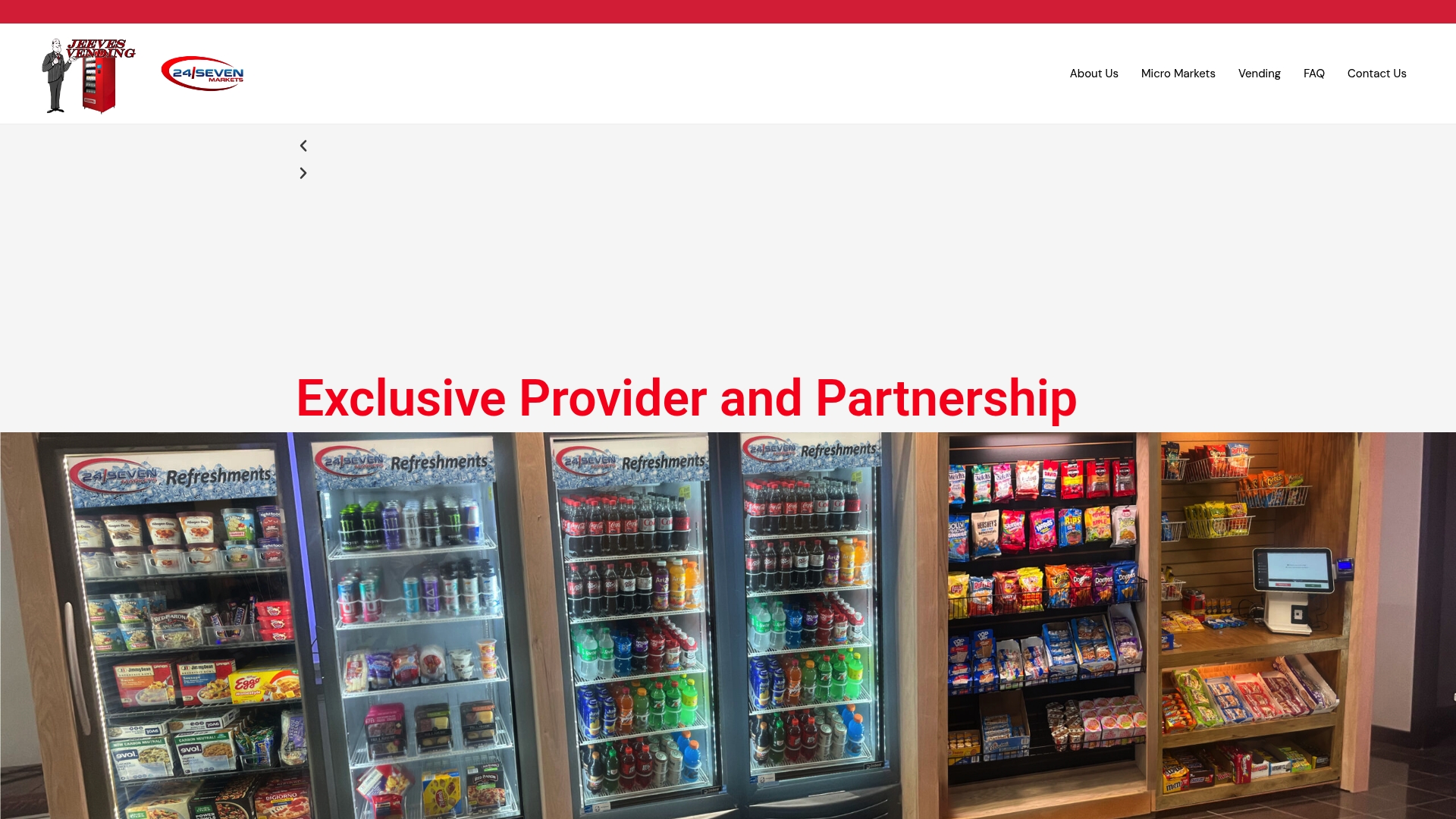
Every install comes with cashless payment support, remote inventory monitoring, and a restocking schedule that adjusts based on actual sales data rather than a fixed route calendar. If your break room still runs on a single coin-slot machine or an outdated snack wall, browse our modern vending machines and AI smart coolers to see what a current-generation setup actually looks like, or check current giveaway promotions running for new business partners. The next step is simple: request a free site walkthrough and quote through Jeeves Vending’s contact page, and we’ll tell you within days whether a vending program or a full micro-market makes more sense for your space.
Frequently Asked Questions
What does “monumental vending” actually mean for my business?
It refers to the shift toward larger-capacity machines, wider product assortments, and micro-market formats, rather than a specific brand or product line. The goal is matching your building’s traffic and space to the right format.
Does it cost anything to install a vending machine or micro-market?
Under a commission-based, full-service model like the one Jeeves Vending offers, equipment installation carries no upfront cost to your business. Revenue comes from product sales, not fees charged to the host.
How long does installation take?
Standard vending machines typically install in under two hours once a site survey is complete. Micro-markets, with shelving, refrigeration, and kiosk setup, usually take a half-day to a full day.
What if a machine breaks down after hours?
A dependable operator commits to a written SLA, typically same-business-day acknowledgment and a 24-to-48-hour resolution window, regardless of when the issue is reported.
Can I cancel if the service doesn’t work out?
Cancellation terms vary by vendor and contract type, so confirm the minimum term and any early cancellation costs before signing. Ask this question directly during the proposal stage rather than assuming standard terms apply.
Sources
- Walmart Built a Giant Vending Machine for Groceries – Business Insider
- Walmart Rolling Out More Giant Order-Fulfillment Vending Machines
- Candymachines