
Parents rarely hold formal veto power over school vending contracts. Approval authority in U.S. K–12 districts typically rests with the principal for day-to-day product decisions, the district business or auxiliary services office for contract negotiations, and the school board when contract values exceed procurement thresholds or when board policy explicitly requires it. Parental involvement in the parent approval process for school vending is real and important, but it almost always takes the form of notification or wellness-committee consultation rather than a binding vote.
Before you do anything else, pull three documents: your district’s vending policy (often numbered 720 or equivalent), your local wellness policy, and your state’s procurement threshold schedule. Also check whether your state has a blind-vendor right-of-first-refusal law, because those statutes can override a competitive bidding process entirely.
- District vending policy (e.g., Policy 720): defines who approves, revenue rules, and board-approval triggers
- Local wellness policy: sets nutrition standards that may be stricter than federal Smart Snacks
- Procurement threshold schedule: determines whether you need sealed bids, two quotes, or a sole-source justification
- State blind-vendor law: may require offering placement rights to licensed blind vendors before opening to commercial bidders
Pro Tip: Route your initial request to the district business or auxiliary services office on day one. They know the procurement thresholds, contract templates, and board-submission calendar. Starting there saves weeks of back-and-forth.
Key Takeaways
The parent approval process for school vending is a stakeholder-management and compliance exercise: parents are consulted, not contracted; the school board holds final authority in most districts; and federal Smart Snacks plus FDA calorie labeling set the product floor.
| Point | Details |
|---|---|
| Who holds final approval | The school board approves vending contracts in most districts; principals manage day-to-day product and hours decisions. |
| Parent role | Parents receive notification and wellness-committee consultation; formal consent is required only for specific program designs like student behavior contracts. |
| Federal compliance floor | All student-facing products must meet USDA Smart Snacks standards; FDA calorie labeling applies to operators with 20 or more machines. |
| Contract and procurement | Contracts above your district’s sealed-bid threshold require a formal competitive process and board approval before signing. |
| Jeeves Vending | Provides Dallas-Denton schools with compliant vending at no upfront cost, including site assessment, Smart Snacks-verified product lists, and reporting for district accounting. |
Table of Contents
- What does the parent approval process for school vending actually look like?
- Who has authority to approve what?
- What nutrition and labeling rules apply?
- How should you involve parents and build their support?
- What should vendor contracts include?
- Placement, hours, and daily operations
- Sample policy language and proposal templates
- How to handle objections from parents and staff
- A practical note on what actually moves approvals forward
- Jeeves Vending makes compliant school vending programs easier to launch
- Sources
What does the parent approval process for school vending actually look like?
The process moves through six stages, each with its own decision-maker and timeline. Here is the sequence most U.S. districts follow.
-
Identify the need and check policy (Week 1). Confirm the location, intended users (students, staff, or both), and hours. Pull your district vending policy and wellness policy. Verify whether the site is elementary, middle, or high school — some districts prohibit student-facing machines in elementary buildings entirely.
-
Prepare the proposal (Weeks 1–2). Assemble: a one-page project summary, proposed location map, product list with Smart Snacks compliance evidence, facilities checklist and requested approval timeline. This packet goes to the principal first, then routes upward.
-
Internal routing (Weeks 2–5). The principal reviews and signs off on site supervision and product appropriateness. The business or auxiliary services office reviews contract terms and procurement method. Legal counsel reviews if the contract deviates from the district’s standard form. Food services confirms no conflict with the meal program.
-
Procurement (Weeks 3–12, depending on method). If estimated annual receipts exceed your district’s sealed-bid threshold, issue a formal Request for Proposals or sealed bid. Competitive bid processes typically run 4–12 weeks. Smaller contracts may qualify for a two-quote process or a sole-source exception with written justification. Keep all procurement records on file.
-
Board approval (next board meeting after procurement). Most district policies require the school board to approve vending contracts. Princeton School District 477’s Policy 720 is a clear example: it places contract approval with the board and requires that vending income be used for educational purposes and reported to the business office. Submit your full packet to the board agenda at least two weeks before the meeting.
-
Installation and pilot (Weeks 12–16+). After board approval, schedule the facilities sign-off, electrical assessment, ADA clearance, and vendor site visit. Run a 30–60 day pilot with a defined compliance check before declaring the program permanent.
Parallel track: parent notification. Send family notification 2–4 weeks before the board vote, not after. Wellness-committee briefing should happen during the proposal stage, not at the end.
Who has authority to approve what?
Knowing who signs what prevents the most common delay: routing a decision to someone who cannot legally make it.
-
Principal: Day-to-day supervision, product approvals for student-facing machines, and hours of operation are typically the principal’s domain. The principal also sets timer schedules to prevent cafeteria competition and handles incident reporting.
-
District business/auxiliary services office: Negotiates contract terms, manages revenue accounting, ensures procurement compliance, and routes contracts to legal. Centralized coordination through this office reduces unauthorized vending and simplifies compliance checks. At the university level, the University of South Carolina’s BUSA 3.09 policy illustrates this well: all departments must coordinate through a designated office, and unauthorized vending operations are prohibited.
-
School board/superintendent: Required for contract approval in most districts when procurement thresholds are met or when board policy explicitly mandates it. Administrators who sign unauthorized contracts face potential personal liability; Princeton District 477’s policy language explicitly states that unauthorized contracts are void.
-
Food service director: Confirms that proposed machines and hours do not undercut the cafeteria meal program. This is a consultation role, not a veto, but food services sign-off is standard before board submission.
-
Vendor: Responsible for maintaining machines, keeping calorie-labeling signage current, carrying required insurance, and complying with all contract clauses. The vendor does not hold approval authority but must provide compliance documentation before installation.
-
Legal counsel: Reviews contracts that deviate from the district’s standard form. The UT System’s UTS 130 policy requires legal review and Board of Regents approval for any vending contract that deviates from the standard form, and mandates submitting executed contracts to the Texas Comptroller with location details. K–12 districts follow similar logic at a smaller scale.
Pro Tip: Build a one-page stakeholder map listing each role, what they sign, and what they consult on. Attach it to your proposal packet. Board members and business-office staff will appreciate the clarity, and it signals that you have done your homework.
What nutrition and labeling rules apply?
Federal law sets the floor; state and local policy often raises it significantly.
USDA Smart Snacks in School is the federal baseline for all foods and beverages sold to students during the school day. Products must meet calorie, fat, sodium, and sugar limits. Smart Snacks compliance is necessary but not always sufficient. Many states maintain their own approved-product lists, and a product that passes the federal standard may still fail state review. Always verify against your state’s list before finalizing the product lineup. Vendors and administrators must check product codes against state-approved lists because Smart Snacks compliance alone does not guarantee state-level approval.
FDA calorie labeling rule requires vending machine operators with 20 or more machines to display calorie counts for each item. The label must be visible before the purchase is made. As the operator of record, your district or the vendor (depending on contract language) is responsible for keeping signage current when products change.
State and local wellness policy variations are where administrators most often get caught. Connecticut’s guidance, for example, requires districts to verify products against an approved list, refuse noncompliant deliveries, and train staff to check shipments to maintain child nutrition program eligibility. Your state may have an equivalent requirement.
Common exemptions:
- Staff-only machines are generally exempt from Smart Snacks but must still comply with FDA calorie labeling if the operator threshold applies.
- After-school-only access (machines locked during the school day) may qualify for an exemption, but the machine must be physically inaccessible to students during school hours.
- Off-campus sales and parent-only purchases fall outside the school-day rule.
Operational controls to enforce compliance:
- Verify every product on delivery against the approved list; refuse substitutions.
- Include a non-substitution clause in the vendor contract.
- Schedule quarterly product audits with written records.
| Regulation | What it requires | Typical enforcement body |
|---|---|---|
| USDA Smart Snacks in School | Calorie, fat, sodium, sugar limits for student-facing sales during school day | USDA / state child nutrition agency |
| FDA calorie labeling rule | Visible calorie count per item before purchase; applies to operators with 20+ machines | FDA / state health department |
| State approved-product list | Products must appear on state list; noncompliant items refused on delivery | State education/nutrition agency |
| Local wellness policy | May impose stricter nutrient standards or ban certain product categories | District wellness committee / school board |
| Staff-only machine exemption | Exempt from Smart Snacks; FDA labeling still applies at operator threshold | District administration |
How should you involve parents and build their support?
Parent involvement in vending decisions falls into three distinct levels, and conflating them creates unnecessary friction.
Notification is the baseline. Parents receive information about the program: what machines will be installed, where, what products will be sold, and what hours the machines will operate. This is not a vote. Send notification 2–4 weeks before the board meeting via the school newsletter, a targeted family email, and a brief post on the school’s parent portal.
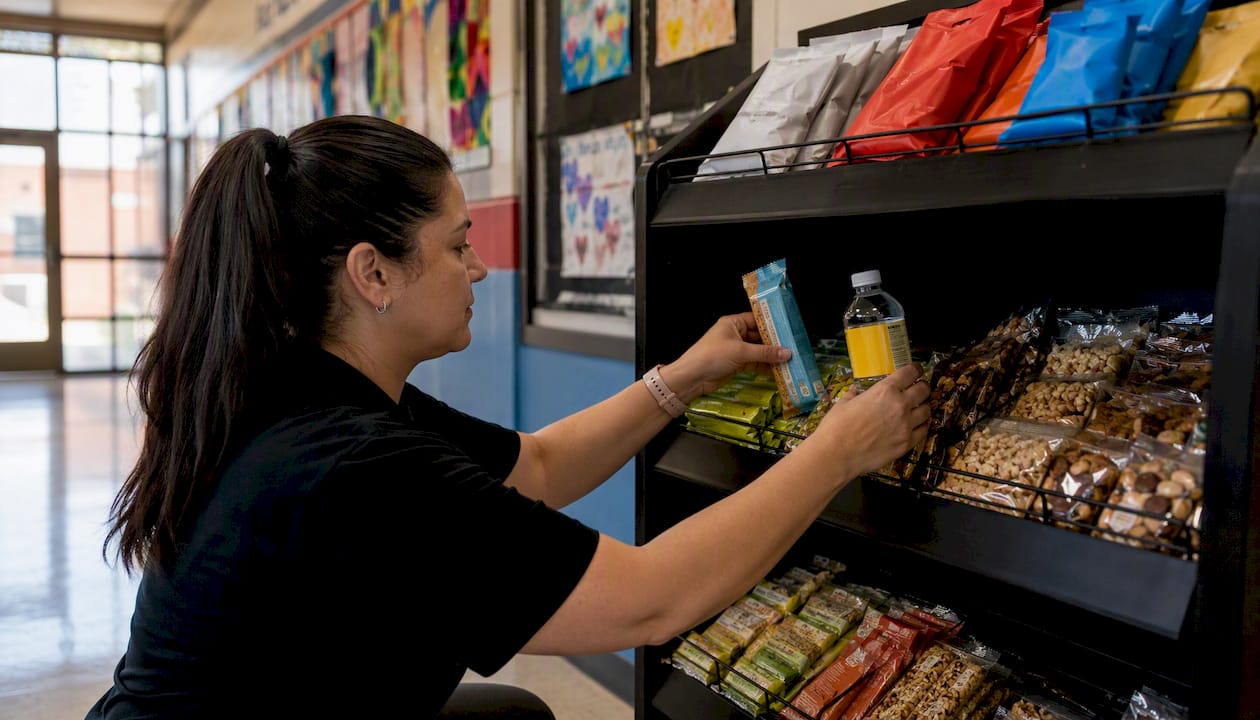
Consultation goes further. The wellness committee, which typically includes parent representatives, reviews the proposal and provides feedback before the board vote. Here you gather input on product selection, hours, and pricing. Wellness-committee sign-off carries real weight with boards and reduces the chance of a public objection derailing the vote.
Targeted consent is rare and applies to specific program designs. One strong model: require students to complete a short video lesson at home with a parent and sign a behavior contract before being authorized to use student-facing machines. Bridges Middle School’s healthy vending program used exactly this approach, pairing mandatory at-home video lessons with a signed student contract to build parent buy-in and enforce behavior rules. This converts the installation into a community-supported wellness initiative rather than a top-down decision.
Sample notification text administrators can adapt:
Family-facing FAQ to pre-empt concerns:
- Will students be able to buy junk food? No. All products must meet federal nutrition standards, and the product list is reviewed before installation.
- Can my child spend too much money? Machines can be configured with daily purchase limits. A parent-student contract can also set household spending rules.
- Will this hurt the cafeteria? Machines will be locked during breakfast and lunch periods.
Escalation flow if opposition concentrates:
- Wellness committee review with written response to objections
- Superintendent briefing with summary of feedback and proposed modifications
- Board public comment period before the vote
- Administrative remedies: pilot suspension, modified product list, or restricted hours
Pro Tip: Present the wellness committee with a draft product list and ask for their edits before you finalize it. Giving parents co-ownership of the product selection is the single fastest way to convert skeptics into supporters.
What should vendor contracts include?
Treat vending agreements as formal business contracts. They often need coordination with facilities, legal, and procurement offices to avoid liability and compliance gaps.
Must-have contract clauses:
- Product-compliance warranty: vendor certifies all products meet Smart Snacks and applicable state standards at delivery
- Non-substitution clause: vendor may not swap approved products without written district approval; Connecticut’s state guidance makes this a legal requirement for districts participating in child nutrition programs
- Delivery and inspection rights: district may inspect shipments and reject noncompliant products
- Maintenance SLA: response time for repairs, restocking frequency, and machine downtime limits
- Liability and insurance: vendor carries general liability and names the district as additional insured
- ADA and energy-efficiency compliance: refrigerated units must meet applicable energy standards; Leon County’s facility policy requires written contracts to include removal and maintenance clauses alongside electrical and energy-efficiency verification
- Termination and removal clause: district may remove noncompliant machines with written notice; vendor removes equipment within a defined period
- Audit and revenue-reporting requirements: vendor provides monthly or quarterly sales reports; district reconciles against deposits
Procurement thresholds:
When estimated annual receipts exceed your district’s sealed-bid threshold, a formal competitive process is required. Minnesota’s ISD 624 Policy 720 illustrates the pattern: sealed bids are required when estimated receipts exceed specified thresholds, and procurement records must be kept on file. Many districts set this threshold around a high aggregate contract value, though the exact figure varies by state law and district policy.
| Estimated contract value | Typical procurement path | Board approval required? |
|---|---|---|
| Below informal threshold | Two written quotes, principal/business-office approval | Often not required |
| Informal to formal threshold | Formal RFQ or small-purchase procedures | Depends on district policy |
| Above formal threshold | Sealed bid or RFP, full competitive process | Yes, in most districts |
| Sole-source exception | Written justification, legal review | Yes |
Revenue accounting: Vending receipts are school funds and must be recorded in the district’s accounting system. Most board policies restrict use to educational purposes. The business office reconciles vendor sales reports against actual deposits on a schedule defined in the contract.
Numbered approval routing:
- Business/auxiliary services reviews contract terms and procurement method
- Legal counsel reviews for deviations from standard form
- Food services confirms no meal-program conflict
- Superintendent endorses for board submission
- School board votes to approve or deny
Placement, hours, and daily operations
Getting the machine approved is one thing. Running it without creating safety, revenue, or compliance problems is another.
Placement rules:
- Avoid narrow corridors; maintain clear sight lines for supervision
- Provide trash receptacles within reach of the machine
- Maintain ADA-required clearance (typically 60 inches of turning radius and accessible reach range)
- Get fire marshal and facilities sign-off before installation; Leon County’s policy requires facilities review for electrical verification, anchoring, and security before any machine goes live
- Review vending machine placement requirements for a facility-level checklist covering ADA and electrical specifics
Electrical and equipment requirements:
- Grounded outlets; vendor is responsible for circuit installation when the existing panel cannot support the load
- Refrigerated units must meet applicable energy-efficiency standards
- Power cords must be secured to prevent tampering or tripping hazards
Hours of operation: Program timers to lock machines during breakfast and lunch periods. District policy documents consistently assign this responsibility to the principal or designated administrator. Timers also reduce after-hours theft.
Daily supervision:
- Designate a staff member to check machines at the start and end of each school day
- Post a refund procedure and contact number on or near the machine
- Report vandalism or theft to administration and the vendor within 24 hours
- Conduct monthly product checks to catch unauthorized substitutions early
Maintenance and emergency removal: The vendor contract must specify response time for repairs (typically 24–48 hours for a non-functioning machine). The district retains authority to remove any machine that fails a compliance check, poses a safety risk, or violates contract terms, with written notice to the vendor.
Pro Tip: For staff-only vending, keep a separate inventory list distinct from student-facing machines. This simplifies compliance audits because staff machines operate under different product rules, and mixing the two lists creates confusion during inspections.
Sample policy language and proposal templates
Authority clause (adapt for your board policy):
Product-approval clause:
Hours-of-operation clause:
Revenue-handling language:
Concise proposal template:
- Project summary (one paragraph: location, users, hours, estimated annual receipts)
- Location map with ADA clearance dimensions marked
- Product list with Smart Snacks compliance evidence for each item
- Procurement method and justification (competitive bid, two-quote, or sole-source)
- Revenue forecast and proposed use of funds
- Facilities checklist (electrical, ADA, fire marshal sign-off status)
- Parent notification plan and wellness-committee briefing date
- Requested approvals and timeline
Board packet presentation tips:
- Lead with compliance: show Smart Snacks alignment and state list verification upfront
- State the revenue use clearly and tie it to a specific educational purpose
- Include the parent notification plan and any wellness-committee feedback
- Attach the vendor’s insurance certificate and a sample maintenance SLA
- Keep the packet under 10 pages; attach supporting documents as exhibits
How to handle objections from parents and staff
Most opposition to school vending concentrates around four concerns: nutrition quality, student spending behavior, cafeteria competition, and equity. Each has a direct, evidence-based response.
Common objections and tactical responses:
- “The food will be unhealthy.” Show the product list with Smart Snacks compliance evidence. Offer to let the wellness committee review and edit the list before finalization.
- “Students will spend their lunch money on snacks.” Explain the timer policy that locks machines during meal periods. Describe the parent-student contract option that sets household spending rules.
- “This will hurt cafeteria participation.” Present the hours-of-operation plan showing machines are off during breakfast and lunch. Note that board policy typically prohibits vending from competing with the meal program.
- “Not all students can afford to use the machines.” Acknowledge the concern. Propose pricing that keeps items accessible, and note that vending revenue can fund programs that benefit all students.
Formal escalation path:
- Respond to written objections in writing within five business days
- Schedule a wellness committee review with a summary of objections and proposed modifications
- Brief the superintendent before the board meeting with a written summary of community feedback
- Allow public comment at the board meeting; have a modified product list or restricted-hours option ready as a fallback
- If opposition is sustained, propose a 30-day pilot with a parent feedback survey before full approval
Sample email response blurb:
A practical note on what actually moves approvals forward
The administrators who get vending programs approved quickly share one habit: they do the parent outreach before the board packet is submitted, not after. Showing up to a board meeting with a signed wellness-committee recommendation and a documented parent notification process is a fundamentally different presentation than asking the board to approve something the community has not heard about yet.
Pre-approval product vetting is the other underrated step. Bringing a draft product list to the wellness committee and asking for their edits costs two weeks and saves months of post-approval controversy. Parents who helped choose the products do not show up at board meetings to oppose them.
One operational trick that consistently reduces pushback: use timed access to separate staff and student machine availability. When parents see that the machine is physically inaccessible during the school day and that staff have a separate inventory, the “junk food in school” objection loses most of its force. Jeeves Vending’s installation process includes a site assessment that maps timer configurations and placement to your specific building layout, which makes this kind of differentiated access straightforward to implement from day one.
Jeeves Vending makes compliant school vending programs easier to launch
Running a school vending program that clears every approval hurdle, from the wellness committee to the board packet, requires more than a machine and a product list. It requires documentation, compliance verification, and a vendor who understands what administrators actually need to present.
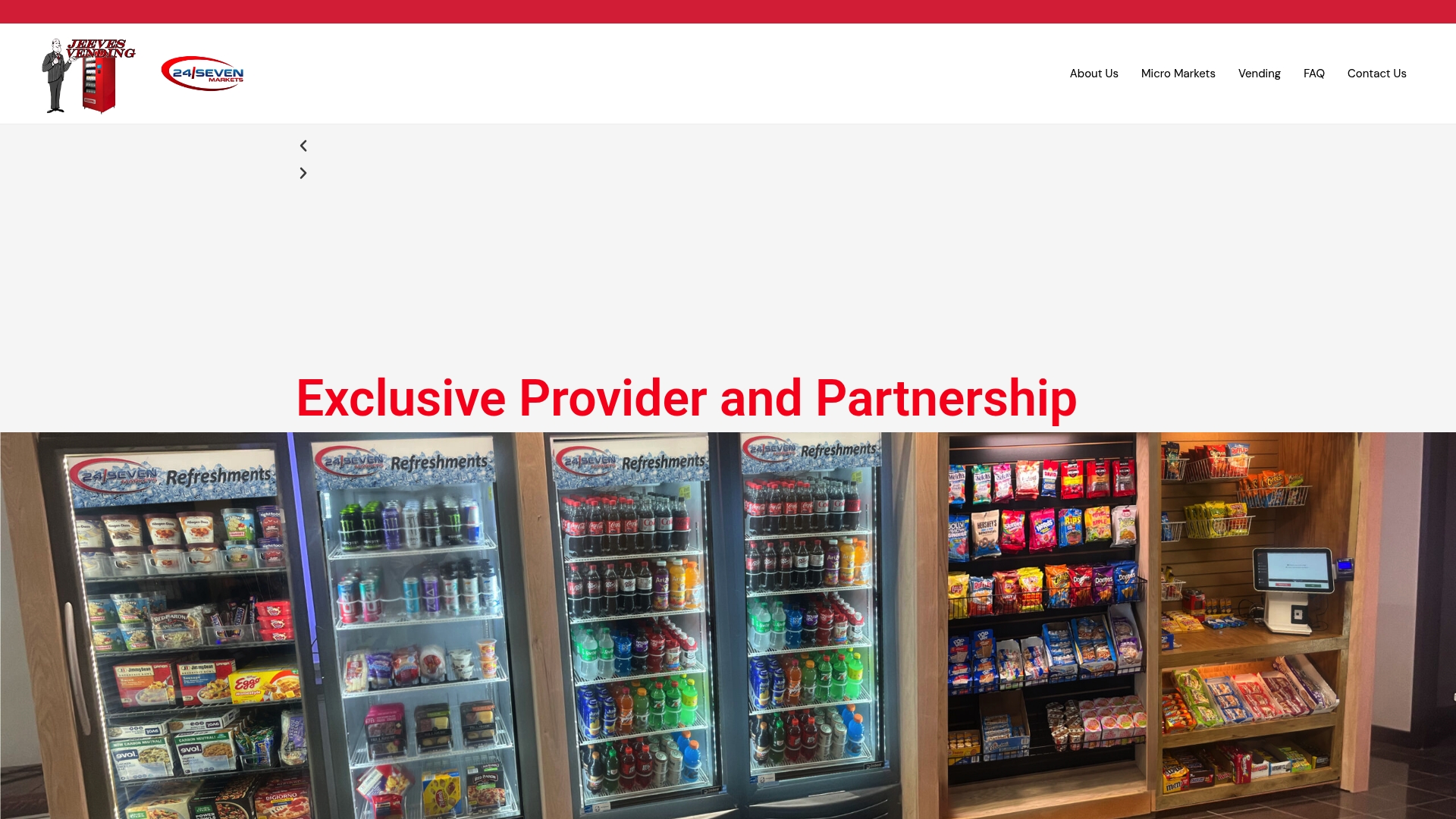
Jeeves Vending provides schools in the Dallas-Denton region with compliant vending solutions at no upfront cost to the district. The service includes a site assessment that maps ADA clearance, electrical requirements, and timer configurations; a contract-ready product list verified against Smart Snacks standards; installation and ongoing maintenance; and sales reporting formatted for district accounting reconciliation. For boards that want a low-risk entry point, Jeeves Vending can support a structured 30–60 day pilot with compliance checks and a parent feedback survey built in.
Contract documents still route through your business office and legal counsel. Jeeves Vending supports the paperwork and provides the compliance documentation your district needs, but the district signs. To request a site assessment or get a compliance checklist for your board packet, contact Jeeves Vending directly.
Sources
Every document below is publicly available and directly relevant to the approval process.
- Policy 720 – Vending Machines – Princeton School District 477
- UTS 130 Vending Machine Contracts | The University of Texas System
- BUSA 3.09 University Vending Services
- Vending machine installation and facility requirements — Leon County policy
- Requirements for Foods and Beverages in Vending Machines in HFC Public Schools (CT SDE)