
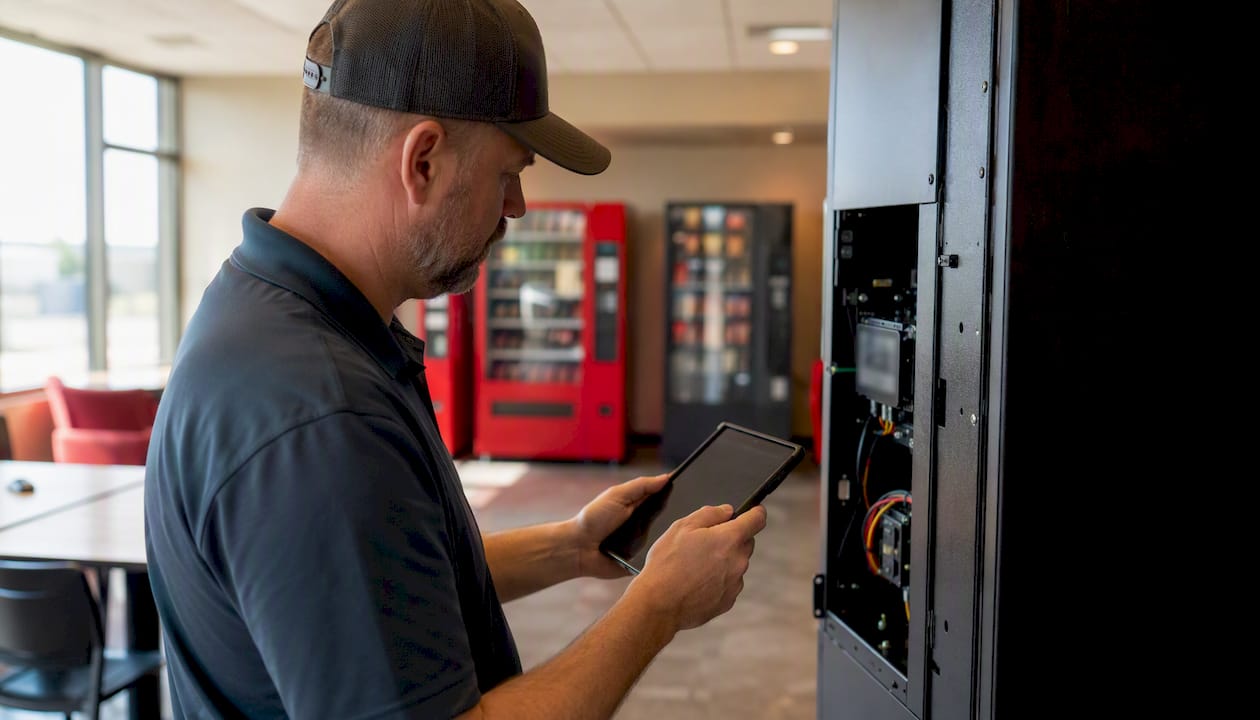
Vending uptime is guaranteed by four systems working together: continuous telemetry, demand-driven restocking, preventive maintenance and contractual service-level agreements with enforceable remedies. Remove any one of those, and machines start going dark, and nobody notices until an employee complains. That is the core failure mode facility managers need to design against.
Before signing with any vending or micro-market partner, require proof of these controls, not promises about them:
- Live telemetry on every machine, reporting stock levels, error codes and payment status in near real time.
- Documented par levels and restock cadence, so machines never run out of the products people actually buy.
- A written MTTR SLA (mean time to repair) with specific hour targets by fault severity.
- A spare-machine and parts plan for when hardware fails outright, not just when it’s low on chips.
Ask for evidence, not assurances: historic uptime percentages by machine, sample fault-alert logs, and fill-rate reports from the last quarter. A partner that can’t produce those numbers on request probably isn’t tracking them, which means they can’t fix what they can’t see.
Key Takeaways
Guaranteed vending uptime depends on telemetry, disciplined restocking, preventive maintenance and enforceable SLAs working together, not any single fix.
| Point | Details |
|---|---|
| Require telemetry access | Insist on live fault alerts, slot-level inventory data, and dashboard or raw log access for every machine. |
| Set enforceable SLA numbers | Contract for uptime %, MTTR by severity, fill rate targets, and response-time windows in writing. |
| Demand contingency coverage | Require local spare machines, stocked replacement parts, and defined emergency restock windows. |
| Validate performance regularly | Reconcile telemetry sales against deposits and audit SLA compliance quarterly, not annually. |
| Jeeves Vending applies this model | Jeeves Vending combines remote stock monitoring, demand-driven routing and preventive maintenance across its Dallas-Denton installations at no cost to the host business. |
Table of Contents
- How Vending Uptime Is Guaranteed Through Telemetry and Diagnostics
- What Keeps Machines Stocked Day to Day?
- What SLA Terms Should Be in Your Vending Contract?
- Contingency Plans When Equipment Fails
- A Quick Checklist Before You Sign a Vending Contract
- Do Hospitals, Schools and Gyms Need Different Uptime Rules?
- How Do You Track Whether a Vendor Is Actually Delivering?
- How Jeeves Vending Applies These Uptime Systems in Practice
- What Field Operations Actually Teaches About Vending Reliability
- Want a Vending Partner That Already Runs This System?
- Frequently Asked Questions
- Sources
How Vending Uptime Is Guaranteed Through Telemetry and Diagnostics
Uptime starts with data, not drivers. Modern vending machines use DEX (Data Exchange) and MDB (Multi-Drop Bus) protocols to report slot-level sales, cash versus cashless totals, error states and inventory counts almost as they happen. Add a cellular telemetry module, and that data leaves the machine and lands on a dashboard someone actually monitors.
The hardware isn’t expensive relative to what it prevents. A cellular telemetry module typically runs $150 to $300 one-time, with $5 to $10 per month in data plan fees per machine. That’s a small line item against the cost of a machine sitting empty for a week because nobody knew the chip slot ran dry on Tuesday.
What should you actually ask to see?
- Live fault alerts for card reader failures, jammed coils and temperature swings in refrigerated units.
- Slot-level inventory counts, not just a general “low stock” flag.
- Last successful vend timestamp per slot, which tells you exactly how stale a machine’s data is.
- Raw log access or a dashboard, not a monthly PDF summary that arrives two weeks late.
This is where the industry’s thinking has shifted. Telemetry turns uptime into a measurable service metric instead of a vague promise, because a card-reader fault or low-stock condition triggers an alert before an employee ever notices a broken machine. That’s remote diagnostics doing its job: a technician can often tell whether a fix needs a truck roll or a software reset before anyone leaves the depot.
Pro Tip: Ask your vendor how often telemetry data refreshes. A feed that updates every 15 minutes is far more useful than one that syncs once a day, especially for payment failures that can silently kill sales for hours.
What Keeps Machines Stocked Day to Day?
Telemetry only matters if it changes what happens on the ground. That means par levels, pre-kitting, and route logic built around real demand instead of a fixed weekly loop.
Par level is the quantity you keep stocked per slot, and it should sit at roughly 30 to 40 percent of slot capacity for most items. Set it too low and popular snacks sell out mid-week; set it too high and you’re rotting perishables in a machine nobody’s watching. Par levels also need to be set per machine, not fleet-wide. A break room machine near a call center behaves nothing like one in a warehouse loading dock.
Pre-kitting takes that data and turns it into faster service visits. Overnight, route planners pull that day’s telemetry and pre-pick totes for each stop, so a technician arrives with exactly what a machine needs instead of guessing from memory. This single change is what lets one driver service more machines per day without cutting corners on quality.
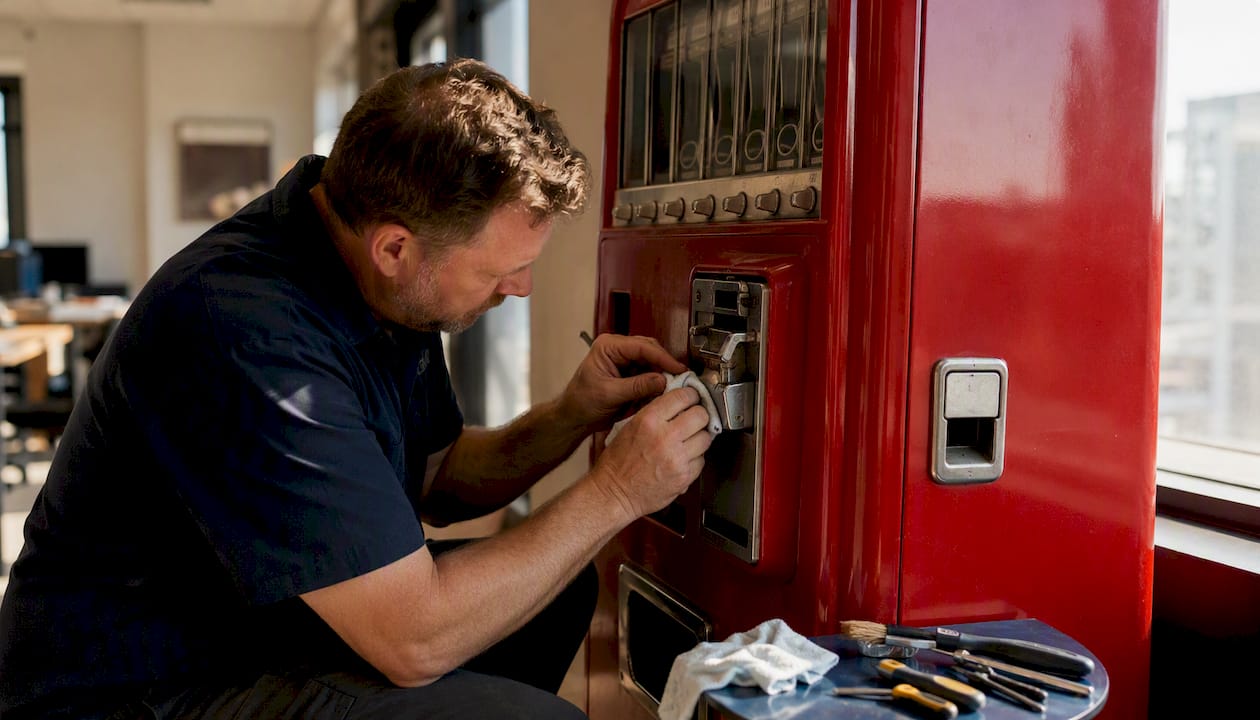
Preventive maintenance rounds out the daily discipline: cleaning bill validators so cash doesn’t jam, inspecting coils for wear, checking refrigeration temperatures on perishable units, and testing card readers on a fixed schedule rather than waiting for a complaint.
| Operational Task | Typical Cadence | Why It Matters |
|---|---|---|
| Par-level review | Monthly, per machine | Adjusts stock levels to actual sales velocity |
| Bill validator cleaning | Every 2 weeks | Prevents jams that block all cash sales |
| Refrigeration temp check | Weekly | Protects perishable inventory and food safety |
| Card reader diagnostics | Continuous via telemetry | Flags payment failures before they cost sales |
| Depot inventory reconciliation | Weekly | Ties warehouse stock to route demand, prevents shortages |
Behind all of it sits the depot: barcode-tracked inventory and FIFO rotation so nothing expires on a shelf while a driver runs low on a bestseller two stops away. Demand-driven routing that mixes telemetry on high-variability machines with scheduled visits on stable ones is the most cost-effective way to run this without paying for sensors everywhere.
What SLA Terms Should Be in Your Vending Contract?
A verbal promise of “we’ll keep it running” isn’t a guarantee. A guarantee is a number in a contract with a remedy attached when the number isn’t hit. Here’s what belongs in an RFP or service agreement:
- Uptime percentage, tracked by machine, not fleet average, since one broken vendor can hide behind nine working ones.
- Fill rate / inventory accuracy, especially for high-turn SKUs.
- Mean time to repair (MTTR), split by severity: a jammed coil versus a dead compressor should have different clocks.
- Response time, the hours between a fault alert and a technician being dispatched.
- Reporting cadence, spelling out exactly when and how data reaches you.
Reasonable targets to request: 98 percent or better uptime per machine, MTTR within 24 to 72 hours depending on fault severity, and a fill rate above 95 percent on your top-selling items. If a proposal doesn’t include numbers like these, that’s a gap worth pushing on before you sign anything.
Contracts also need remedies. Service credits for missed uptime targets, a defined escalation path when a fault isn’t resolved on schedule, and a requirement that the vendor supply telemetry or alert-history logs to back up any dispute. Without supporting logs, an uptime claim is just an assertion. Dashboard access with raw log export is what lets you audit performance instead of taking someone’s word for it.
Contingency Plans When Equipment Fails
Even with tight telemetry and disciplined routes, hardware breaks. What separates a reliable partner from a risky one is what happens in the hours after that failure.
- Local spare machines or rapid swap units that can replace a dead vendor same-day rather than leaving a location empty for a week.
- Stocked replacement parts: bill validators, coin mechs, coils, and card readers, kept on hand rather than special-ordered after a breakdown.
- Emergency restock windows separate from routine cadence, for sudden demand spikes like a company event or an unusually hot week driving drink sales.
- Redundant payment peripherals, so a single card-reader failure doesn’t take an entire machine offline for cash-only customers.
Local depots matter more than they get credit for. A vendor working out of a warehouse two hours away can’t hit a same-day swap commitment no matter what the contract says. Proximity is part of the guarantee, not a footnote.
A Quick Checklist Before You Sign a Vending Contract
Print this, paste it into your RFP, or hand it to whoever’s running the vendor comparison.
- Does every machine have telemetry, and can you get direct dashboard or log access?
- What’s the alert SLA between a fault occurring and a technician being notified?
- How are par levels set, and are they reviewed per machine or fleet-wide?
- Is pre-kitting part of the route process, or are technicians restocking from memory?
- What’s the preventive maintenance schedule, in writing, not verbally described?
- Are technicians background-checked, particularly for school, hospital or gym sites?
- What are the uptime %, fill rate and MTTR targets, and what happens contractually if they’re missed?
- Is there a same-day or next-day emergency swap policy for total machine failure?
- Can the vendor produce historic performance logs, not just a sales pitch deck?
Weight these three ways: technical criteria (telemetry, data access) should carry roughly a third of your scoring, operational process (par levels, maintenance, staffing) another third, and contractual enforceability (SLA numbers, remedies, reporting) the final third. A vendor that’s strong on hardware but vague on contractual remedies is still a risk.
Do Hospitals, Schools and Gyms Need Different Uptime Rules?
Not every site has the same tolerance for downtime, and a good partner adjusts service design accordingly rather than running one generic playbook everywhere.
Hospitals need faster restock cycles and stricter temperature monitoring, since staff working odd shifts often depend on vending for meals when the cafeteria is closed, and food-safety documentation isn’t optional. Fast restocking in hospital settings is a distinct service tier, not an upgrade.
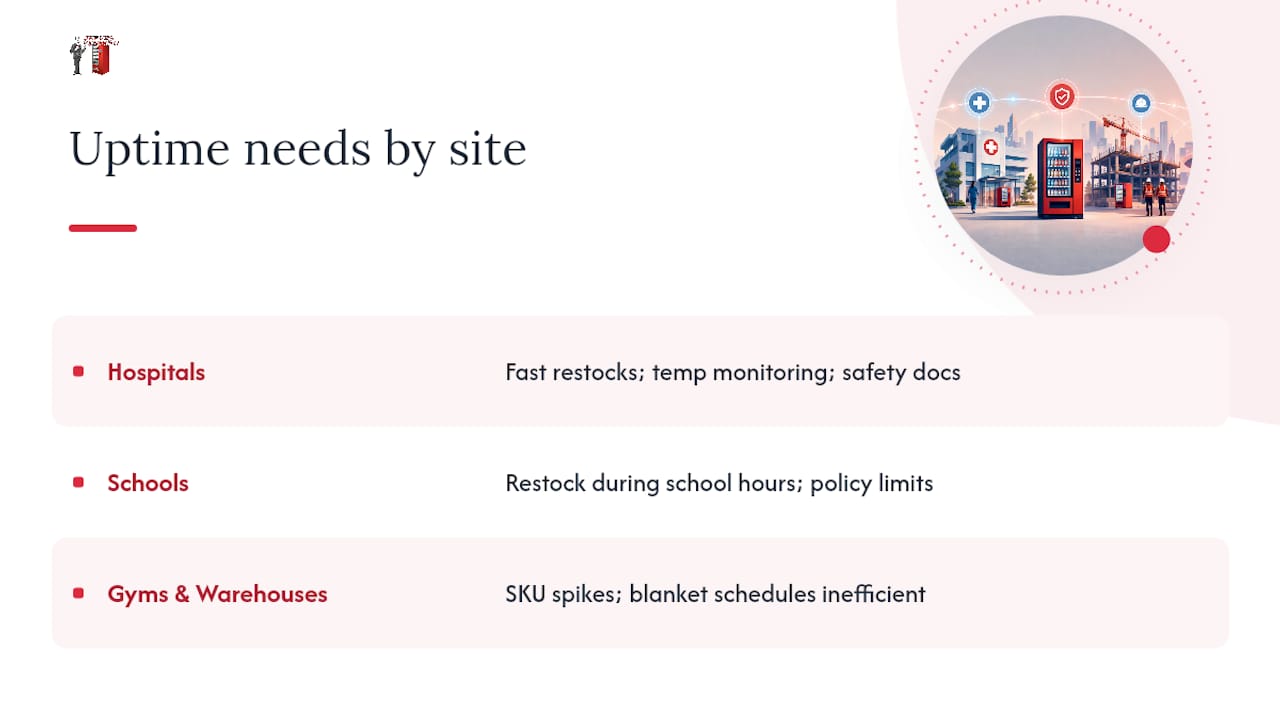
Schools run on a different clock entirely. Restocks need to happen around school hours to avoid disrupting classes, and product placement and cadence has to respect district policy on what can be sold and when. Age-appropriate options aren’t a nice-to-have; they’re often a compliance requirement.
Gyms and warehouses see brutal spikes on specific SKUs: protein bars and sports drinks empty out fast while snack slots barely move. Blanket restock schedules waste a driver’s time on slots that don’t need it and starve the ones that do.
Access windows and security protocols change everything about route planning. A hospital may require badge access and off-peak service hours; a school may lock vending areas outside specific times. Both push MTTR expectations up, because a technician can’t just walk in and fix a jam at 2 p.m. on a Tuesday.
How Do You Track Whether a Vendor Is Actually Delivering?
Measurement is where most facility managers lose the thread. They sign a contract with good SLA language, then never check whether the numbers are being hit.
Collect four data streams on an ongoing basis: telemetry uptime logs per machine, slot-level fill counts, MTTR and response-time logs, and a reconciliation of telemetry-reported sales against actual cash and card deposits. That last one catches discrepancies that pure uptime numbers miss entirely.
| Reporting Interval | What to Review | Red Flag |
|---|---|---|
| Weekly | Fill-rate rollups per machine | Any machine below 90% for two straight weeks |
| Monthly | Uptime % by machine | Sustained drop below the contracted target |
| Quarterly | Full SLA audit against contract terms | Repeated MTTR misses with no remedy applied |
Validate claims instead of accepting a summary at face value. Spot-check raw logs occasionally, and reconcile a sample of telemetry sales data against actual deposit manifests. If a vendor resists giving you that access, treat it as a signal, not an inconvenience. When KPIs slip below threshold for two consecutive reporting periods, that’s the trigger to invoke escalation clauses and service credits, not to wait and see if it improves on its own.
How Jeeves Vending Applies These Uptime Systems in Practice
Jeeves Vending builds its service model around the same controls covered above: remote stock monitoring, demand-driven route planning, scheduled preventive maintenance, and documented service expectations rather than informal check-ins.
For hospitals specifically, Jeeves structures faster restock cycles to match the round-the-clock demand of shift-based staff, and schools get restocking scheduled around class hours rather than a one-size-fits-all route. The underlying machine technology and remote monitoring approach is documented on Jeeves’ own site, which is exactly what a facility manager should ask any prospective partner for before signing anything.
Ask to see the dashboard, not just hear about it. A partner confident in their uptime numbers will show you live data, sample SLA language and their emergency swap policy in the first conversation, not after three follow-up emails.
If you’re comparing vendors, request the same documentation from each: uptime history, sample fault logs, and a written emergency-swap timeline. Jeeves’ service model page outlines what a no-cost installation and ongoing support arrangement looks like, which gives you a baseline to measure other proposals against.
What Field Operations Actually Teaches About Vending Reliability
Most uptime failures aren’t dramatic. They’re not compressor fires or vandalism. They’re a card reader quietly failing on a Thursday and nobody noticing until Monday, because no one was watching the feed.
If you take one thing from vetting a vending partner, make it this: insist on live alerts before you worry about anything else. A vendor with mediocre routing but real-time fault notifications will outperform one with a beautiful truck schedule and no telemetry, every time. Ask to sample the actual data feed during the sales process, not a mockup screenshot from a slide deck. If they hesitate, that tells you something.
Start telemetry rollout on your highest-volume machines first if a phased approach is offered. That’s where downtime costs the most, and it’s where problems surface fastest, giving you real evidence of a vendor’s response speed within the first month rather than waiting a full quarter to find out.
On the operational side, put pre-kitting and weekly cadence for mid-volume machines in writing, along with a defined emergency swap window, measured in hours, not “as soon as possible.” Vague language is where good intentions quietly become bad outcomes.
Want a Vending Partner That Already Runs This System?
Everything in this checklist, telemetry, demand-driven restocking, preventive maintenance, documented SLAs, is what Jeeves Vending builds into every installation across the Dallas-Denton region at no upfront cost to your business. That last part matters: you’re not paying for equipment or service, so there’s no reason to settle for a partner that can’t produce fault logs on request.
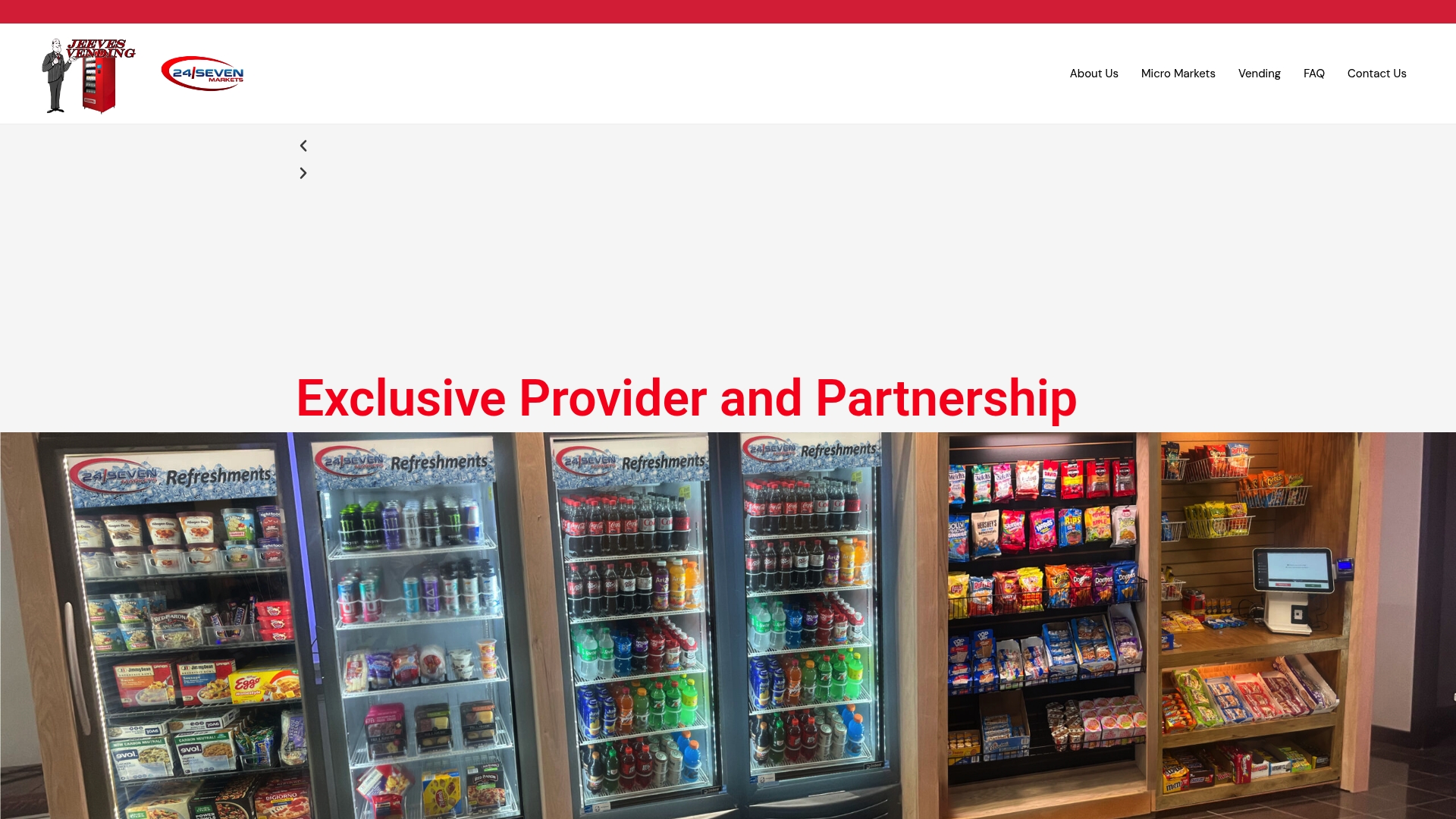
In a sales conversation with Jeeves, expect a live look at the monitoring dashboard, sample SLA language, and a clear explanation of the emergency swap policy before you commit to anything. If your site has specific demands, a hospital’s around-the-clock schedule, a school’s access windows, a gym’s spiky demand on specific SKUs, ask how Jeeves adjusts restocking around them. The modern machine lineup includes remote monitoring as standard, not an add-on. Request a site assessment and see the numbers for yourself before you sign with anyone else.
Frequently Asked Questions
What does vending machine uptime actually mean?
Uptime measures the percentage of time a machine is stocked, functional and able to complete a sale, tracked per machine rather than as a fleet-wide average, since one broken unit shouldn’t hide behind nine working ones.
How is vending uptime guaranteed contractually?
Through SLA language specifying uptime percentage targets, MTTR by fault severity, fill-rate minimums and remedies like service credits when those numbers aren’t met, backed by telemetry logs that can verify performance.
What’s a reasonable uptime percentage to expect from a vending partner?
Many facility managers request 98 percent or better uptime per machine, with MTTR windows of 24 to 72 hours depending on how severe the fault is.
How does telemetry improve vending machine performance?
Telemetry reports slot-level sales, inventory and error codes in near real time, letting technicians diagnose and often resolve payment or mechanical issues remotely before a truck needs to roll out at all.
What maintenance tips actually reduce vending downtime?
Clean bill validators every few weeks, inspect coils and refrigeration units on a fixed schedule, and rely on telemetry alerts rather than manual inspection alone to catch problems early.
Do hospitals and schools need different uptime guarantees than offices?
Yes. Hospitals typically require faster restock cycles and stricter temperature controls, while schools need restocking scheduled around class hours and compliance with policies on product placement.
Sources
For a deeper look at telemetry mechanics and cost expectations, Deelo’s guide to vending route and inventory tracking breaks down DEX/MDB data and typical module pricing. On the service-metric side, Vending Times’ coverage of predictive telemetry explains why live alerts are reshaping vendor accountability.
For par-level math and pre-kitting workflows, VendBuddy’s restocking guide is the clearest walkthrough available. On the routing and inventory side, WhiteBox’s practical inventory management guide covers how demand-driven routing ties depots to machine performance.
- Predictive vending: Why telemetry Is changing the way we think about service | Vending Times
- How to Track Vending Machine Routes, Inventory, and Revenue | Deelo Blog
- How to Restock Vending Machines Efficiently (Routes, Par Levels, Timing)
- Vending Machine Inventory Management: A Practical Guide – WhiteBox