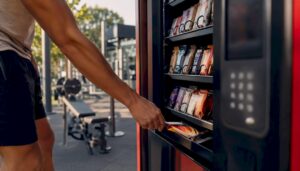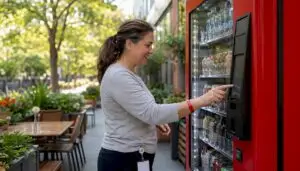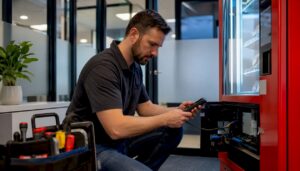

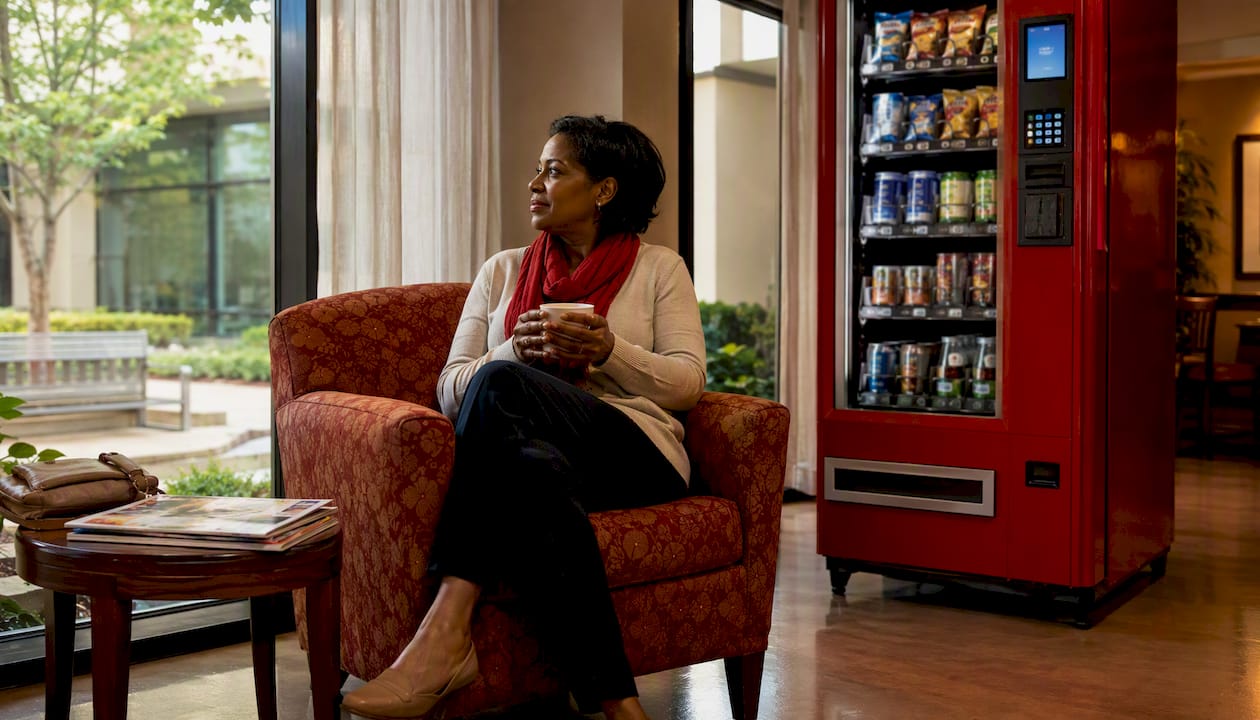
The fastest, lowest-effort way to give patient families reliable on-site refreshment access is a fully managed vending or micro-market service with no upfront equipment cost. Jeeves Vending installs, stocks, and maintains the machines at no charge to your facility, so your team handles none of the operational burden. For a facility manager ready to act, the path is short:
- Contact a managed provider (Jeeves Vending serves hospitals, clinics, and long-term care sites in the Dallas-Denton region) to schedule a site survey.
- Select placement near high-stress clinical areas, such as a NICU family lounge or a Family Nourishment Room, not just a public lobby.
- Confirm power and access — a standard 120V outlet and a clear ADA-compliant path are the minimum site requirements to get started.
Table of Contents
- What are the fastest refreshment options for patient families?
- Why does refreshment access matter for family-centered care?
- How do the main options compare in detail?
- How do you choose a provider and negotiate the contract?
- What does a realistic 30–90 day implementation look like?
- What dietary and food-safety standards should you require?
- What operational KPIs should you request from your vendor?
- How Jeeves Vending supports patient families on-site
- Key Takeaways
- The part most facilities get wrong
- Jeeves Vending: no-cost refreshment for your hospital’s families
- Useful sources and further reading
What are the fastest refreshment options for patient families?
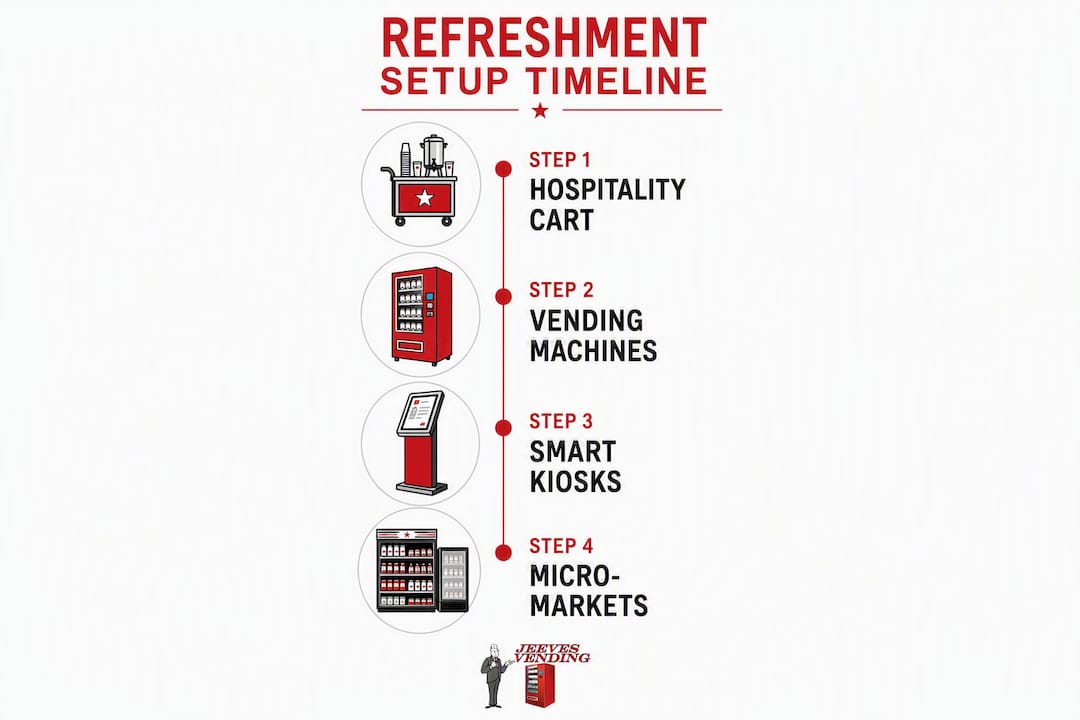
Four delivery formats cover nearly every hospital scenario, and each has a realistic install window.
Vending machines are the quickest to deploy, typically within two to four weeks of a signed agreement. They work around the clock, require minimal floor space, and accept cashless and contactless payment. The trade-off is limited fresh food capacity, though modern AI smart cooler units can hold refrigerated items alongside shelf-stable snacks.
Micro-markets take a bit longer to set up (four to eight weeks) but offer the widest product variety, including fresh salads, sandwiches, and hot meals, through a self-checkout kiosk. They work best in higher-traffic family lounges where families spend extended time.
Smart kiosks sit between the two: a compact footprint with a curated fresh menu, machine-vision checkout, and 24/7 remote monitoring. They suit smaller family rooms or private NICU waiting areas where a full micro-market would feel oversized.
Hospitality carts and free pantries are the lowest-tech option and can be operational within days. NYC Health + Hospitals/Lincoln runs a pediatric hospitality cart that circulates through units, delivering grab-and-go snacks and beverages directly to bedsides. Volunteer-run carts and nonprofit partnerships (Ronald McDonald House programs, for example) are effective interim strategies while a permanent vendor install is being arranged.
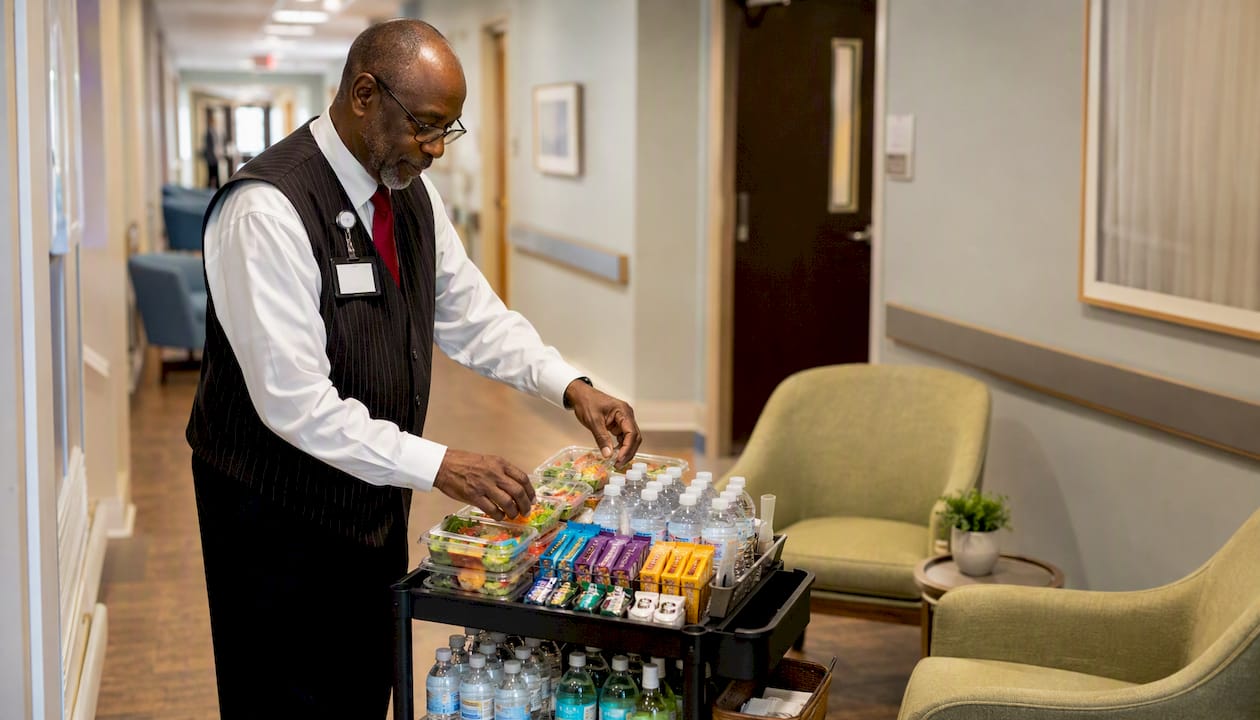
Pro Tip: If your timeline is under two weeks, start with a hospitality cart or free pantry stocked by your food service team, then layer in a managed vending or micro-market solution once the site survey is complete.
Why does refreshment access matter for family-centered care?
On-site refreshment is not a convenience amenity. It is a practical tool for keeping families at the bedside. When a parent in a NICU has to leave the unit to find food, that is time away from their child during some of the most stressful hours of their life. Family Nourishment Rooms stocked with salads, fresh snacks, and ready-to-heat meals reduce that logistical burden and let families stay close to patients while preserving their dignity.
The emotional dimension matters too. At Children’s Hospital of Philadelphia, Jennifer Scales, a mother of a CHOP oncology patient, described the Wawa Coffee and Care Cart as “a great source of comfort and kindness” during months of inpatient stays. A bottle of iced tea or a warm cup of coffee provided her family “a sense of normalcy during a challenging time.”
Facilities that treat refreshment access as a family-support function, not just a food service line item, consistently see higher family satisfaction and stronger alignment with family-centered care standards.
Pro Tip: Place refreshment services inside or directly adjacent to family rooms and NICU lounges, not just near public elevators. Placement near high-stress clinical areas drives significantly higher family usage than lobby-only installations.
How do the main options compare in detail?
Vending machines
Pros: Fastest install, lowest space requirement, 24/7 availability, cashless payment, remote inventory monitoring, no host cost under a managed service model. Cons: Limited fresh food capacity in standard units; product variety is narrower than a micro-market. Site needs: One 120V outlet, roughly 4–6 sq. ft. of floor space, ADA-compliant clearance. Badge-reader integration is available for restricted family areas.
Micro-markets
Pros: Broadest product variety (fresh meals, dietary-friendly options, beverages, snacks), self-checkout with itemized receipts, strong data and reporting. Cons: Larger footprint (typically 100–200 sq. ft.), longer setup timeline, requires refrigeration power. Site needs: Dedicated space, 20-amp circuit for refrigerated cases, network connection for POS kiosk.
Smart kiosks
Pros: Compact, fresh food capable, machine-vision checkout, 24/7 remote monitoring. Cons: Higher per-unit cost if purchased outright; managed service availability varies by market. Site needs: Small footprint, standard outlet, network access.
Hospitality carts and free pantries
Pros: Operational within days, no infrastructure required, strong for private family rooms. Cons: Requires staff or volunteer labor, limited hours, supply chain dependent on internal procurement. Site needs: Storage space for cart and inventory; refrigeration if fresh items are included.
| Dimension | Vending Machine | Micro-Market | Smart Kiosk | Hospitality Cart |
|---|---|---|---|---|
| Host cost / upfront capex | — | — | Varies | Low (supplies only) |
| Service model | Fully managed | Fully managed | Managed or self | Self / volunteer |
| Food variety | Moderate | High | Moderate-high | Low-moderate |
| Technology | Cashless, remote monitoring | Self-checkout POS, reporting | Machine vision, app | None |
| Install timeline | 2–4 weeks | 4 weeks | 4–6 weeks | Days |
| Maintenance / SLA | Provider-managed | Provider-managed | Provider-managed | Internal staff |
| Data / reporting | Item-level sales, uptime | Full item-level, shrinkage | Remote monitoring | None |
How do you choose a provider and negotiate the contract?
Healthcare experience is the single most important filter. A vendor who has never worked inside a hospital will underestimate infection control requirements, badge-access integration, and the restocking cadence that clinical environments demand. Ask specifically for references from hospital or long-term care deployments.
Key contract points to negotiate:
- Installation timeline with a hard go-live date
- Uptime SLA (aim for 98% or better) and maximum response time for service calls (four hours or less for a hospital setting)
- Restocking frequency tied to usage data, not a fixed weekly schedule
- Pricing transparency: itemized product pricing visible to families at point of sale
- Data access: item-level sales reports, uptime logs, and restock history on a cadence you define
- Access control integration: the vendor should support badge-reader or verified-family access without adding work for your staff
Red flags: No written uptime guarantee, reporting access locked behind the vendor’s portal with no export option, and inability to integrate with your facility’s existing access control system. Hospitals that set up family-focused refreshment areas often require tiered access so supplies stay available to the families who need them, not general foot traffic.
Understanding how vending service agreements work before you sign protects your facility from surprise fees and service gaps.
What does a realistic 30–90 day implementation look like?
| Phase | Timeline | Key Actions | Internal Stakeholders |
|---|---|---|---|
| Site survey and approval | Up to two weeks | Vendor site visit, placement decision, power/network assessment | Facilities, Infection Control |
| Procurement and legal | — | Contract review, SLA finalization, access control plan | Procurement, Legal, Patient Services |
| Site prep | — | Electrical work, ADA routing confirmed, network drop installed | Facilities, IT |
| Installation and stocking | — | Equipment delivered, initial product load, POS configured | Vendor, Facilities |
| Soft launch and review | — | Usage data reviewed, product mix adjusted, family feedback collected | Patient Services, Vendor |
Site requirements checklist before installation: 120V outlet (20-amp for micro-markets), ADA-compliant path with 36-inch minimum clearance, HVAC adequate for refrigerated units, network connection for cashless POS and remote monitoring, and a confirmed point of contact for badge-access integration. Seattle Children’s Family Resource Centers use inpatient caregiver badge access for after-hours areas, a model worth replicating for family-only refreshment spaces.
What dietary and food-safety standards should you require?
Every item in a hospital refreshment program should carry clear ingredient and allergen labeling. That means full ingredient lists, the nine major allergens called out per FDA labeling standards, and expiration dates visible at point of sale. For heated items, preparation instructions need to be on the packaging, not just on a nearby sign.
Product mix matters as much as labeling. Ready-to-eat meals, fresh fruit, and lean proteins are what families in crisis actually want and what delivers the highest perceived value. Gluten-free, low-sodium, and nut-free options should be standard, not add-ons. Hospitals like Stanford Children’s Health supplement vending with guest meal vouchers and family food bags for families who cannot afford to pay, a policy worth coordinating with your social work team.
Hospitals that design these programs in consultation with a Family Advisory Council tend to get the access policies right, avoiding both stigmatizing means-testing and unrestricted access that depletes supplies.
Pro Tip: Ask your vendor to build a “family-first” product tier: ready-to-eat salads, protein packs, fresh fruit cups, and whole-grain snacks as the primary shelf space, with traditional vending items as secondary. Families under stress make better use of a service that feels like real food.
What operational KPIs should you request from your vendor?
Before signing, define the reporting package in writing. The metrics that matter most in a hospital setting:
- Uptime percentage reported weekly, with timestamps for every service interruption
- Restock frequency and fill rate by item, so you can catch chronic stockouts before families notice
- Item-level sales data broken down by time of day, useful for adjusting product mix around shift changes and visiting hours
- Service response time logged from the moment a fault is reported to the moment it is resolved
- Shrinkage and loss reporting for micro-markets with open-shelf access
For contingency planning, require the vendor to document a backup protocol: a hospitality cart or emergency stocking run within 24 hours of extended downtime, a direct escalation contact (not just a general service line), and a supply-shortage communication plan. Fast restocking in hospital settings is not optional; a machine that sits empty overnight in a NICU family lounge fails the families it was installed to serve.
How Jeeves Vending supports patient families on-site
Jeeves Vending’s model is built around exactly that premise. For hospitals and healthcare facilities in the Dallas-Denton region, the service covers equipment, installation, stocking, and maintenance at no cost to the host. Remote inventory monitoring means restocking happens before shelves run empty, not after a family files a complaint. Placement near NICU lounges, pediatric family rooms, and inpatient waiting areas is part of the site survey process, not an afterthought.
Key Takeaways
A fully managed, no-upfront-cost vending or micro-market service is the fastest, lowest-effort path to reliable on-site refreshment for patient families in any hospital or clinical setting.
| Point | Details |
|---|---|
| No capex required | Managed providers like Jeeves Vending cover equipment, install, and maintenance at zero host cost. |
| Placement drives usage | Locate refreshment services near NICU and pediatric units, not just public lobbies, for maximum family benefit. |
| Fresh food first | Prioritize ready-to-eat meals, fresh fruit, and lean proteins over standard snack vending for families in crisis. |
| SLA and reporting are non-negotiable | Require written uptime guarantees, item-level sales data, and a documented contingency plan before signing. |
| Jeeves Vending for DFW facilities | Jeeves Vending serves hospitals in the Dallas-Denton region with fully managed vending and micro-market installs. |
The part most facilities get wrong
The conversation about patient family refreshments almost always starts in the wrong place: food service budgets and cafeteria hours. Those are the wrong constraints to optimize. The real question is how far a family has to travel from their child’s room to get something to eat at 2 AM, and whether that distance is acceptable given what they are going through.
Facilities that get this right treat refreshment access as a family-support function with its own placement logic, its own product standards, and its own SLA. The ones that get it wrong drop a vending machine near the main elevator bank, stock it with chips and soda, and call it done. The difference between those two outcomes is almost entirely in how the vendor relationship is structured and how seriously the facility manager treats the site survey conversation.
The no-capex managed service model removes every financial excuse for doing this poorly. There is no equipment budget to fight over, no maintenance staff to train. The only remaining decision is whether to treat this as a real family-support program or a checkbox.
Jeeves Vending: no-cost refreshment for your hospital’s families
Zero equipment cost, zero maintenance burden, and a product mix built for families who need more than a bag of chips. Jeeves Vending installs and manages vending machines and micro-markets for hospitals, clinics, and long-term care facilities across the Dallas-Denton region, with remote inventory monitoring and restocking handled entirely by the Jeeves team.
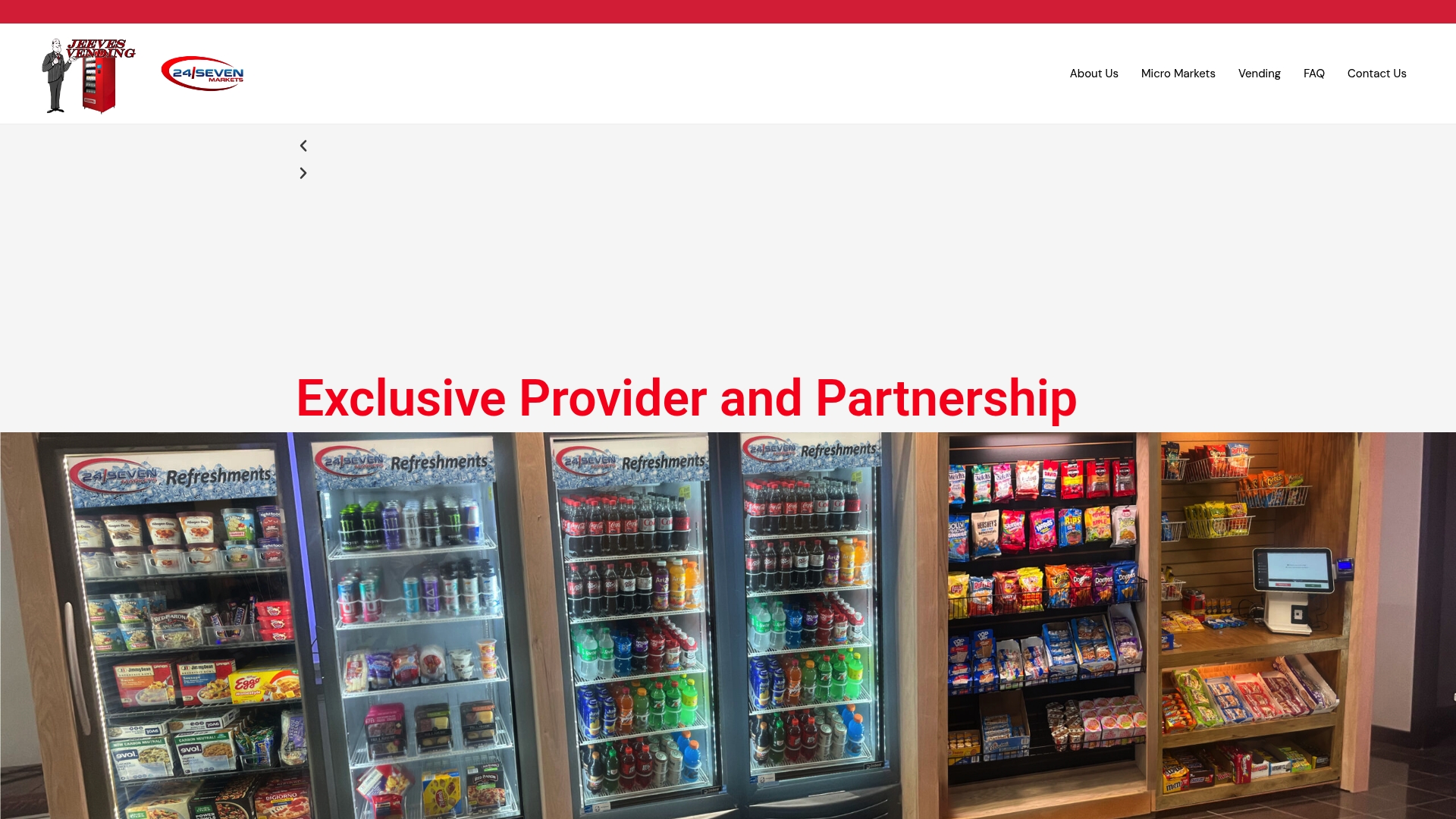
The setup process starts with a site survey, which costs nothing and takes about an hour. From there, Jeeves Vending handles placement, power coordination, installation, and initial stocking. Your team’s job is to approve the location and confirm access. To get a survey scheduled and see what a managed refreshment program looks like for your facility, contact Jeeves Vending today.
Useful sources and further reading
- Family Nourishment Room gives NICU families one less reason to worry — Catholic Health World case study on a hospital-based Family Nourishment Room program, including access policy design and family feedback.
- NYC Health + Hospitals/Lincoln pediatric hospitality cart — Press release detailing a mobile cart program that delivers bedside snacks and beverages to pediatric patients and families.
- Wawa Coffee and Care Cart at CHOP — Children’s Hospital of Philadelphia example of a volunteer-staffed hospitality cart program with direct family testimonials.
- Family Resource Center — Seattle Children’s — Operational details on badge-access family resource centers with kitchens, vending, and caregiver support programs.
- Hospital Amenities for Families and Visitors — Dayton Children’s — Overview of managed amenities including family lounges, access controls, and no-cost refreshment services.
- Food and Gift Shop — Stanford Children’s Health — Details on guest meal vouchers, family food bags, and 24/7 vending availability as part of an integrated food service program.