A small office is usually best served by one or two well-chosen vending machines, such as a snack machine and a cold-drink or fresh-food cooler, rather than a full micro market. Micro markets are built for larger, steady crowds. Below 50 or so people on site, a compact machine with cashless payment and a well-matched product mix almost always makes more sense. We run vending and micro-market programs for workplaces in the Dallas-Denton region, and this guide covers how to size the setup, what to stock, how payment and restocking work, and what to do if your office is half empty most days.
TL;DR
- Most small offices do best with one or two machines, or a smart cooler, placed in the break room. A micro market is a better fit once headcount on site is in the range of a few hundred or the break room is busy all day.
- Space is rarely the limit. A single machine needs a small corner footprint, a power outlet and a path for delivery.
- For remote and hybrid offices, choose fewer items, fresher rotation and remote stock monitoring so nothing sits and expires.
- Pick a mix of snacks and drinks your team will actually buy, with a share of healthier choices that follows public nutrition guidelines.
- A full-service program can come at no cost to the host business, with the operator providing, stocking and servicing the equipment.
Table of Contents
- Vending machine or micro market: which fits a small office?
- How much space does a small office actually need?
- What to stock: snacks, drinks and fresh food
- Payment: what small-office employees expect
- Restocking: how often, and who handles it
- Vending for remote and hybrid offices
- Perspective: why we start small
- What it costs a small office
- Set up vending in your office with Jeeves
- A simple way to decide
- FAQ
- Sources
Vending machine or micro market: which fits a small office?
The two options solve different problems.
A vending machine is a self-contained unit that dispenses packaged snacks, drinks or fresh items. It has a small footprint, needs little setup and works for almost any headcount. A micro market is a mini self-serve store: open shelves, coolers and a self-checkout kiosk, usually inside a dedicated room or corner. It offers more variety, including fresh food, but it needs enough regular shoppers to keep the inventory moving.
That last point decides most small-office questions. Industry operators generally look for a steady, closed group of people on site before recommending a micro market, because fresh items spoil if they do not sell. Published rules of thumb vary by operator and region, and there is no legal minimum, so treat any single number as a guideline rather than a rule. In practice, an office of 10 to 40 people rarely generates the daily volume that justifies a full market, while a machine or two will earn its place from the first week.
| Factor | Vending machine or smart cooler | Micro market |
|---|---|---|
| Best for | Small offices, remote sites, tight break rooms | Larger, steady on-site teams |
| Space | A small corner with an outlet | A dedicated room or large alcove |
| Variety | Moderate, set by machine capacity | Wide, including fresh meals and sandwiches |
| Payment | Card, tap and mobile wallet | Self-checkout kiosk |
| Restocking | Scheduled, adjusted to sales | More frequent, with fresh rotation |
| Fit for 10 to 40 people | Strong | Usually too much |
If you are unsure, start with machines. A good operator can add a cooler or grow into a market later, using the sales data from the first months to show whether demand is there. We explain why operators often pair the two in our piece on micro market adoption and why markets and coolers go together.
How much space does a small office actually need?
Less than most managers expect. For a single machine, plan for:
- A floor footprint about the size of a tall refrigerator, plus a few inches behind it for ventilation.
- A dedicated outlet within reach, so no extension cords run across the floor.
- Clearance in front so two or three people can stand at the screen without blocking a hallway or an exit.
- A route for delivery: doorways and hallways wide enough for the machine to come in, and an elevator or ramp if you are above ground floor.
- A connectivity check: cashless readers and remote monitoring need a cellular signal or Wi-Fi, which matters in basements and interior break rooms.
A site visit settles all five in a few minutes. Machine dimensions vary by model, so ask the operator for the exact width, depth and height of each unit before you commit to a spot.
A micro market is a bigger project. It needs a room or a clearly defined zone with shelving, coolers, a kiosk and some form of access control, so only your people shop there. For most small offices that is more floor than the break room can spare.
Placement that gets used
The best location is the one people already walk past: the break room, a kitchenette or a corridor near the main work area. A machine tucked in a far corner or a supply closet sells less than the same machine beside the coffee maker. If you have two floors or two suites, one machine on each is better than two in one place.
What to stock: snacks, drinks and fresh food
The right mix depends on who works there and when. An accounting office with a lunchtime rush wants different items than a call center with long shifts. Before you choose, ask your team. A two-minute poll covering snacks, drinks and dietary needs beats guesswork. Our HR guide on customizing a vending menu for staff walks through how to do it.
A sensible small-office starting mix looks like this:
- Salty snacks: chips, pretzels, popcorn, crackers.
- Sweet snacks: candy, cookies, granola bars.
- Healthier picks: nuts, jerky, protein bars, fruit snacks, baked or low-sugar items. See which protein snacks sell well in vending.
- Cold drinks: water, sparkling water, juice, energy drinks, soda.
- Coffee: a bean-to-cup or single-serve option if your break room has no coffee setup.
- Fresh or frozen items: sandwiches, salads, yogurt and frozen meals, where a cooler is available. More on fresh food vending for offices, campuses and gyms.
Variety matters more than volume. A machine with a few well-chosen items per category sells better than one crammed with duplicates. Research on workplace variety is covered in our note on the productivity benefits of vending variety.
Healthier choices without a snack ban
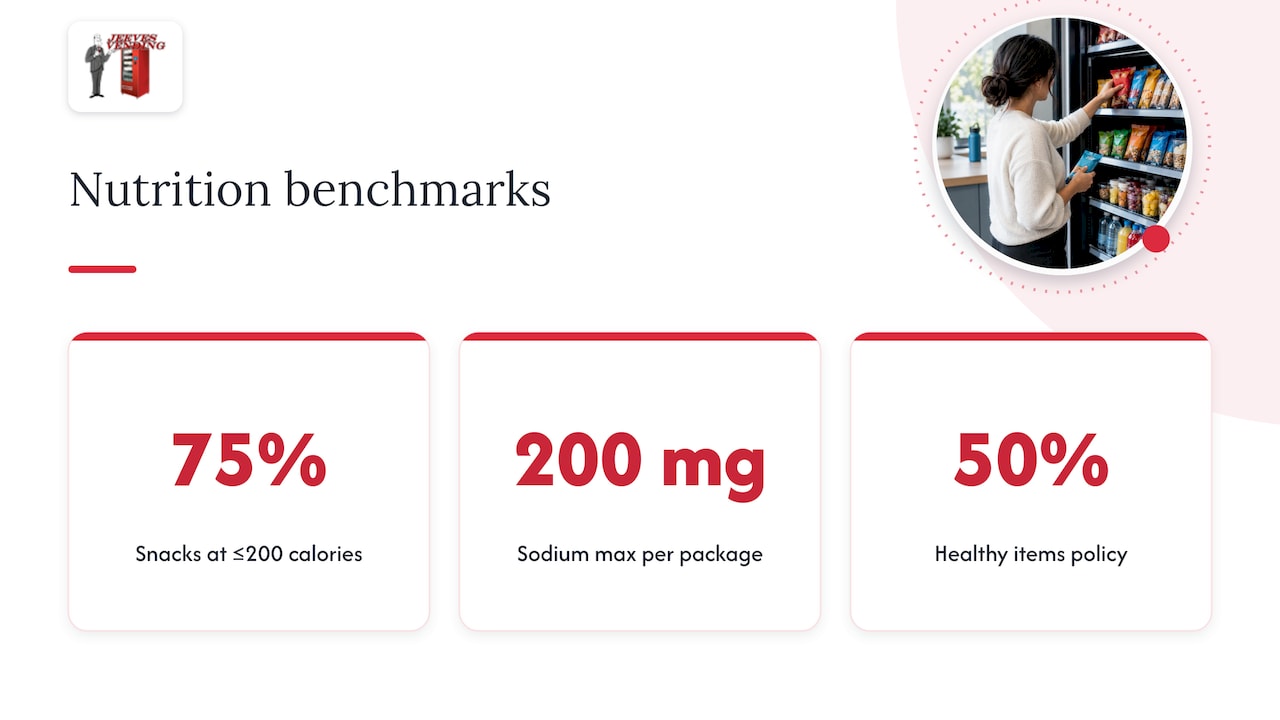
Nutrition guidance gives you a ready benchmark. The federal food service guidelines for concessions and vending call for at least 75% of packaged snacks to stay at or under 200 calories, and for all packaged snacks to contain no more than 200 mg of sodium per package, according to the CDC-hosted federal guidelines. Those are written for federal facilities, so a private office is under no obligation to follow them, but they are a clear, credible yardstick if you want a healthier lineup.
The CDC’s own dining and vending policy takes the view that chronic diseases are often related to poor dietary patterns and physical inactivity, and that better food access can support employee health and performance, per its food service guidelines policy. It uses nutrition standards plus behavioral design, such as placement and pricing, to nudge people toward better options rather than removing the others.
That approach works well in an office. Keep the favorites, add healthier items at eye level, and let people choose. Our one-page office vending policy with 50% healthy items and the HR vending policy guide give you wording you can adapt.
Drinks follow the same logic. If your team leans on coffee, think about what the break room offers beyond the machine. If you also want to say thanks with something more personal, a corporate coffee gifting guide can help you pick a gift that suits the team.
Payment: what small-office employees expect
People rarely carry cash now. A machine that takes only coins and bills will sit idle. For a small office, look for:
- Card and tap-to-pay on every machine.
- Mobile wallet support, so phones work as well as cards.
- Clear on-screen pricing before the purchase.
- A way to report problems, such as a QR code or phone number on the machine, so a stuck item or a failed charge gets fixed quickly.
Some employers also want to subsidize part of the cost, for example by covering a free item a day or a discount on healthier options. That is possible, but the rules around labeling and tax treatment deserve a careful look. We cover them in subsidized vending for employers.
Restocking: how often, and who handles it
In a small office, restocking should be invisible. The operator tracks what sells, refills before items run out and removes anything near its date. Remote stock monitoring makes this far more efficient than a fixed weekly route: the operator sees which slots are empty and which items are stalling, and arrives with the right products instead of a full truck.
What to ask any operator:
- How often will you visit, and can the schedule change as we learn what sells?
- Do you monitor inventory remotely?
- How do we report a problem, and how fast do you respond?
- Who is responsible for repairs, refunds and expired product?
- Can we swap items if staff ask for something different?
- What are the terms if we want to change or end the arrangement?
Get the answers in writing in your agreement.
Vending for remote and hybrid offices
The hardest case is the office that is nearly empty on some days: a hybrid team with two or three people in on Mondays and a full room on Thursdays, or a satellite office with a handful of staff. The usual vending logic of steady daily volume breaks down, so adjust the setup:
- Choose a smaller machine or one cooler instead of several units. Lower capacity means less stock sitting through quiet days.
- Favor shelf-stable items such as nuts, bars, chips and canned or bottled drinks, and keep perishables limited to what you can expect to sell in a day or two.
- Rely on remote monitoring. If the operator can see sales, it can match deliveries to your in-office days and avoid unnecessary trips.
- Match restocking to your busy days. A visit on Wednesday for a Thursday crowd beats a Monday visit for an empty room.
- Skip the micro market. Open shelves and fresh meals depend on predictable traffic, which a low-occupancy site cannot offer.
If your remote office is in a building with shared amenities, ask whether the property manager already has an arrangement. Some multi-tenant buildings have a vending contract that covers common areas.
Perspective: why we start small
We have seen the same mistake in small offices again and again: someone sees a polished micro market in a large headquarters and assumes their 20-person suite needs the same thing. It does not. What a small team needs is a machine that is always full of things people want, takes a card without fuss and never makes the office manager chase anyone.
That is how we set up programs. We look at who works there, when they are in the building and what they ask for. Then we choose equipment sized to the room, stock it with a mix that fits the team, and use remote monitoring so we are refilling what sells rather than guessing. If the office grows, a cooler or a micro market can follow, and the first months of sales data tell us whether it is time.
We are a family-owned team and we manage our locations locally, so when something goes wrong, you reach a person who knows your building. That, more than any machine spec, is what makes vending feel effortless to the people who host it.
Gary
What it costs a small office
For the host business, the usual full-service arrangement costs nothing: the operator supplies the equipment, installs it, stocks it and services it, and earns its revenue from the products employees buy. That is why you can find free vending programs, as we explain in why free vending machines exist.
The trade-off is that the operator needs enough sales to make the route worthwhile, which is why placement and headcount matter. If you prefer to own the equipment and run it yourself, that is a different arrangement with its own responsibilities. Whichever route you take, check the contract for term length, service response times and who owns the machine.
Set up vending in your office with Jeeves
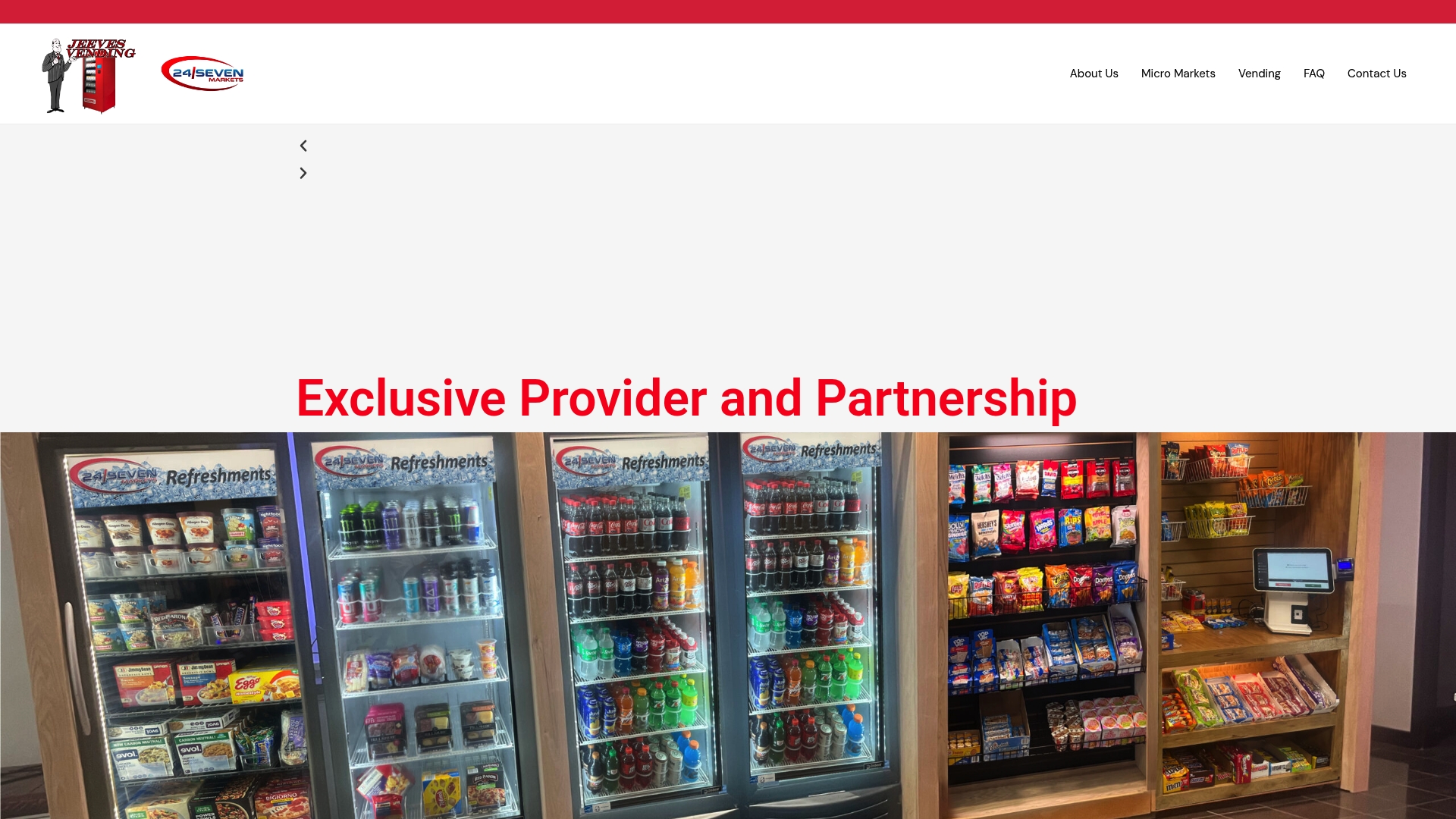
We install and manage modern vending machines, smart coolers and custom micro markets for offices, schools, gyms, hospitals and warehouses in the Dallas-Denton region. Our full-service program comes at no upfront cost to the host business, with installation, stocking, maintenance and remote stock monitoring handled by our team. We start by looking at your space, your headcount and your schedule, then recommend the smallest setup that will serve your people well.
See how our free full-service vending program works, or contact us through our site to talk through your break room.
A simple way to decide
Use this checklist before you call anyone:
- Count regular people on site on a typical day, not total headcount.
- Measure the break room for a corner with an outlet and a clear path in.
- Ask your team what they would buy, and note any dietary needs.
- Decide your healthy-item share and whether you want to subsidize anything.
- Check connectivity at the spot where the machine will sit.
- Choose a trial. A single machine or cooler for a few months shows you what sells before you commit to more.
If the answers point to fewer than a few dozen people on site, start with a machine or cooler. If they point to a big, steady population and a spare room, ask about a market.
FAQ
Is there a minimum number of employees for a micro market?
There is no legal minimum, and the threshold varies by operator, location and how busy your site is. Industry guidance generally expects a large, steady group on site, often well above what a small office has. Smaller teams usually do better with a machine or smart cooler, which can be upgraded later.
How much space does a small office need for vending?
A single machine needs roughly a refrigerator-sized corner, a nearby outlet and clear space in front. A micro market needs a dedicated room or zone for shelves, coolers and a kiosk. Ask the operator for the exact dimensions of the model you are considering.
Can a remote or hybrid office have vending?
Yes. Choose one compact machine or cooler, keep mostly shelf-stable items and use remote monitoring so restocking follows your in-office days. That keeps waste low even when the office is quiet.
Does vending cost the business anything?
Under a full-service program like ours, the host business does not pay for the equipment, installation or service. Revenue comes from employee purchases. Always confirm the terms in writing before you sign.
Can we offer healthier snacks in the machine?
Yes, and it does not require removing favorites. Many offices set a share of healthier items and follow public guidelines such as the federal one that caps packaged snacks at 200 mg of sodium per package. Your operator can build the mix around your team’s preferences.
Sources
- Food Service Guidelines for Federal Facilities: concessions and vending operations (CDC)
- Food Service Guidelines in CDC-Owned or -Operated Dining and Vending Facilities (CDC)
- Why coffee gifts suit corporate gifting: a buyer’s guide