
Finding a workplace vending service that provides national coverage, customized product selection, and minimal upfront costs remains difficult for facilities teams. Many vendors limit free equipment offers to select regions or require sites to meet minimum size thresholds, leaving smaller or widely scattered worksites underserved. This comparison lists alternatives based on coverage, product variety, and installation fees so facilities teams can match a vendor to their organization’s needs without wasted trials.
Table of Contents
Jeeves Vending
At a Glance
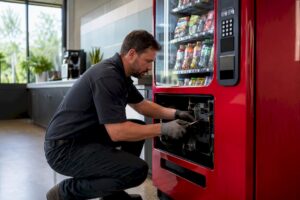
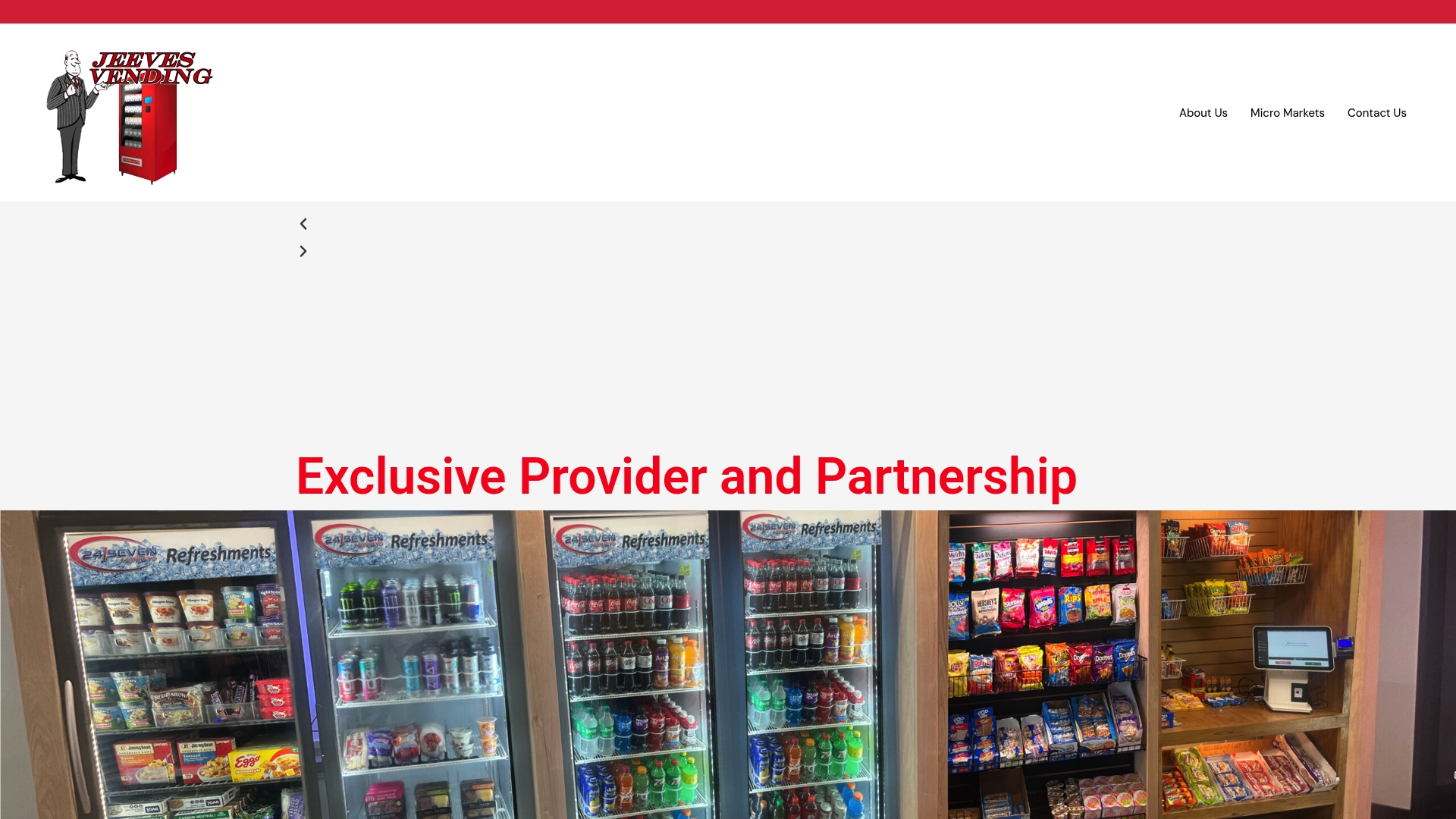
Equipment and installation come at no cost to client organizations. The vendor advertises same-day installation. The platform pairs fully digital point of sale with remote monitoring and AI-assisted systems to manage uptime and inventory across the Dallas–Denton region.
Core Features
The software layer includes a fully digital POS and remote monitoring that reports machine status and sales in real time. Inventory management and automatic product replenishment are handled as part of the service, while product mixes can be tailored for hospitals, offices, schools, gyms, and hospitality venues. Equipment and installation are offered at no upfront charge, with operations funded through market placement.
Key Differentiator
Zero upfront cost for equipment combined with continuous remote oversight is the single strongest distinguishing element. That pairing shifts capital expense off your balance sheet while keeping control of SKU selection and stocking cadence in one managed platform. For facility teams, that reduces vendor coordination and on-site technical troubleshooting.
Pros
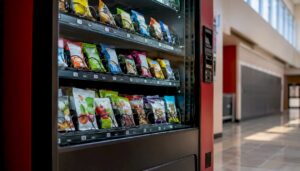
Free installation and equipment reduce capital expenditure and simplify procurement for facilities teams. Custom product selection and environment-specific setups help match offerings to cafeteria hours, shift patterns, and guest needs. Remote monitoring and digital POS data improve uptime and give you sales visibility for replenishment and reporting. The service covers refrigerated options, healthy snacks, and traditional items while including ongoing maintenance and restocking.
Cons
- Service coverage is primarily focused on the Dallas–Denton area, so availability outside that region may be limited.
Who It’s For
Operations managers, workplace experience leads, and facilities directors who want turnkey vending without capital outlay will find this a good fit. Healthcare systems, corporate campuses, educational institutions, hotels, and gym operators benefit from tailored product mixes and centralized reporting. If you need national reach, verify local availability first.
Unique Value Proposition
Free equipment and installation funded through market placement lets you deploy vending and micro-market hardware with no capital expense. That economic model lets procurement and finance teams avoid purchase approvals and depreciation entries. At the same time, remote-monitored POS and managed inventory reduce day-to-day vendor management for site staff, freeing them to focus on core operations.
Real World Use Case
A Dallas hospital implemented remote-monitored, customized vending machines to provide 24/7 snack and beverage access for staff and visitors. Jeeves Vending handled installation and ongoing restocking, which kept machines stocked during night shifts and reduced calls to facilities. The hospital avoided upfront costs while gaining sales data to guide product choices.
Website: https://jeevesvending.com
Canteen
At a Glance
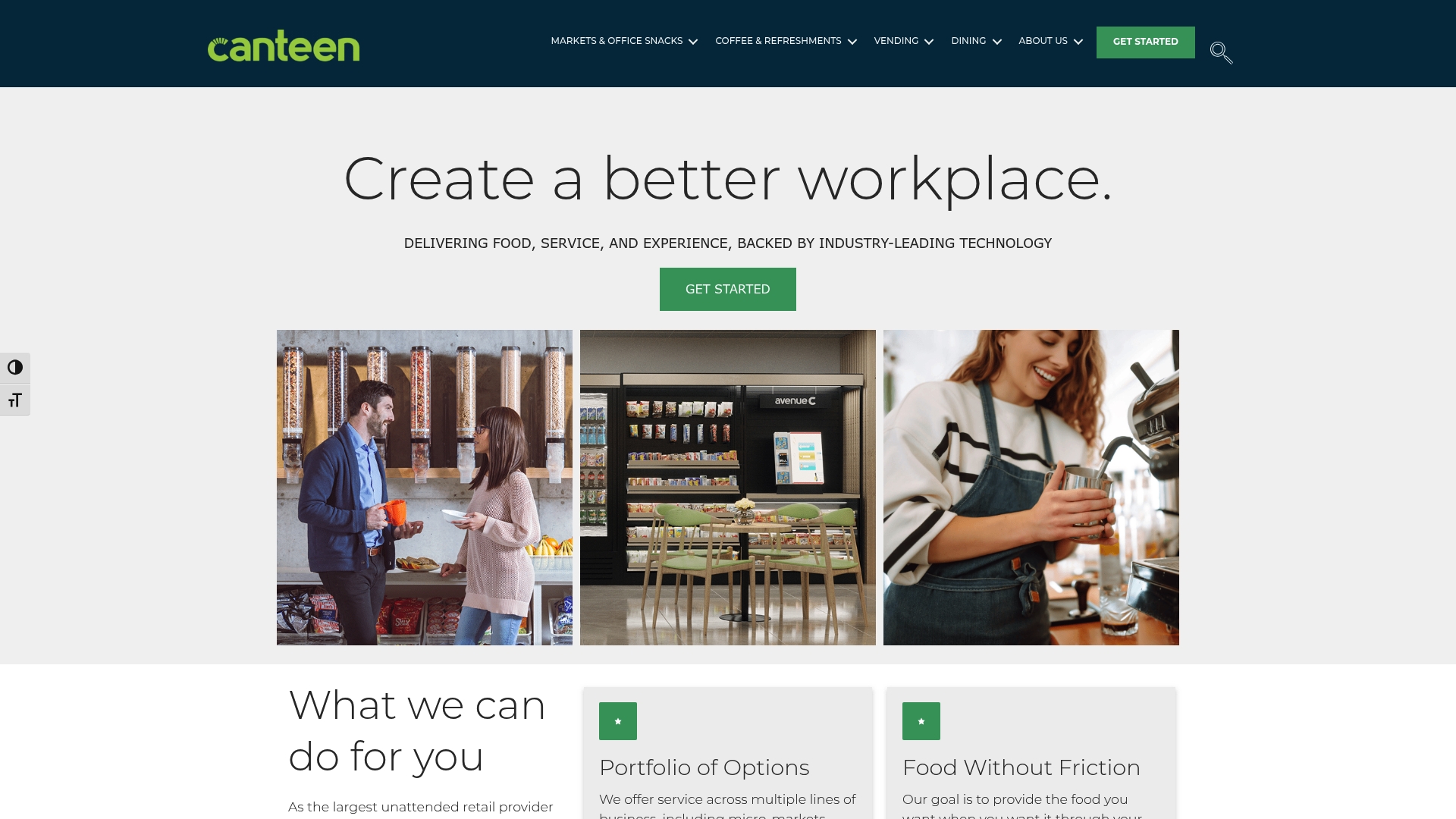
Canteen reports over 95 years of service and more than 225 distribution locations across 48 states. The company centers on unattended retail for workplaces, combining micro-markets, vending, coffee, and catering. Its messaging highlights a focus on contactless options and quicker access to food during the workday.
Core Features
Canteen deploys micro-markets and vending machines stocked with healthier snack choices and full meal options, plus on-site coffee and refreshment services. The offering includes catering and culinary concepts for meetings and events, and technology-driven delivery with contactless payment to reduce transaction friction. Those capabilities are organized to serve large facilities and multi-site employers.
Key Differentiator
Canteen’s national scale stands out for multi-location deployments. That geographic reach and long tenure let the company manage rollouts and logistics across states without multiple vendors. For organizations with many offices, that footprint reduces vendor coordination and simplifies replenishment.
Pros
The vendor advertises a 98% customer retention rate. Broad service coverage across 48 states and a large distribution network lower operational complexity for employers with many sites. A full portfolio that spans micro-markets, vending, coffee, and catering lets a single supplier handle daily refreshments and event catering.
Cons
-
Pricing and contract details are not publicly listed. Buyers must request quotes to compare total cost of ownership.
-
Specific product-level features and per-unit costs are not described in the available materials. That makes precise budgeting difficult without a site assessment.
-
The publicly stated materials do not detail technical integrations or API access. Organizations that rely on a particular procurement or building-management integration should confirm capabilities before contracting.
Who It’s For
Large organizations and facilities that require a single vendor to manage foodservice across many locations will see the most value. Multi-site employers looking to reduce vendor count and centralize vendor management fit well. Companies that prefer packaged solutions for daily refreshments and event catering will find this model practical.
Real World Use Case
A corporate campus installs micro-markets in multiple office buildings, adds vending machines in satellite locations, and selects on-site craft coffee for employee areas. The company uses a single contract for replenishment and catering for town-hall events. That approach reduces billing complexity and centralizes service-level discussions.
Pricing
Canteen lists pricing as not applicable in its public materials. Contract terms, per-site fees, and install costs are not published. Prospective buyers must contact the company for a tailored quote and site-specific proposals.
Website: https://canteen.com
Vending Group
At a Glance
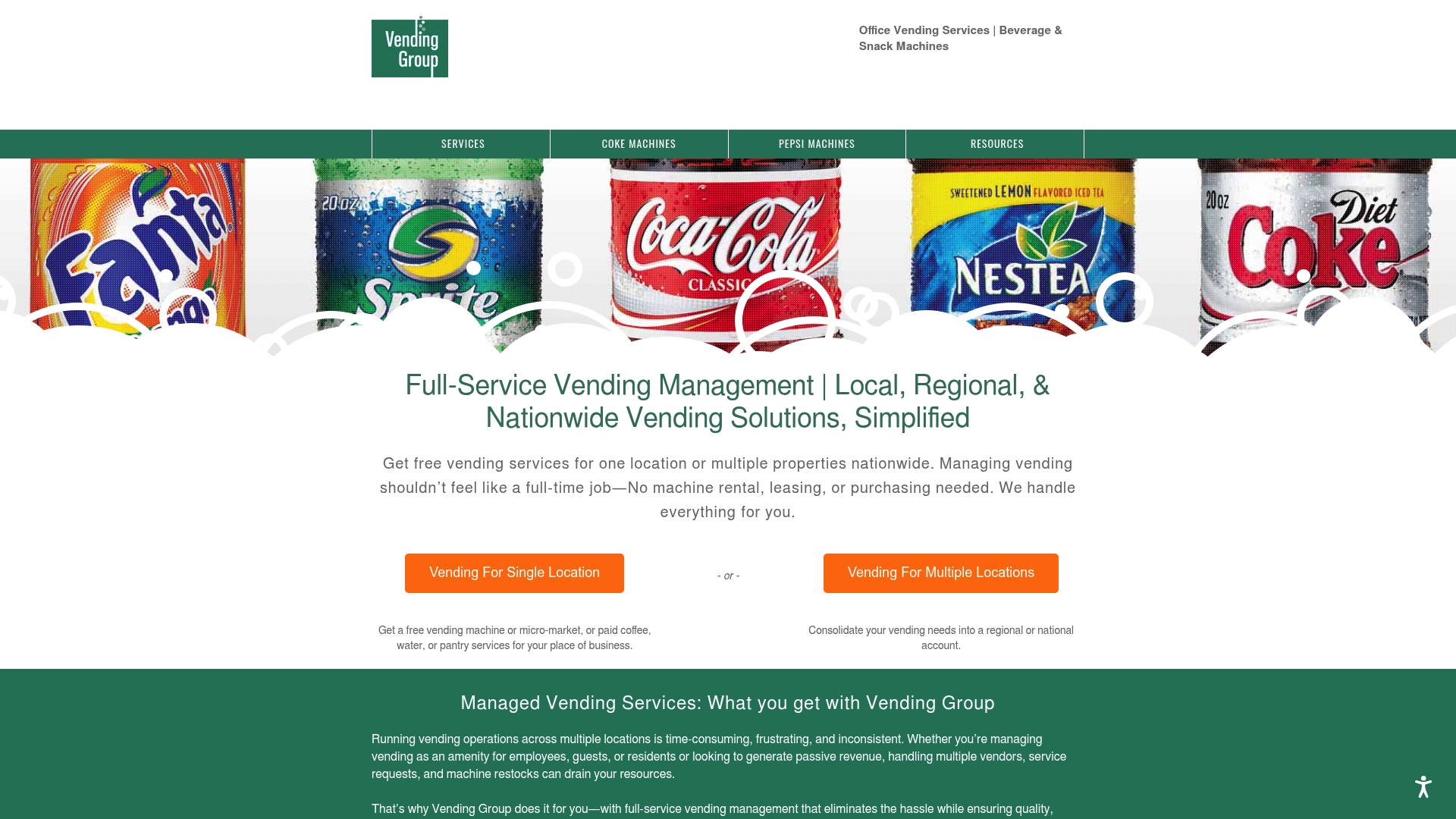
Zero-cost vending machines and micro-markets are available to qualifying sites, subject to minimum size thresholds for offices and hotels. The company pairs free equipment with ongoing installation, restocking, maintenance, and reporting. That approach removes upfront capital outlay for locations that meet the qualification rules.
Core Features
Vending Group handles installation, restocking, maintenance, and reporting while operating micro-markets, coffee, water, and pantry services. The vendor deploys energy-efficient machines that accept cashless payments and supports centralized management for multiple locations with a single point of contact. Product mixes can be customized to include healthier items and major brands like Coca-Cola and Pepsi.
Key Differentiator
A no upfront equipment cost model for qualifying multi-site operators sets Vending Group apart from many refreshment providers. That model combines nationwide coverage and centralized account management so multi-location operators can consolidate vendor relationships and reduce local procurement work.
Pros
The free equipment model reduces capital requirements and lowers barriers to adding vending or a micro-market in qualifying sites. Centralized, nationwide service simplifies operations for property and facilities managers who run multiple locations and want a single contact for scheduling and reporting. Modern, energy-efficient machines with cashless payment make transactions easier for occupants and let managers offer healthier and branded options.
Cons
- Buyers must meet minimum size thresholds to qualify for free machines, such as office locations with about 40 or more employees and hotels with roughly 30 rooms.
- Service availability varies by geography, so coverage may be limited in some rural or remote markets.
- Machines still require electricity, so energy costs remain a running expense for the site.
When It May Not Fit
If your site falls below the published employee or unit thresholds, the free equipment option will not apply and payback must be modeled differently. Organizations that need guaranteed coverage in every county should verify regional availability before committing. Small single-site operators may find vendor options with lower minimums or direct-purchase models a better match.
Who It’s For
Property managers and business operators running multiple locations who want centralized vending and refreshment management will find this model practical. You will benefit if reducing upfront capital outlay matters and if you can meet the qualifying thresholds. Facilities teams that prefer a single vendor relationship across sites will see administrative savings.
Real World Use Case
A regional office park rolled vending and coffee services into a centrally managed contract across three campuses. Vending Group installed machines and a small micro-market at qualifying buildings, then handled stocking and maintenance from a single account manager. The property manager stopped managing multiple vendor relationships and received consolidated reporting for all sites.
Website: https://vendinggroup.com
Vending Solutions
At a Glance
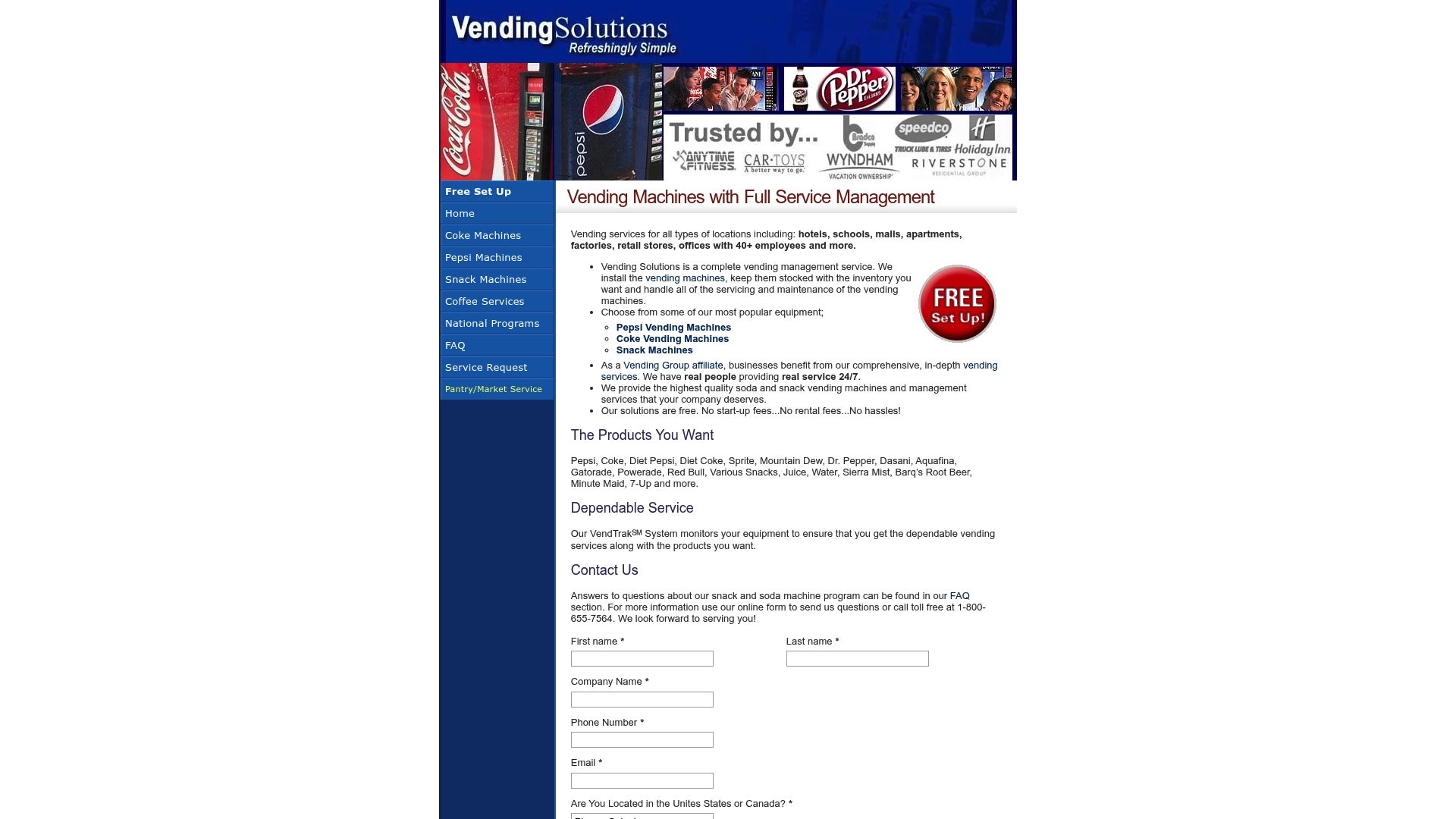
Free setup and no startup or rental fees for vending installations across the U.S. and Canada. The company pairs that offer with VendTrak, a real time monitoring system for machine status and restock alerts. This combination reduces administrative work for site managers and keeps machines stocked without recurring setup costs.
Core Features
Vending Solutions manages installation, stocking, servicing, and maintenance for machines placed in offices, hotels, malls, and schools. Their fleet covers beverages, snacks, office coffee, micro markets, laundry machines, and massage chairs, with local route teams handling replenishment. VendTrak gives operators remote visibility into inventory levels and machine faults so technicians respond faster.
Key Differentiator
The standout is full service management tied to nationwide coverage and VendTrak monitoring. That pairing shifts responsibility for stocking and repairs to the vendor while giving clients remote oversight of availability. For organizations with multiple sites, this model reduces coordination burden and centralizes vendor communication.
Pros
Clients get a hands-off model where the vendor handles installation and ongoing maintenance, freeing facilities staff from daily machine checks. Product variety includes major beverage brands and popular snack lines, which helps satisfy diverse employee preferences. Dedicated support reportedly offers real people available around the clock, and the lack of setup fees lowers the barrier for trial deployments at new locations.
Cons
- Third-party reviews and detailed customer feedback are not publicly available to validate the service claims.
- Customization options and specific machine model choices are not documented, which could limit specialized branding or product mixes.
- Pricing structure and contract terms are not listed, making it hard to compare long term costs across vendors.
Who It’s For
Businesses and organizations that want a turnkey vending partner for multiple locations will find this service suited to their needs. Facilities teams that prefer to transfer stocking and repair responsibilities to a vendor benefit most. The offer also fits sites that want minimal upfront investment and prefer vendor-managed logistics.
Real World Use Case
A corporate campus hires Vending Solutions to install snack and beverage machines in its break areas and lobby. Route staff use VendTrak to spot low inventory and flag machine faults. The campus operations team avoids daily checks and gets predictable service without paying setup fees.
Website: https://vendingsolutions.com
AVI Foodsystems

At a Glance
Family-owned since 1960, AVI Foodsystems pairs traditional food service with micro markets and event catering for corporate, healthcare, education, and entertainment sites. The company emphasizes fresh ingredients, sustainability, and local community ties. Its service mix targets organizations that operate on-site dining and guest-facing food services.
Core Features
AVI combines on-site dining services, micro markets and vending, event catering, refreshment services including coffee, and high-tech micro markets like Market C into a single vendor offering. These services support day-to-day meals, grab-and-go options for staff, and catered functions for visitors. The setup aims to centralize food operations under one vendor for member organizations.
Key Differentiator
The company’s long family ownership shapes a person-to-person service model that many national chains do not match. That ownership connects to community involvement and tailored menu planning for member groups. The presence of Market C shows a willingness to pilot newer micro market hardware alongside traditional dining.
Pros
AVI brings decades of operator experience across multiple sectors, which helps when your organization needs a single partner for dining, vending, and catering. The menu planning and sustainability focus support enterprise procurement teams looking to meet dietary variety and responsible sourcing goals. Family ownership often means decision makers are locally accessible and willing to adapt service models to each site. Offering coffee programs and refreshment services reduces the number of separate suppliers your facilities team must manage.
Cons
- Limited visible digital or software-driven solutions. The offering reads as operational and service focused rather than a tech-first community platform.
- High customization across services may lengthen onboarding and require more operational coordination from your facilities staff.
- No published pricing or standard contract templates are provided in the available materials.
When It May Not Fit
If your organization operates primarily remote teams or seeks a vendor that delivers a cloud-first management portal for multiple sites, AVI may not match that requirement. Small offices without on-site dining needs will likely find the breadth of services unnecessary. Organizations that prioritize a turnkey digital ordering and analytics stack should evaluate tech-forward vendors instead.
Who It’s For
Medium to large organizations that operate physical sites and want a single, relationship-driven partner for food services will get the most value. Typical fits include corporate campuses, hospitals, universities, and entertainment venues that need daily dining plus vending and catering support. Procurement teams that prefer local decision makers will appreciate the family-owned model.
Real World Use Case
A hospital contracts AVI to operate patient and staff dining, run micro markets in staff break rooms, and handle event catering for conferences. The vendor coordinates menus with clinical nutrition staff and supplies coffee programs for waiting areas. That arrangement keeps food operations under one vendor and adapts menus for patient needs and staff schedules.
Website: https://avifoodsystems.com
Comparison of alternatives
In the competitive landscape of workplace vending services, Jeeves Vending excels with its unique no-cost installation and equipment model tailored for the Dallas–Denton region. This service differentiates itself by offering monitoring and inventory management through technology-led solutions. At the same time, other contenders provide their own strengths that make them suitable for different organizational needs.
National Coverage and Operational Scale
Canteen outpaces competitors with its nationwide coverage, boasting over 225 distribution centers across 48 states and delivering micro-markets, catering, and vending solutions. This scale allows multi-location organizations to centralize foodservice operations under one vendor, reducing logistics and coordination burdens effectively. Meanwhile, both Vending Group and Vending Solutions also provide large area service, albeit with qualifying conditions and variable coverage, which sometimes necessitate upfront confirmations of availability.
Focus on Customization and Local Partnerships
AVI Foodsystems emphasizes customized menu planning and sustainability, supported through its long-standing family ownership. This vendor is ideal for facilities requiring tailored dining and refreshment solutions, particularly enterprises prioritizing fresh food and local community integration. While Jeeves Vending offers configurable product mixes, AVI’s ability to blend vending, dining, and catering under a single umbrella adds operational clarity, although it poses lengthier refinements during onboarding.
Best fit
- Facilities within Dallas–Denton prioritizing no-cost installations will benefit from Jeeves Vending’s free equipment and ongoing oversight model.
- Organizations with dispersed offices across the United States should explore Canteen for its multi-location coverage and centralized service coordination.
- Regional office parks or hotel chains meeting size thresholds will find Vending Group’s no upfront equipment costs advantageous, particularly for multi-site implementation.
- Institutions aiming to integrate fresh food sources into catering and dining operations may prefer AVI Foodsystems for its deep customization and sustainability-driven practices.
Our pick
Jeeves Vending emerges as the recommended choice for its economic installation model and technology-integrated inventory monitoring, which simplify vending operations at no additional financial burden upfront. While its geographic focus is limited to the Dallas–Denton area, organizations in this region seeking a turnkey vending solution with minimal procurement overhead will find it highly suitable.
Find below a comparison table summarizing the features and distinctions of several workplace vending services to assist in selecting the provider that aligns with your needs.
| Company | Core Features | Key Differentiator | Best For | Notable Limitation |
|---|---|---|---|---|
| Jeevesvending | Fully digital POS, remote monitoring, tailored product mixes | Free equipment and installation with remote oversight | Facilities managers seeking no-cost vending with centralized reporting | Regional focus in the Dallas–Denton area |
| Canteen | Micro-markets, vending, coffee, catering with contactless payments | National scale and extensive distribution network | Organizations needing centralized management across multiple states | No public pricing; technical capability details scarce |
| Vending Group | Energy-efficient machines, cashless payments, centralized management | Free equipment for qualifying multi-site operators | Property managers with multiple locations meeting size thresholds | Availability and service limited in some areas |
| Vending Solutions | Real-time monitoring with VendTrak, variety in products and locations | Full service vending with VendTrak monitoring | Facilities teams wanting minimal management and no setup fees | Limited public customer reviews |
| AVI Foodsystems | On-site dining, micro-markets, catering, sustainability focus | Relationship-driven service from a family-owned enterprise | Large organizations with tailored multi-service dining and catering needs | Less focus on digital integrations |
How Can Jeevesvending Solve Your Vending Challenges Compared to thevendlist.com Alternatives?
Managing vending services with no upfront investment can feel tricky, especially when your organization needs efficient stocking and maintenance tailored to your environment. Jeevesvending offers a digital point-of-sale system paired with remote monitoring, making it easier for operations managers and facilities directors to maintain uptime and inventory without juggling multiple vendors or capital expenses.
Consider these benefits:
- Free installation and equipment reduce costs and speed deployment.
- Custom product mixes fit schools, offices, hospitals, and gyms.
- Real-time sales data supports smarter replenishment decisions.
Learn more about Jeevesvending and see how their no-cost model works across Dallas–Denton businesses.
Check Jeevesvending’s service details to see if their tailored vending solutions fit your organization’s needs and simplify your operations.
FAQ
How does Jeevesvending simplify the procurement process for businesses?
Jeevesvending reduces capital expenditure by offering free equipment and installation. This allows businesses to deploy vending services without upfront costs, making the process straightforward and cost-effective. To maximize efficiency, organizations can take advantage of the digital POS and inventory management features.
What is the difference between Jeevesvending and Canteen?
Canteen reports a robust service history and 98% customer retention rate, showcasing its strong presence across 48 states. Jeevesvending is a better option for organizations seeking zero upfront costs since it focuses on free installation with continuous remote oversight for effective operations. Consider what your organization prioritizes: national coverage or cost savings.
Which platform offers tailored product mixes for specific environments?
Jeevesvending provides customized product selections specifically designed for environments such as hospitals, offices, and schools. This ensures that offerings meet the unique needs of different settings, enhancing user satisfaction and engagement. Organizations looking for this level of customization will find Jeevesvending particularly beneficial.
Can I expect ongoing support with Jeevesvending services?
Jeevesvending offers ongoing maintenance and inventory replenishment as part of its service, ensuring that machines remain stocked and operational. Facilities teams can rely on this comprehensive support to minimize the burden of vendor management. It’s an ideal solution for organizations that want to maintain seamless operations without significant effort.
How does Jeevesvending manage remote monitoring and inventory?
The platform incorporates AI-assisted systems for real-time reporting on machine status and sales, which enhances inventory management. This means facilities teams can easily monitor stock levels and machine performance, leading to improved uptime and service efficiency. Teams interested in advanced monitoring capabilities should consider adopting Jeevesvending.