

Demand a written SLA: remote diagnosis within 1 hour, on-site response for critical faults within 4 hours where the route allows it, and same-day resolution for most tickets. Track mean time to repair (MTTR) from the moment you report the issue, not when a technician shows up, and hold your provider to a 95% uptime floor. Jeeves Vending builds its service model around exactly these numbers.
TL;DR:
- Vendors should provide specific response times, including remote diagnosis within one hour and on-site repairs within four hours for critical issues.
- Response tiers must be clearly defined in contracts, separating remote troubleshooting from on-site visits, with priorities based on safety, payment failures, or stock issues.
- Accurate MTTR and uptime are only verifiable through detailed logs, timestamps, and root-cause codes, not just summarized reports or vendor claims.
- Red flags include repeated unresolved issues, inconsistent uptime reports, lack of remote monitoring, and missing service records, indicating poor vendor reliability.
- Asking vendors for last quarter’s MTTR and uptime data is the best way to assess their actual response performance and operational readiness.
Table of Contents
- What counts as a good vending service response time?
- Why response time actually matters for your bottom line
- What service tiers should your vendor commit to?
- How do you actually measure MTTR and uptime?
- What should your vending service contract actually say?
- Is it time to fire your vending provider?
- How Jeeves Vending operationalizes fast response
- How to get started with faster vending service
- The real reason vendors avoid giving you a number
- Sources
What counts as a good vending service response time?
Not every broken machine deserves the same urgency. A jammed candy bar isn’t a payment terminal down on payday, and treating them the same wastes everyone’s time. Facility managers should sort issues into priority tiers before they ever sign a contract, so there’s no argument later about what “urgent” means.
Use this as a starting checklist when comparing vendors or drafting an RFP:
- Critical/machine down (won’t dispense, won’t power on): on-site within 4 hours, remote diagnosis within 1 hour
- Payment failure (card reader, cashless system down): remote diagnosis within 1 hour; often fixable without a visit
- Refrigeration or temperature alarm: same-day on-site, treated as high priority for food safety
- Low stock: restocked on the next scheduled route or within 24 to 48 hours
- Cosmetic or cleaning issue: addressed on the next regular visit, no rush SLA needed
“Same day” should mean resolved before close of business, not just acknowledged. Remote or low-density routes may need a wider window, and any contract should say so explicitly rather than leaving it vague.
Why response time actually matters for your bottom line
Uptime is the percentage of time a machine is working and stocked. MTTR is how long it takes, on average, from the moment you report a problem to the moment it’s fixed. Measuring MTTR from technician arrival instead of your original report flatters the vendor’s numbers while hiding the hours you actually lost.
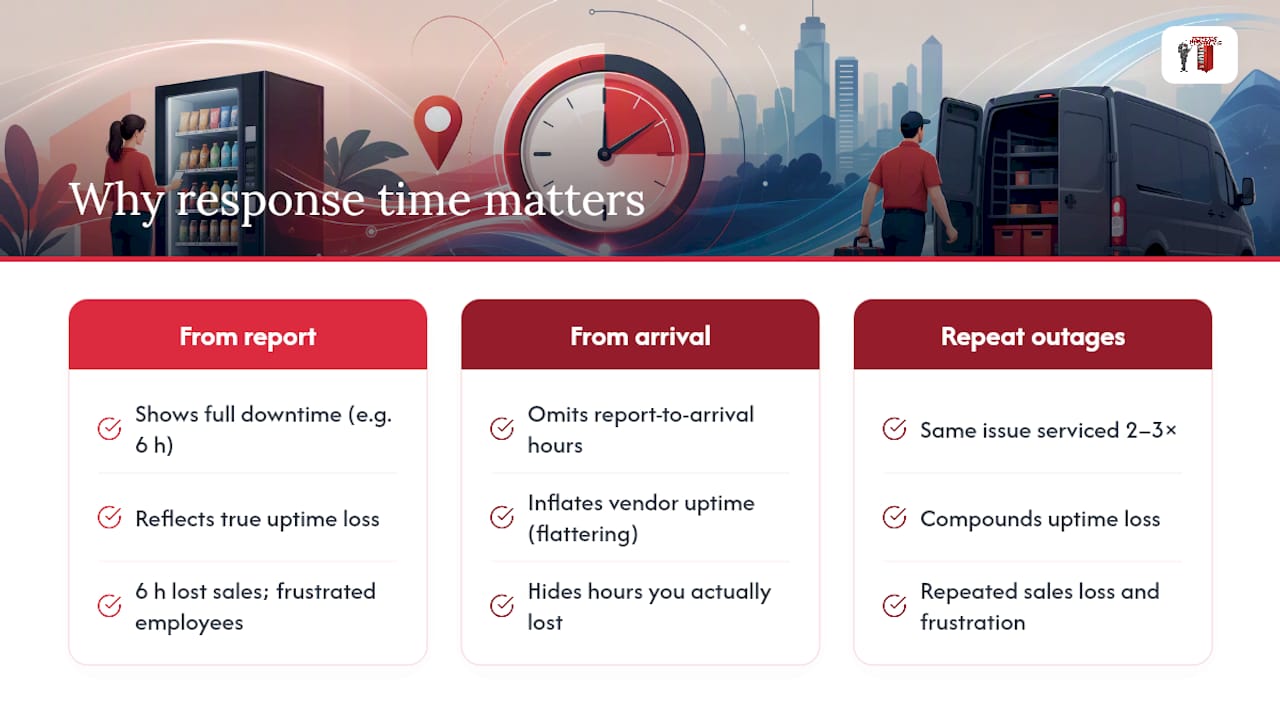
The math is straightforward: a machine down for six hours during a workday is six hours of lost snack and drink sales, plus frustrated employees who now associate the break room with disappointment. Repeat outages compound the damage, since a low first-time-fix rate means the same machine gets serviced two or three times for one problem. Most credible providers aim for around 95% uptime, with same-day turnaround on anything critical.
What service tiers should your vendor commit to?
Vague promises like “we’ll get to it soon” don’t survive a bad week. Ask your provider to commit, in writing, to a tiered response model that separates remote work from a physical visit.
- Priority 1 (machine down, safety issue): 1-hour remote diagnosis, 4-hour on-site target, spare parts pre-staged on the truck
- Priority 2 (payment or cashless failure): 1-hour remote diagnosis, often resolved without dispatch
- Priority 3 (low stock, minor mechanical glitch): resolved on next route, typically 24 to 48 hours
- Priority 4 (cosmetic, non-urgent): folded into the regular maintenance visit
Good contracts also separate remote diagnosis from on-site dispatch so a five-minute software reset isn’t billed or timed like a full repair call.
Pro Tip: Ask your provider how route density affects their on-site guarantee. A technician already working three buildings away can hit your site in 90 minutes; one covering a rural territory alone might genuinely need the full 4-hour window. Both can be honest SLAs, just calibrated to reality.
How do you actually measure MTTR and uptime?
You can’t manage what you don’t log. MTTR is calculated as total repair time divided by number of incidents, measured from ticket open to ticket close. Uptime is the percentage of scheduled operating hours the machine was functional and stocked.
Here’s how to audit a vendor’s real performance instead of taking their word for it:
- Request raw ticket timestamps, not summarized reports, so you can verify open and close times yourself.
- Ask for root-cause codes on every ticket to spot repeat failures on the same machine.
- Confirm which technician handled each call and whether parts were used or a return visit was needed.
- Cross-check the vendor’s self-reported uptime against your own observations for one month.
- Review dashboards or logs quarterly, not just when something breaks.
A vendor with nothing to show when asked for this data is telling you something important on its own.
What should your vending service contract actually say?
A handshake deal is where response-time disputes go to die. Put these clauses in writing before you sign anything:
- Defined response windows by priority tier, stated in hours, not “as soon as possible”
- An escalation matrix naming who gets contacted if the first response window is missed
- Clear exclusions (weather delays, remote-site travel time, parts backordered from the manufacturer)
- A reporting cadence, monthly at minimum, showing MTTR and uptime by machine
- Remedies for repeated SLA misses, including service credits or a documented remediation plan
Without measurable KPIs written into the agreement, “fast service” is just a marketing phrase with no teeth. A written service record also protects you if a lease renewal or complaint ever needs a paper trail, the same way downtime documentation protects facility managers in other service categories.
Is it time to fire your vending provider?
Some warning signs are obvious the moment you see them twice. If the same machine gets serviced for the same problem three months running, that’s not bad luck, that’s a broken process. Watch for these red flags:
- Repeated callbacks for issues the vendor claims are “fixed”
- A gap between the uptime percentage they report and what you actually observe
- No remote monitoring, meaning they only learn about outages when an employee complains
- Missing or inconsistent service records when you ask for history
Before you switch, ask the current provider directly for their MTTR and uptime numbers over the last quarter. A vendor who can’t produce a specific figure likely never had a real SLA to begin with. If you’re testing a replacement, run a 60 to 90 day pilot on one location before moving your whole account.
How Jeeves Vending operationalizes fast response
Jeeves Vending installs and services machines and micro-markets at no upfront cost, which only works long term if response time stays tight. Remote stock monitoring flags low inventory and payment issues before they become complaints, and route planning tied to real machine data keeps technicians close to the accounts that need them most. For hospitals and other time-sensitive sites, that means restocking cycles built around actual usage patterns rather than a fixed weekly schedule.
How to get started with faster vending service
If you’ve been living with a provider who can’t quote you a response-time number, that’s the problem this whole article is about. Jeeves Vending installs machines and micro-markets at no cost to your business, and backs that install with remote monitoring built to catch stock and payment issues before your employees notice them.
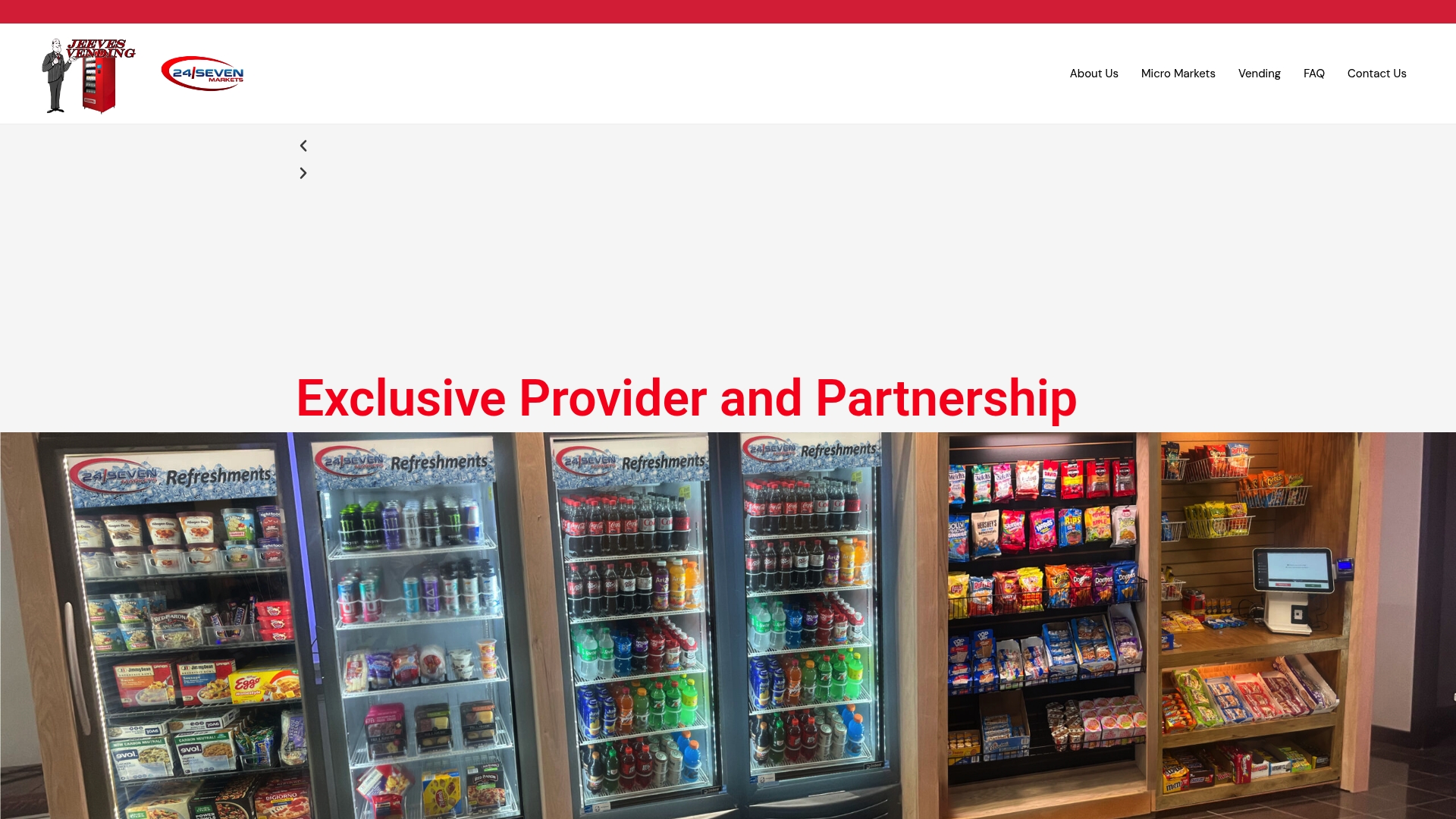
The next step is simple: request an SLA breakdown for your specific location, including expected diagnostic and on-site windows for your area. You can review machine and micro-market options to see what fits your space, or go straight to Jeeves Vending’s contact page and ask what a pilot placement would look like for your building.
The real reason vendors avoid giving you a number
Every vendor will tell you they’re “responsive.” Almost none will put a number on it, and that gap is the whole story. A specific SLA is a liability for a vendor who can’t hit it consistently, so vague language protects them, not you.
What gets missed in most conversations about vending service is that response time isn’t really about speed for its own sake. It’s about whether a provider has built systems, remote monitoring, route optimization, digital ticket logs, that make fast response possible in the first place. A company promising a 4-hour on-site window without any remote diagnostics is just guessing. One that can tell you exactly how many tickets closed within window last quarter has actually built the operation to back the promise.
The facility managers who get the best service aren’t the ones who ask “how fast are you?” They’re the ones who ask “show me your last quarter’s MTTR,” and then walk away from any vendor who can’t answer.
— Gary
Sources
- Vending Machines Service: Maximize Profit & Uptime
- Vending Machine Preventive Maintenance and AMC Contract Checklist for Operators