
A hospital vending policy has to do three things: set explicit nutrition criteria tied to Nutrition Facts labels, bind vendors to those criteria through contract language, and require ongoing monitoring against a planogram. Anything short of that is a suggestion, not a policy, and vendors will default to whatever sells fastest, not what’s healthiest.
Three sources should anchor your language. The CDC’s Food Service Guidelines for Federal Facilities gives you federal-level rationale and criteria categories. The NYC Standards for Food Vending Machines implementation guide hands you actual numeric thresholds and sample planograms you can lift almost verbatim. And Eskenazi Health’s Choose Health program shows what happens when a real hospital applies both: a 31% drop in average sodium per vending item, achieved without raising prices, documented in CDC Stacks.
Before you draft anything longer, take these three actions:
- Attach a specific nutrition standard (CDC or NYC-style thresholds) as an exhibit to any vending RFP or contract renewal, not as a vague “healthy options” clause.
- Request a current vendor item list cross-checked against Nutrition Facts labels, not vendor marketing claims of “better for you” products.
- Pick one high-traffic, low-complexity location, a staff break room works well, and run a 90-day pilot before rolling changes out system-wide.
Key Takeaways
A hospital vending policy only works when nutrition criteria, vendor verification, planogram enforcement, and ongoing monitoring are all written into the same enforceable document.
| Point | Details |
|---|---|
| Anchor the policy in named standards | Cite CDC federal guidance and NYC’s numeric thresholds directly in contract exhibits, not general “healthy options” language. |
| Require label verification, not vendor claims | Every SKU needs Nutrition Facts data checked at restock, since branded “healthy” claims are unreliable on their own. |
| Set concrete slot rules | Reserve top-row, eye-level slots for green items and require at least half of facings to be whole or minimally processed. |
| Measure before and after | Use NEMS-V audits and track sodium, calories, and sales mix monthly to prove the policy is working. |
| Choose an operational partner built for compliance | Jeeves Vending installs machines and micro-markets at no cost and handles planogram execution, restocking, and reporting that hospital policies require. |
Table of Contents
- Understanding US Hospital Vending Regulations and Guidance
- What Nutrition Thresholds Should a Vending Policy Set?
- Writing Procurement Language and Vendor Contracts That Enforce the Policy
- How Do You Turn the Policy Into a Daily Operation?
- Food Safety and Equipment Standards for Vending Machines
- How Should You Track Compliance and Impact Over Time?
- What Did Eskenazi Health’s Choose Health Program Actually Change?
- Building Your Hospital Vending Policy Checklist
- Frequently Asked Questions
- Sources
Understanding US Hospital Vending Regulations and Guidance
No single federal law tells your hospital what to stock in a vending machine. Instead, you’re working with a layered set of guidance and rules: federal frameworks for rationale, municipal standards for specifics, and state or county health departments for licensing and equipment sign-off. Knowing which layer governs which decision keeps your policy from citing the wrong authority.
The CDC’s Food Service Guidelines for Federal Facilities were built for federal buildings and cafeterias, but hospitals across the country use them as the credibility backbone for internal policy. They establish that institutions serving food to employees and visitors have a legitimate public-health interest in what’s available, and they outline categories, nutrition standards, availability, and pricing, that translate directly into hospital vending policy language. If your legal or compliance team wants to know why the hospital is regulating its own vending machines, this is the document that answers it.
For actual numbers, NYC’s standards do more work than any other public document available. The implementation guide doesn’t just say “offer healthier options.” It specifies that at least half the items in a machine should be whole or minimally processed foods, gives example planogram layouts, and requires calorie information posted per item at the point of purchase. Hospitals in Texas, Ohio, or anywhere else that adopt these thresholds aren’t required to by law, but they’re adopting a standard that’s already been tested at scale in vending fleets far larger than a typical hospital system.
Then there’s the layer most administrators underestimate: state and local plan review. Vending machines dispensing potentially hazardous foods, think sandwiches, dairy, or anything requiring refrigeration, typically require a plan review and license from your local health department before installation. Oregon’s health authority, for example, publishes a vending machine plan review packet that requests floor plans, equipment specifications, and lockout testing documentation. Ohio counties run similar processes. Skip this step and you risk a machine that violates local code even if it perfectly satisfies your nutrition policy.
When you’re deciding which standard to formally attach to your internal policy or vendor contract, a simple rule works: use CDC guidance for your rationale section, NYC’s numeric standards for your enforceable criteria, and your local health department’s plan review checklist for equipment and licensing requirements. Citing all three in the same document isn’t redundant. It’s what makes the policy defensible to your board, your legal team, and your health inspector at the same time.
What Nutrition Thresholds Should a Vending Policy Set?
Vague language like “prioritize healthy snacks” gives vendors nothing to comply with and gives your compliance team nothing to audit. Numeric thresholds fix that, and you don’t need to invent them from scratch.
A workable starting point, drawn from NYC’s and CDC’s frameworks, looks like this:
- Packaged snack items: 200 calories or fewer per package as a general target for the “green” category.
- Sodium: cap individually packaged snack items well below 200 mg per serving for green-tier classification; items above that threshold shift to yellow or red.
- Fat: no more than 0.5 g trans fat per serving (effectively zero, given how the label rounds), and limit saturated fat as a percentage of total calories.
- Added sugar: minimal or no added sugar for green items; beverages should avoid high-fructose corn syrup as a first ingredient where a lower-sugar alternative exists.
- Beverage sizing: cap standard vending beverage sizes, with unsweetened water and seltzer unrestricted in size.
Layer a traffic-light system on top of those numbers and you give staff, visitors, and your own auditors a shared visual language. Green means the item meets all thresholds above. Yellow covers items that clear calorie and fat limits but run moderate on sodium or sugar, think a granola bar with 250 mg of sodium. Red is everything else: candy, full-sugar soda, chips exceeding 400 calories per bag. The point of the color system isn’t just customer-facing signage. It’s an internal classification tool your procurement team uses to sort every SKU a vendor proposes.
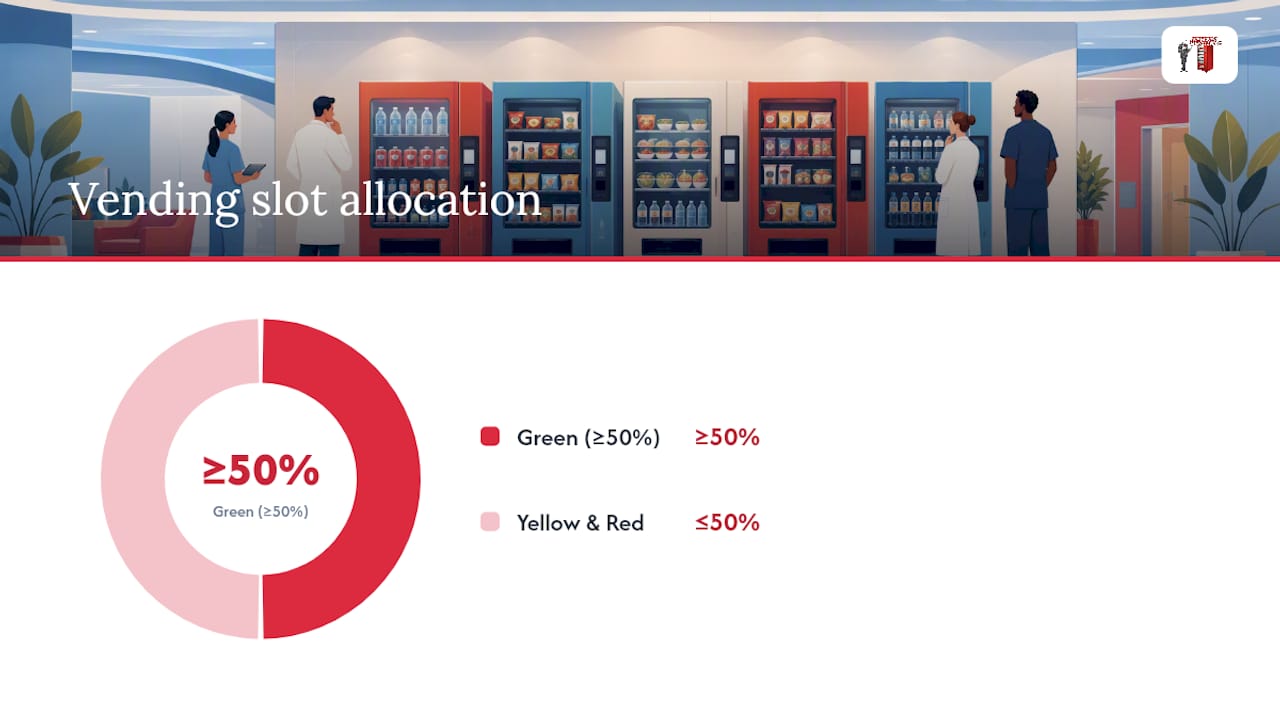
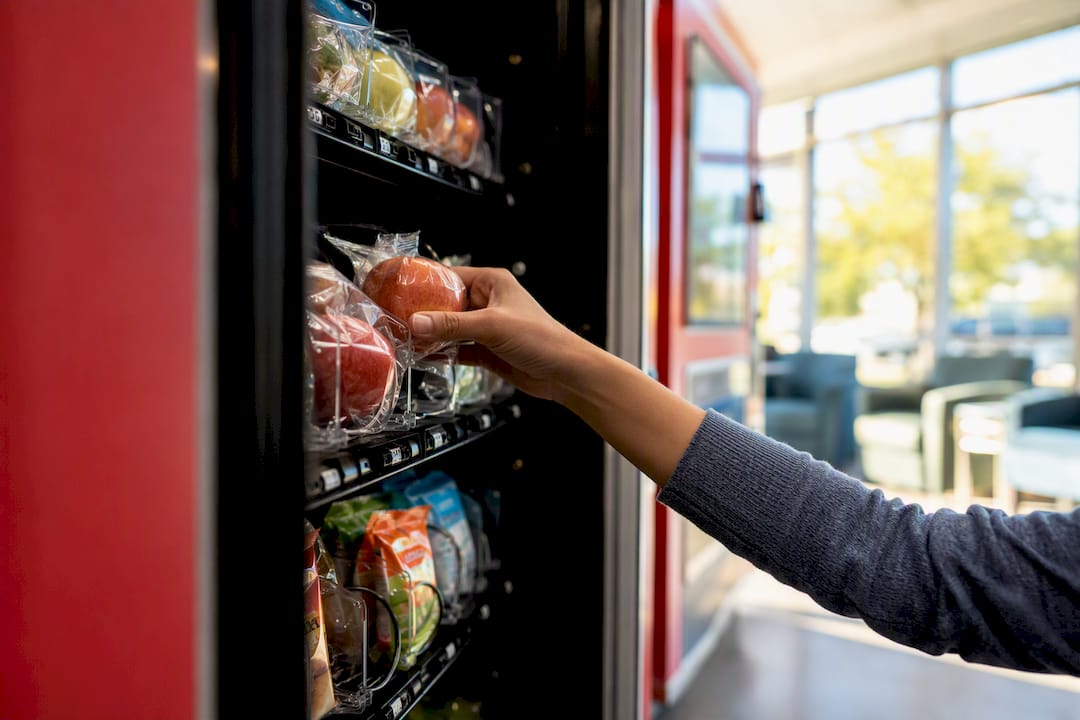
Slot allocation is where the policy actually bites. NYC’s guide recommends that at least half of vending slots carry whole or minimally processed items, and hospitals adopting similar rules typically require the top two rows, the ones at eye level, to be reserved for green items exclusively. Beverage machines should cap the largest available size and dedicate a fixed share of facings to water, unsweetened tea, or zero-calorie options.
One clause matters more than any other: require per-slot calorie display and independent verification against the printed Nutrition Facts label, not vendor self-certification. Vendors routinely describe items as “healthier” based on marketing positioning rather than the actual label. A one-page item audit at every restock, checking the Nutrition Facts panel against your approved list, closes that gap.
Statistic Callout: Eskenazi Health’s Choose Health program cut average sodium per vending item from 210 mg to 145 mg, a 31% reduction, simply by applying thresholds like these and reworking their planogram. Cost per item remained essentially unchanged.
Writing Procurement Language and Vendor Contracts That Enforce the Policy
A nutrition policy without contract teeth is a memo. The clauses below turn your standards into something a vendor has to comply with or lose the account.
Start with documentation. Require the vendor to supply a complete item list for every machine, with each SKU tied to its actual Nutrition Facts label, not a marketing description. Build this into an approved-item registry that updates every time a new product rotates in. The NYC implementation guide explicitly warns against relying on vendor “healthy” lists without label verification, and that warning exists because vendors have gotten this wrong often enough to earn it.
Next, planogram adherence. The contract should specify the required percentage of green, yellow, and red facings, reference the agreed planogram layout by document version, and require written approval before any substitution changes that ratio. Pricing matters here too: build in pricing parity, or a modest discount, for green-tier items so cost doesn’t undercut the nutrition goals you just wrote into the same document.
Then comes the part most draft contracts skip: dates and names. Assign an implementation date, name a responsible person on both the hospital side and the vendor side, and specify a reporting cadence (monthly item audits, quarterly compliance summaries). Include remediation language: what happens when compliance slips, a 30-day correction window, then penalty clauses or termination rights if it doesn’t improve.
Finally, fold equipment and sanitation requirements into the same contract rather than treating them as a separate conversation. Require NSF/ANSI-certified equipment and automatic lockout mechanisms for any unit dispensing time/temperature control for safety (TCS) foods.
- Vendor-supplied item list verified against Nutrition Facts labels, updated at every restock.
- Planogram compliance clause specifying facing percentages by color category.
- Pricing parity or discount requirement for green-tier items.
- Named implementation date, responsible parties, and reporting cadence.
- Remediation and penalty clauses tied to compliance audits.
- NSF/ANSI equipment certification and TCS lockout requirements as contract prerequisites.
Pro Tip: Ask vendors for a CSV export of SKUs, Nutrition Facts URLs, serving sizes, and lot codes at every restock. It turns a monthly audit from a scavenger hunt into a fifteen-minute spreadsheet check.
How Do You Turn the Policy Into a Daily Operation?
Policy language means nothing if the person restocking machine 4B at 6 a.m. doesn’t know which slot gets the granola bar and which gets the chips. Operations is where most hospital vending policies quietly fail, not because the standards were wrong, but because nobody translated them into a floor plan.
Start with the planogram itself. Keep the SKU count manageable. Eskenazi Health cut its snack lineup from 92 items down to 47, and that reduction wasn’t a compromise, it made stocking faster and compliance easier to verify at a glance. Map every slot to a color category before you order a single case of product, and build in two or three pre-approved substitutes per green slot so a stockout doesn’t force an emergency call for sign-off.
- Draft the planogram with slots numbered and color-coded, then get sign-off from food service and facilities before installation.
- Set stocking frequency based on traffic. High-turnover machines in ED waiting areas or staff break rooms may need restocking three to five times a week; low-traffic units can run weekly.
- Place green items at eye level and in the top two rows, where NYC’s guide and most retail behavior research agree shoppers look first.
- Set pricing at parity with, or slightly below, red and yellow items to nudge purchasing without mandating it.
- Add simple signage or decals marking green items, reinforcing the traffic-light system visually at the point of purchase.
- Confirm payment systems support both cash and card, and check machine placement and controls for ADA compliance, reachable coin slots, card readers, and clear pathways.
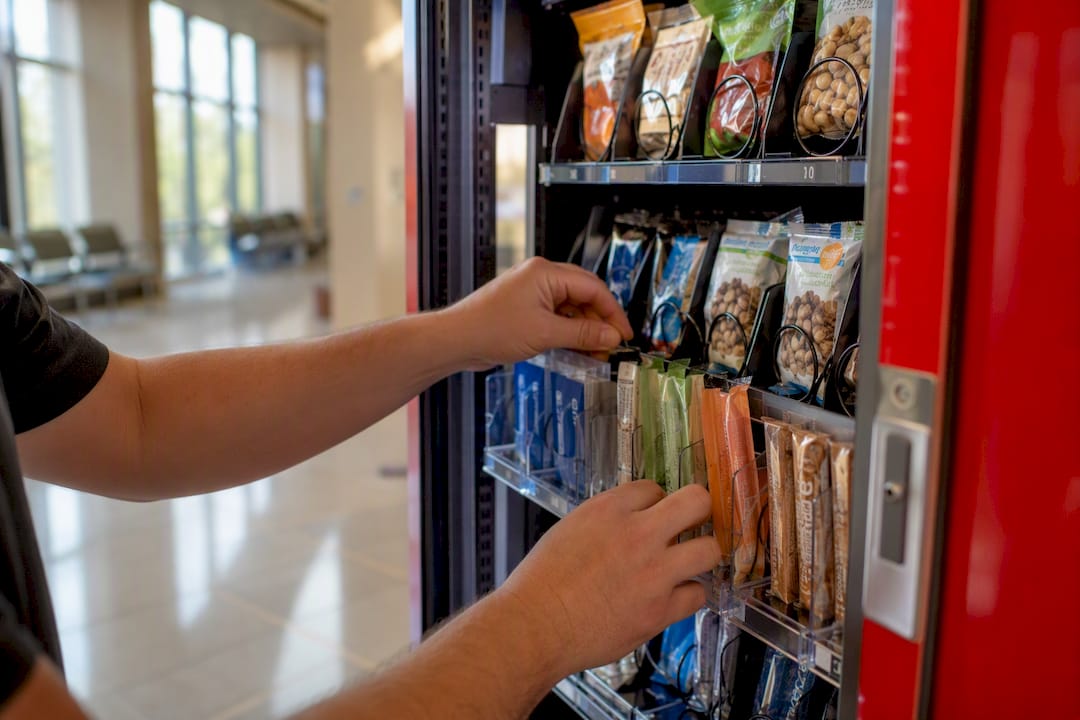
Digital point-of-sale systems earn their keep here. A modern POS can display per-item calorie and price data directly on the machine screen, log every transaction for your sales-mix reporting, and flag when a slot’s actual contents drift from the approved planogram. That last feature turns a manual audit into something closer to automatic compliance tracking, which matters a great deal when you’re running dozens of machines across a hospital campus and can’t physically inspect every one weekly.
Restocking speed deserves its own line item in your operational plan, particularly in a 24/7 facility where a stalled-out machine on night shift means a nurse coming off a twelve-hour rotation has nothing but a candy bar between her and the parking garage. Fast, reliable restocking isn’t a nice-to-have in this setting; it’s what keeps green slots from silently reverting to whatever’s easiest to grab off the truck.
Pro Tip: Build your planogram around fewer, better SKUs rather than more variety. A tighter lineup is easier for staff to restock correctly and easier for you to audit.
Food Safety and Equipment Standards for Vending Machines
Nutrition policy and food safety are separate compliance tracks, and a hospital vending program has to satisfy both. Get the nutrition rules right but skip a required plan review, and your machine gets shut down anyway.
The FDA Food Code sets the baseline that most state and local health departments adopt or adapt. It governs how vending equipment handles time/temperature control for safety foods, items like dairy, sandwiches, or cut produce that can support bacterial growth if held at the wrong temperature. Any machine dispensing TCS items needs refrigeration capable of holding food at or below the code’s threshold, along with a way to prove it’s doing so.
That proof comes in the form of equipment certification and automatic lockout. NSF/ANSI-certified units are the standard vendors should already be supplying, and refrigerated machines dispensing TCS foods need an automatic lockout mechanism that disables the vend function if internal temperature climbs above the safe range. Without lockout, a malfunctioning compressor on a Friday night can keep selling potentially unsafe sandwiches straight through the weekend.
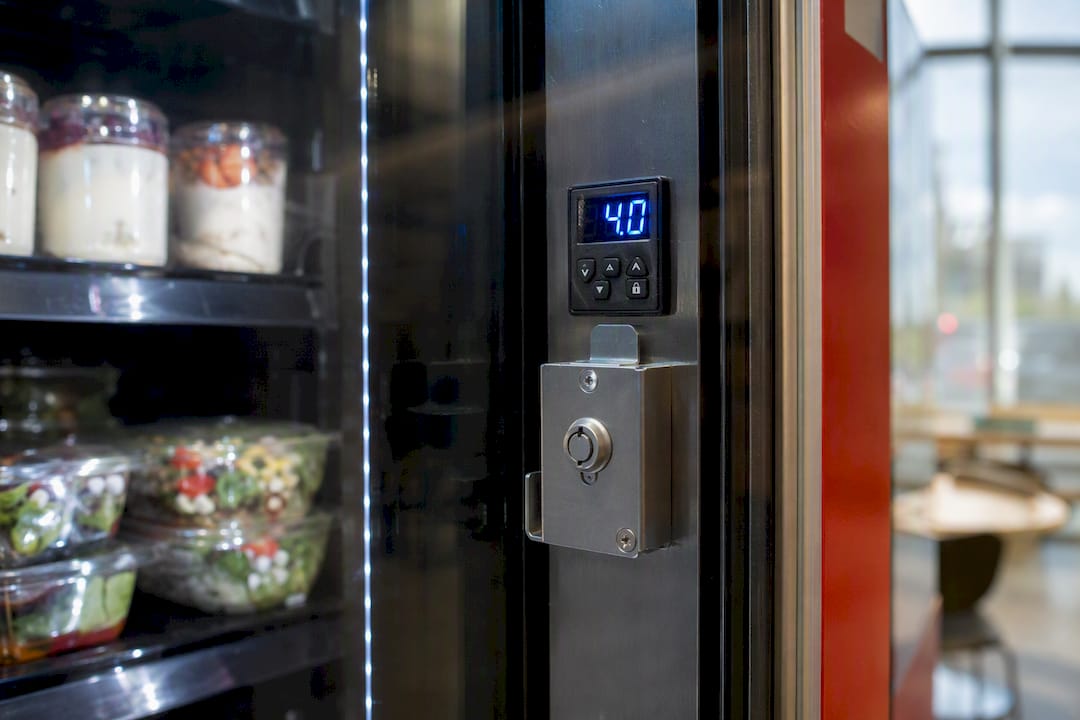
Before any new machine goes in, your local health department likely requires a plan review. Oregon’s vending machine plan review packet is a useful template for what to expect nationally: submitted floor plans, equipment specification sheets, documentation of lockout testing, and confirmation of refrigeration temperature limits. Erie County, Ohio, runs a comparable process. Build time for this review into your implementation timeline; it’s not a formality you can skip by moving fast.
Once machines are live, build these checks into your ongoing operational routine:
- Weekly temperature logs for every refrigerated unit, reviewed by facilities or food service leadership.
- Quarterly lockout function tests, documented and filed alongside your compliance records.
- A fixed sanitation schedule for machine exteriors, coin mechanisms, and touchscreens.
- Confirmation that vendor-supplied equipment carries current NSF/ANSI certification before installation, not after.
How Should You Track Compliance and Impact Over Time?
A policy you can’t measure is a policy you can’t defend at your next budget review or board presentation. Build the measurement framework at the same time you build the policy, not six months after launch when someone asks for results.
Track a small set of KPIs monthly:
- Percentage of facings classified green versus yellow versus red across all machines.
- Average sodium and calorie content per item sold, not just per item stocked.
- Sales mix shift over time (are green items actually selling, or just occupying shelf space?).
- Revenue per machine, to confirm nutrition changes aren’t quietly tanking your vending income.
- Staff and visitor satisfaction, gathered informally or through a brief periodic survey.
The Nutrition Environment Measures Survey for Vending (NEMS-V) gives you a standardized audit tool for baseline and follow-up assessments. Run it before you make any changes to establish where you’re starting from, then repeat it 90 days and again 12 months after implementation. The comparison tells you whether your planogram changes actually moved the needle or just looked good on paper.
Set a reporting cadence and stick to it: monthly compliance summaries from the vendor, quarterly reviews with hospital administration, and an annual policy refresh. When a machine or vendor falls below your compliance threshold, say, green facings drop below the required percentage, trigger a defined remediation step rather than an ad hoc conversation. A documented monitoring loop, baseline audit, regular vendor reporting, and corrective action tied to specific thresholds, is what separates a policy that sticks from one that quietly erodes after the first staff turnover.
Statistic Callout: Programs that pair traffic-light labeling with planogram simplification, like Eskenazi Health’s, have shown that healthier facings can rise substantially while average sodium per item drops 31%, all without a meaningful shift in per-item cost.
What Did Eskenazi Health’s Choose Health Program Actually Change?
Eskenazi Health, a public hospital system, gives administrators the clearest US case study available for what a policy-to-practice vending overhaul looks like in a real facility, not a pilot lab. The Choose Health project applied traffic-light labeling, cut SKU count, and restructured planograms across its vending fleet, then measured the results against a documented baseline.
Planograms were rebuilt to prioritize whole and minimally processed snacks in top-row, eye-level positions, and the highest-sugar beverage options were pulled from rotation.
The Eskenazi Health results matter precisely because nothing about them required raising prices or shrinking the vending program. Cutting SKU count from 92 to 47 while eliminating red-tier snack items entirely, and dropping average sodium per item by nearly a third, shows that a hospital can tighten nutrition standards and keep cost per item essentially flat.
The operational lessons carry directly into any hospital’s rollout plan. Staff engagement mattered: communicating the “why” behind removed items headed off the complaints that inevitably show up when a favorite candy bar disappears. Vendor engagement mattered just as much since the vendor had to agree to a smaller, more tightly specified product list rather than defaulting to a standard catalog. And the planogram substitution strategy, pre-approving a short list of acceptable swaps for each green slot, kept the machines stocked without constant sign-off delays.
For a hospital planning something similar, expect a 90-to-120-day runway from baseline audit to full implementation across a pilot set of machines, with systemwide rollout following once the pilot data confirms the sales mix and revenue hold up.
Building Your Hospital Vending Policy Checklist
Turning everything above into an adoptable document is mostly a matter of sequencing. Skip stakeholder buy-in and jump straight to vendor contracts, and you’ll spend the next six months fielding complaints instead of running a pilot.
- Engage stakeholders first. Loop in food service leadership, facilities, legal or compliance, and a representative group of staff and patient family advocates before drafting a word of policy.
- Run a baseline audit. Use NEMS-V or a comparable tool to document your current vending mix, sodium and calorie averages, and existing SKU count.
- Draft the policy with attached standards. Reference CDC guidance for rationale and NYC-style numeric thresholds for enforceable criteria, and attach both as exhibits.
- Write the contract clauses. Cover nutrition criteria, documentation and verification requirements, planogram specifications, equipment and sanitation prerequisites, implementation timeline, reporting cadence, and penalties.
- Select and run a pilot. Choose one or two high-traffic, operationally manageable locations and commit to a 90-day test window.
- Communicate before launch. Post signage, brief department heads, and explain the traffic-light system to staff so the change doesn’t land as a surprise.
- Train vendor staff. Make sure restocking personnel understand the planogram and substitution rules, not just the delivery schedule.
- Establish the feedback loop. Collect staff and visitor input for the first 60 days and adjust the product mix within approved categories as needed.
- Set the audit schedule. Commit to monthly vendor reports, quarterly compliance reviews, and an annual full policy review.
| Policy Element | What to Verify Before Sign-Off |
|---|---|
| Nutrition criteria | Numeric thresholds attached as a contract exhibit, not described in general terms |
| Documentation requirement | Vendor supplies Nutrition Facts data per SKU, verified at each restock |
| Planogram specification | Slot-by-slot color mapping approved in writing before installation |
| Reporting and enforcement | Reporting cadence, responsible parties, and remediation steps named explicitly |
A note on making the policy work day to day
Good vending policy dies in the gap between what the contract says and what actually gets restocked at 6 a.m. on a Tuesday. The nutrition thresholds and planogram rules only hold if the vendor relationship is tight, restocking is fast enough that green slots never sit empty, and someone is actually checking Nutrition Facts labels instead of trusting a catalog description. That’s an operational discipline as much as a policy one, and it’s exactly where a vendor built around rapid restocking and remote stock monitoring, like Jeeves Vending, tends to close the gap that catalog-driven national vendors leave open.
Getting Compliant Vending Installed Without the Procurement Headache
Most hospitals writing a vending policy hit the same wall: the standards are clear, but finding a vendor who’ll actually build a planogram around them, document every SKU, and restock fast enough to keep green slots full is another matter entirely. Jeeves Vending installs and manages vending machines and micro-markets at no cost to the host facility, which means your hospital can adopt strict nutrition criteria without negotiating equipment costs into the same conversation.
Here’s how the services map directly onto what your policy needs to require:
- No-cost equipment installation, so nutrition standards don’t get traded off against a capital budget line.
- Planogram execution built around your approved slot allocation and color-coded criteria.
- Item documentation and Nutrition Facts verification maintained as products rotate.
- Restocking cadence fast enough to keep 24/7 facilities, break rooms, and waiting areas consistently stocked.
- Remote stock monitoring and reporting that feeds directly into your compliance audits.
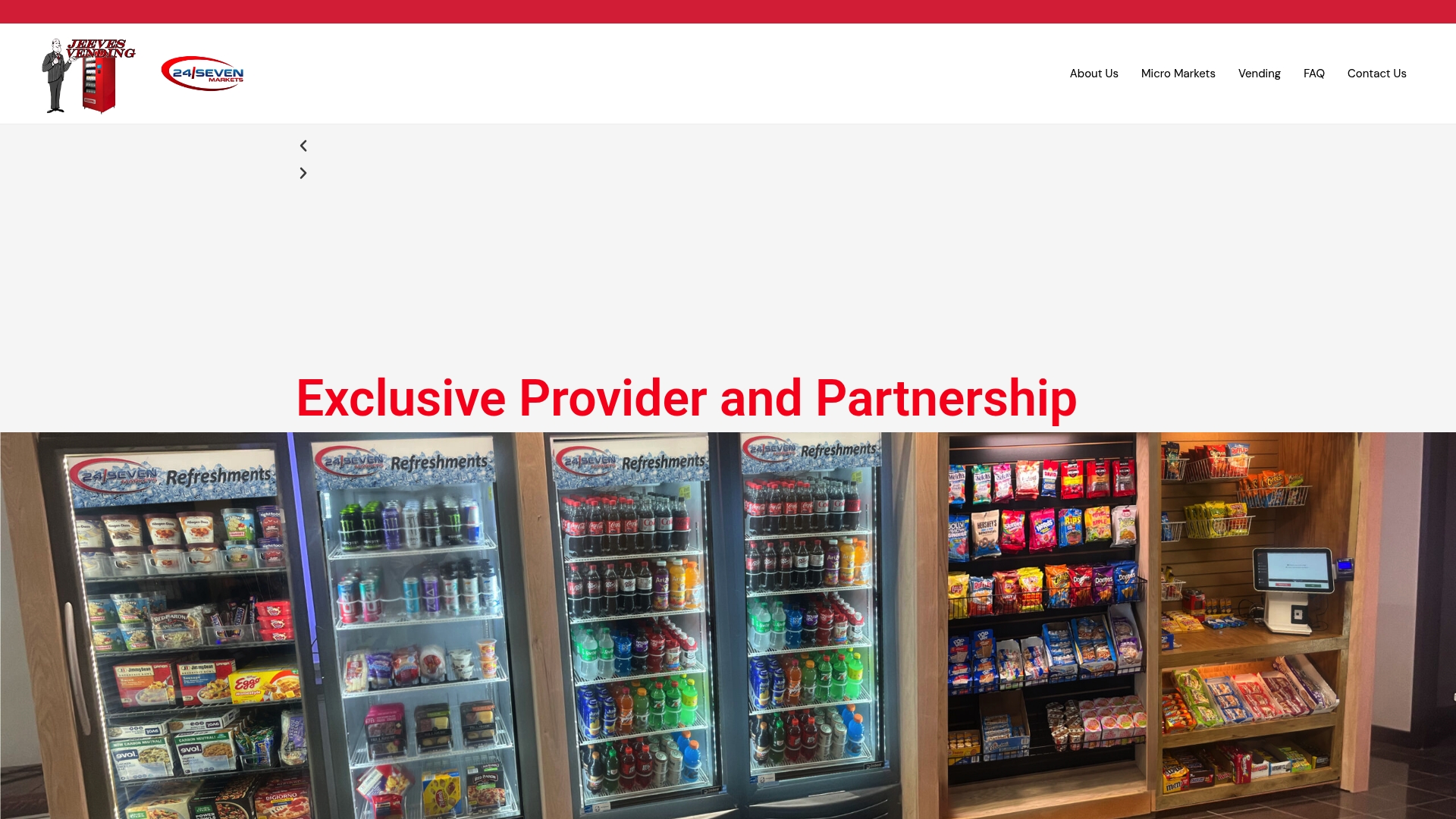
For hospitals that want more variety than a standard machine allows, a self-checkout micro-market is worth considering for larger break rooms or cafeterias, since it lets you stock a wider range of green and yellow items without the slot constraints of a traditional machine. If your facility is ready to move from policy draft to pilot installation, reach out to Jeeves Vending to scope out a machine or micro-market for your first location.
Frequently Asked Questions
Do hospitals have to follow a specific federal law for vending machines?
No single federal law mandates hospital vending nutrition standards. Most hospitals build policy by adapting the CDC’s Food Service Guidelines for Federal Facilities and municipal models like NYC’s standards, then layering in state or county licensing requirements for equipment and food safety.
What nutrition thresholds should a hospital vending policy require?
A workable baseline caps packaged snacks around 200 calories, limits sodium well below 200 mg per serving for the “green” category, sets trans fat near zero, and restricts added sugar, with at least half of vending slots reserved for whole or minimally processed items.
How often should vending machines be restocked in a hospital setting?
High-traffic locations like ED waiting areas or staff break rooms typically need restocking three to five times weekly, while lower-traffic units can run on a weekly schedule. Restocking speed matters more in hospitals than in most other settings because staff work around the clock.
What food safety rules apply to hospital vending equipment?
Machines dispensing time/temperature control for safety foods must meet FDA Food Code standards, carry NSF/ANSI equipment certification, and include automatic lockout mechanisms that disable vending if refrigeration temperature rises above safe limits.
How do you measure whether a hospital vending policy is working?
Track the percentage of green versus red facings, average sodium and calorie content per item sold, and sales mix over time. The Nutrition Environment Measures Survey for Vending (NEMS-V) provides a standardized baseline and follow-up audit tool.
Does adding a hospital vending policy require new equipment or a new vendor?
Not necessarily. Many hospitals rework nutrition criteria and planograms with their existing vendor. Others switch to a provider offering no-cost equipment installation, like Jeeves Vending, when they need faster restocking or better compliance reporting than their current setup provides.
Sources
- Eskenazi Health Food & Nutrition Services — Sodium Reduction in Vending Machines (CDC Stacks)
- Standards for Food Vending Machines implementation guide (NYC)
- Food Service Guidelines for Federal Facilities | CDC
- Oregon vending machine plan review packet (Oregon Health Authority)