
Before you sign anything, insist on these six items in writing: a placement exhibit with machine serials and exact location, a defined vendor access method (badge, escort, or outside-the-secure-zone placement), measurable SLAs covering uptime and restock cadence, a clear commission or rent formula with monthly telemetry statements, a certificate of insurance naming your facility as additional insured, and a removal/termination clause with a defined notice window. A vending machine contract guide confirms that written agreements covering maintenance, restocking, commission terms, termination mechanics, and renewal processes are what prevent disputes, not goodwill.
Before your first meeting, send or bring these:
- A site summary: daily headcount, shift schedule, and break-room locations
- A request for the vendor’s standard SLA document and a sample sales statement
- A request for a certificate of insurance (COI) naming your facility as additional insured
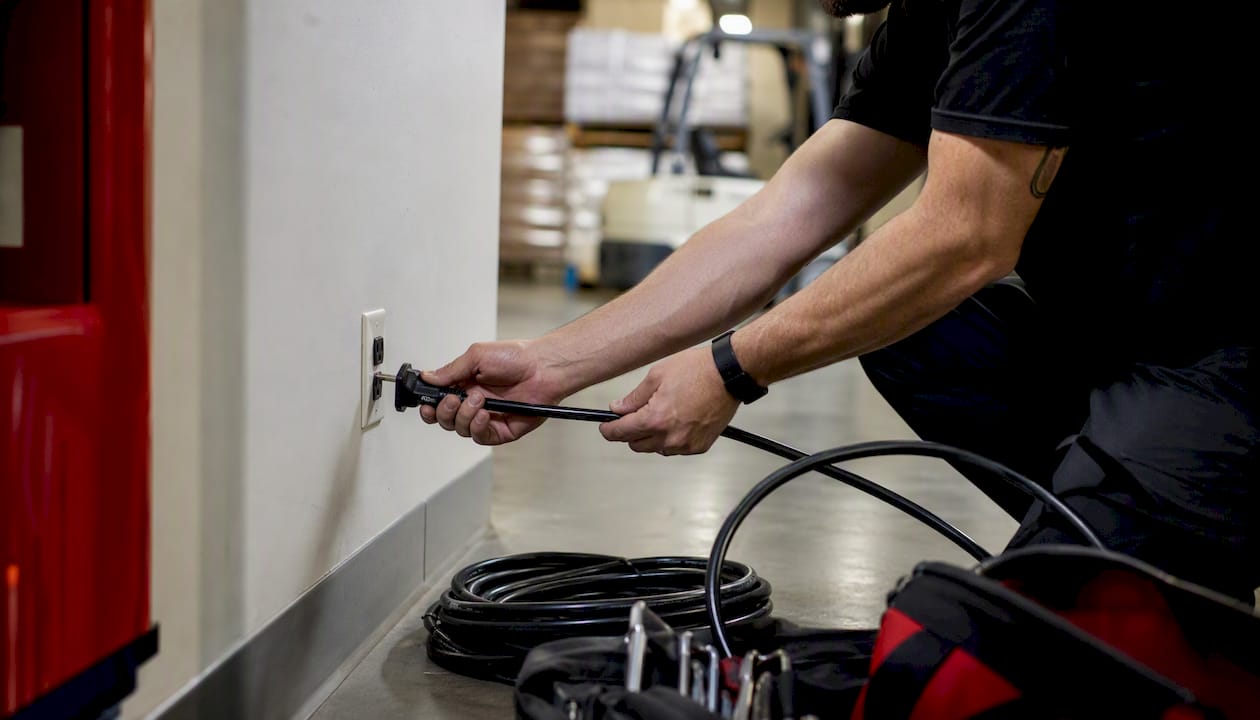
- A list of your preferred machine locations with power outlet access confirmed
- A draft placement exhibit (machine serial, exact location, power source)
- A written question about vendor access: badge, escort, or outside-line placement
Any vendor who refuses to put terms in writing is a red flag. Treat that refusal as a dealbreaker.
Key Takeaways
A warehouse vending contract only protects you when it names specific numbers, not intentions. Vague language on access, restock cadence, and removal is where disputes start.
| Point | Details |
|---|---|
| Written access clause is non-negotiable | Define badge, escort, or outside-line access in the contract before any SLA can be enforced. |
| Commission ranges 8–15% for active warehouses | Require monthly telemetry statements to verify every payment. |
| Start with a 1-year trial term | Shorter initial terms reduce risk; push for longer renewals only after the location performs. |
| Tie exclusivity to performance metrics | Exclusivity should suspend automatically if uptime or restock targets are missed for two consecutive months. |
| Jeeves Vending covers the contract basics | No-cost install, telemetry access, COI handling, and shift-aware restocking for Dallas-Denton warehouses. |
Table of Contents
- What must-have clauses belong in a warehouse host agreement?
- How should you run the negotiation step by step?
- What financial models and costs should you expect?
- Which SLAs and KPIs should you write into the contract?
- What legal, compliance, and insurance items do you need before signing?
- What sample clause language can you propose to the vendor?
- What should you check and do right after signing?
- What actually works for warehouse accounts
- Jeeves Vending makes warehouse vending contracts straightforward
- Sources
What must-have clauses belong in a warehouse host agreement?
A solid warehouse service agreement covers seven clause categories. Each one protects a different part of the relationship.
| Clause Category | What to Specify | Why It Matters for Warehouses |
|---|---|---|
| Placement exhibit | Machine serial numbers, exact floor location, power source | Prevents unauthorized moves; ties SLAs to specific equipment |
| Term and renewal | Initial 1-year trial; auto-renewal with 30-day opt-out notice | Limits risk on a new vendor; avoids silent lock-ins |
| Exclusivity | Tied to performance metrics (uptime, restock) | Protects you if service degrades |
| Operational responsibilities | Restock cadence, cleaning, date rotation, refund posting | Assigns accountability clearly |
| Electricity | Vendor pays or host deducts from commission | Prevents surprise utility disputes |
| Assignment | Vendor must notify you 30 days before any ownership transfer | Protects you if vendor sells the route |
| Termination and removal | 30-day written notice; vendor removes equipment within 14 days | Avoids abandoned machines |
According to The Vending Club’s contract guide, standard agreements should include term, exclusivity, service and maintenance, termination for cause, and placement exhibits tied to machine serials. Templates increase professionalism and reduce disputes.
Watch for vague language. “Regular restocking” means nothing enforceable. “Reasonable notice” is whatever a lawyer argues it is. Replace both with specific numbers before you sign.
Pro Tip: Tie exclusivity to performance. Failure for two consecutive months voids exclusivity." That single sentence gives you leverage without killing the relationship.
How should you run the negotiation step by step?
A structured approach keeps the process from dragging past 30 days.
- Estimate your traffic. Count daily headcount per shift and identify peak break times. A distribution center running two 10-hour shifts needs a different restock cadence than a 9-to-5 office.
- Request documents before the first meeting. Ask for a sample SLA, a recent sales statement from a comparable account, and the vendor’s standard contract draft. A vendor who refuses any written agreement is signaling how disputes will go.
- Separate the three negotiation levers. Treat placement/lease terms, service delivery, and revenue allocation as distinct topics. Negotiating them together lets vendors trade service quality for a higher commission number.
- Ask these questions in the first meeting: How does your technician access the building after hours? What telemetry system do you use, and can I pull sales reports directly? What is your guaranteed response time for a machine outage? What happens if you sell this route?
- Anchor on a 1-year initial term. A shorter trial reduces your risk on a new vendor. Push for longer renewals only after the location performs well.
- Set a 30-day negotiation deadline. If terms are not agreed within 30 days of first contact, move to the next vendor. Stalled negotiations rarely improve.
- Red flags that should stop the deal: no written contract offered, no COI available, vague access plan, no telemetry or sales reporting, and commission paid only on request rather than automatically.
What financial models and costs should you expect?
Three payment structures cover most warehouse vending agreements.
Percentage of gross sales is the most common model for active warehouse accounts. The vendor pays the host a commission on every sale. For warehouses with meaningful volume, commission of roughly 8–15% of gross sales (excluding tax) is realistic. Require monthly telemetry statements to verify the numbers.
Flat monthly rent works when the host wants predictable income regardless of sales volume. It suits high-traffic locations where the vendor is confident in revenue. The risk: if sales drop, the vendor may push to renegotiate.
Free placement means no commission and no rent. The vendor keeps all revenue in exchange for providing and servicing the equipment at no cost to the host. This is the right model when your primary goal is employee convenience, not revenue generation.
| Model | Best For | Host Risk |
|---|---|---|
| Commission (8–15% gross) | High-volume warehouses wanting revenue share | Requires telemetry to verify |
| Flat monthly rent | Predictable income, high-traffic sites | Vendor may renegotiate if sales fall |
| Free placement | Convenience-first, no revenue goal | No income; service quality is the only lever |
A mid-size distribution center running 150 employees across two shifts might see $3,000–$5,000 in monthly machine sales. At free placement, you get zero revenue but also zero administrative overhead.
Pro Tip: *Link any commission concession to a measurable performance requirement.
Which SLAs and KPIs should you write into the contract?
Measurable SLAs are what separate a professional vending agreement from a handshake deal. Write them as specific numbers, not intentions.
| SLA Metric | Target | Verification Method | Remedy |
|---|---|---|---|
| Machine uptime | at least twice weekly | Telemetry log or service ticket history | 5% commission credit per 1% below target |
| Restock frequency | Twice weekly (or per shift schedule) | Delivery log signed by facility contact | Service credit or step-up commission |
| Outage response time | 4 business hours for jams; 24 hours for mechanical failure | Service ticket timestamp | Credit equal to one day’s average sales |
| Sales reporting | Monthly telemetry statement by the 10th | Email delivery with raw data | Withhold commission until delivered |
| Date rotation / cleaning | Weekly product date check; monthly machine wipe | Vendor log available on request | Written cure notice; termination after 30 days |
For remedies, use a three-step structure: first, a service credit applied to the next commission cycle; second, a step-up commission rate if the miss continues; third, a termination right after a 30-day cure period with no improvement.
- Write cure periods as: “Vendor has 30 days after written notice to correct a service failure. If uncorrected, host may terminate with no further obligation.”
- Require vendor access to be defined in writing — badge, escort window, or outside-the-secure-zone placement. Without reliable access, every SLA above becomes unenforceable.
What legal, compliance, and insurance items do you need before signing?
Insurance checklist:
- General commercial liability with product liability coverage, at least $1,000,000 per occurrence
- COI naming your facility as additional insured, delivered before installation
- Confirmation that coverage renews annually and that you receive notice of cancellation
Standard insurance practice for warehouse placements is $1,000,000 per occurrence general and product liability, with the COI delivered before the machine enters the building.
Compliance items to verify:
- Food safety: vendor follows date-rotation protocols and allergen labeling requirements
- Perishable items: confirm vendor’s health department permits if the machine carries fresh food
- Assignment: any transfer of the vendor’s contract rights requires 30 days’ written notice to you
- State-specific consumer safety rules: varies by state; confirm with counsel
Get a lawyer to review indemnity caps, assignment language, and any state-specific consumer safety rules before you sign. These three areas carry the most financial exposure and are the hardest to renegotiate after the fact. A one-hour attorney review costs far less than a dispute over a $500,000 indemnity clause.
Pro Tip: Ask the vendor to email the COI directly to your facilities manager and your insurance broker. That creates a paper trail and confirms the coverage is real, not just a certificate someone printed from a template.
What sample clause language can you propose to the vendor?
Use these as drafting anchors, not final legal language. Have counsel review indemnity and assignment clauses before signing.
Placement description: “Vendor shall operate one (1) vending machine, serial number [XXXXX], at [specific location, e.g., Break Room B, Building 2], connected to the dedicated 20-amp outlet at that location. Vendor may not relocate the machine without 14 days’ prior written consent from Host.”
Access method: “Vendor technicians shall access the premises via [badge / escort / exterior entrance] during the hours of [6 AM–8 PM, Monday–Saturday]. After-hours access requires 24-hour advance written notice to Host’s facilities manager.”
Service levels: “Vendor shall restock the machine no fewer than twice per calendar week. Failure to meet either standard for two consecutive months entitles Host to terminate this Agreement with 30 days’ written notice.”
Exclusivity is suspended automatically upon failure of either metric for two consecutive months.
Termination and removal: “Either party may terminate this Agreement with 30 days’ written notice. Upon termination, Vendor shall remove all equipment within 14 days and restore the placement area to its prior condition.”
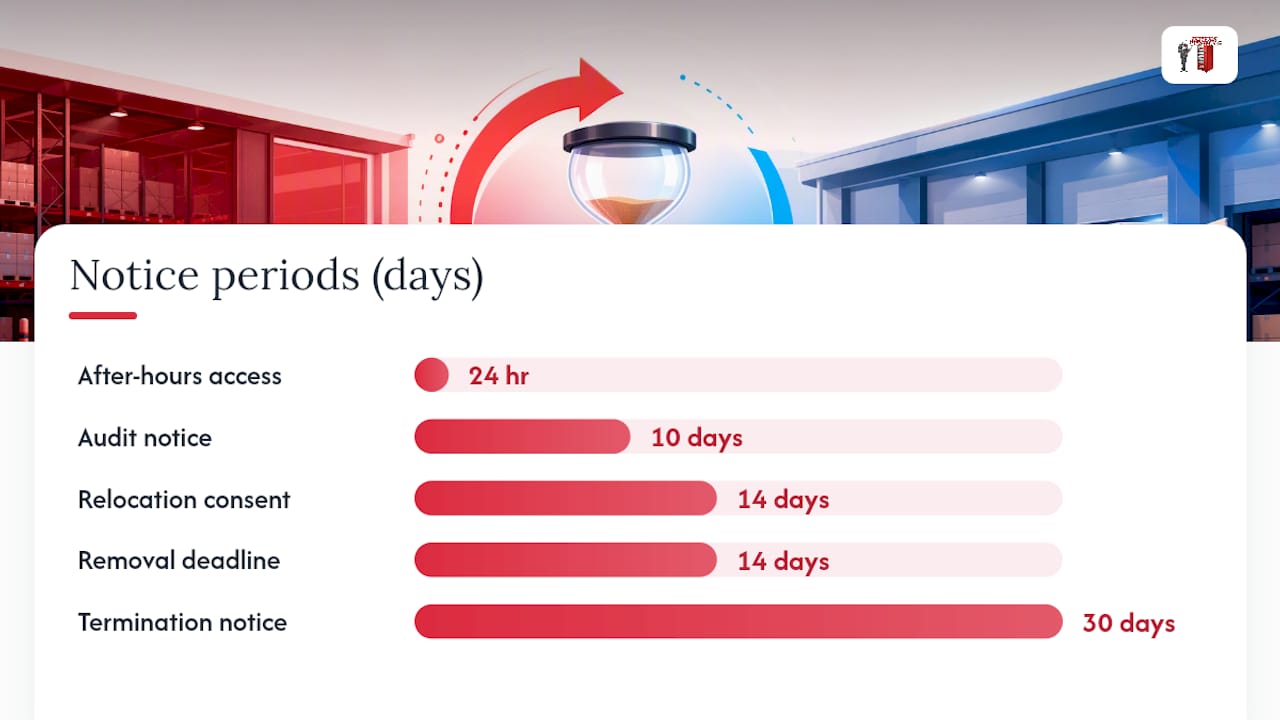
Audit rights: “Vendor shall provide Host with monthly sales statements no later than the 10th of the following month. Host may audit Vendor’s sales records for any machine on this Agreement upon 10 days’ written notice, no more than once per calendar year.”
A compact vending agreement typically runs 1–3 pages and should specify placement details, term, commission structure, restock responsibilities, electricity allocation, and insurance requirements. These snippets cover the core of that structure.
- Replace “regularly” with “twice weekly” or “per the restock schedule in Exhibit A.”
- Replace “reasonable notice” with “30 days’ written notice via email to the facilities manager.”
- Replace “standard insurance” with “COI naming Host as additional insured, $1,000,000 per occurrence.”
What should you check and do right after signing?
Post-signature is where most warehouse vending agreements quietly fail. Run through this checklist before the machine goes in.
| Step | Action | Deadline |
|---|---|---|
| COI collection | Receive and file COI naming your facility as additional insured | Before installation day |
| Placement exhibit | Confirm machine serial and location match the signed exhibit | Day of installation |
| Refund posting | Vendor posts refund phone number and contact info on machine | Day of installation |
| Telemetry access | Receive login credentials for vendor’s reporting portal | Within 3 business days of install |
| First restock verification | Confirm restock occurred within the agreed cadence | Within first week |
| 30-day review | Pull first telemetry report; verify uptime and sales data | Day 30 |
| SLA check after first 30 days | Measure uptime and restock frequency against contract targets | Day 30 |
If a problem appears in the first 30 days, document it in writing immediately. Send an email to the vendor’s account manager with the date, the issue, and the specific contract clause it violates. That email starts the cure-period clock and creates a paper trail if you need to invoke termination rights later.
What actually works for warehouse accounts
The single most common reason warehouse vending accounts fail is not product selection or pricing. It is access. A vendor who cannot reliably enter the building during second or third shift cannot restock on schedule, cannot fix a jammed machine before the next break, and cannot meet any SLA you write into the contract. The access clause is not a formality. It is the load-bearing wall of the entire agreement.
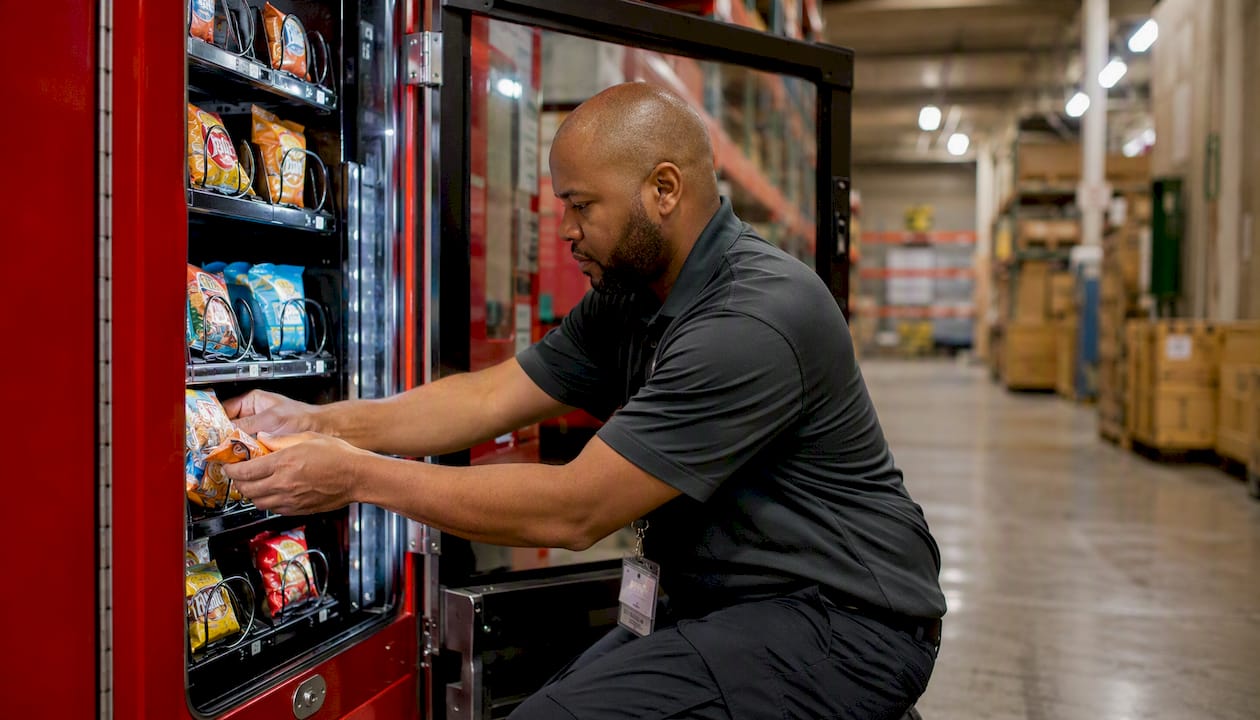
Shift-aware service is the second piece most managers overlook. A warehouse running 24/7 operations needs a vendor who maps their restock visits to shift breaks, not to a convenient Tuesday morning window. When Jeeves Vending assesses a warehouse account, the first questions are about shift schedules and access method, not machine count or product mix. Those two factors determine whether the account will work before anything else is negotiated.
Jeeves Vending makes warehouse vending contracts straightforward
Warehouse managers in the Dallas-Denton region who want vending without the contract headaches have a direct option. Jeeves Vending installs and manages vending machines and custom micro-markets at no cost to the host facility. No equipment purchase, no service retainer, no guessing about SLA language.
The standard Jeeves Vending agreement covers shift-aware restocking, remote telemetry so you can verify sales data yourself, COI handling before installation, and a dedicated account manager who handles the operational details. For warehouses exploring self-checkout options, micro-market solutions are available for larger break areas. Every placement comes with a written agreement that includes the clause categories covered in this article.
To get a site assessment and a contract draft specific to your facility, contact Jeeves Vending and request a warehouse walkthrough.
Sources
- Vending machine contract guide
- The Vending Club: Vending Contract and Agreement Guide 2026
- Vending Machine Contract Template (Free Download)
Before you finalize any agreement, have an attorney review the indemnity caps, assignment language, and any state-specific consumer safety provisions. Those three areas carry the most financial exposure and are the hardest to fix after signing.