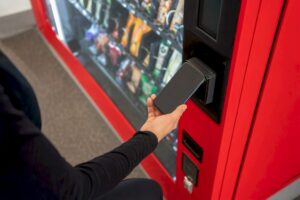

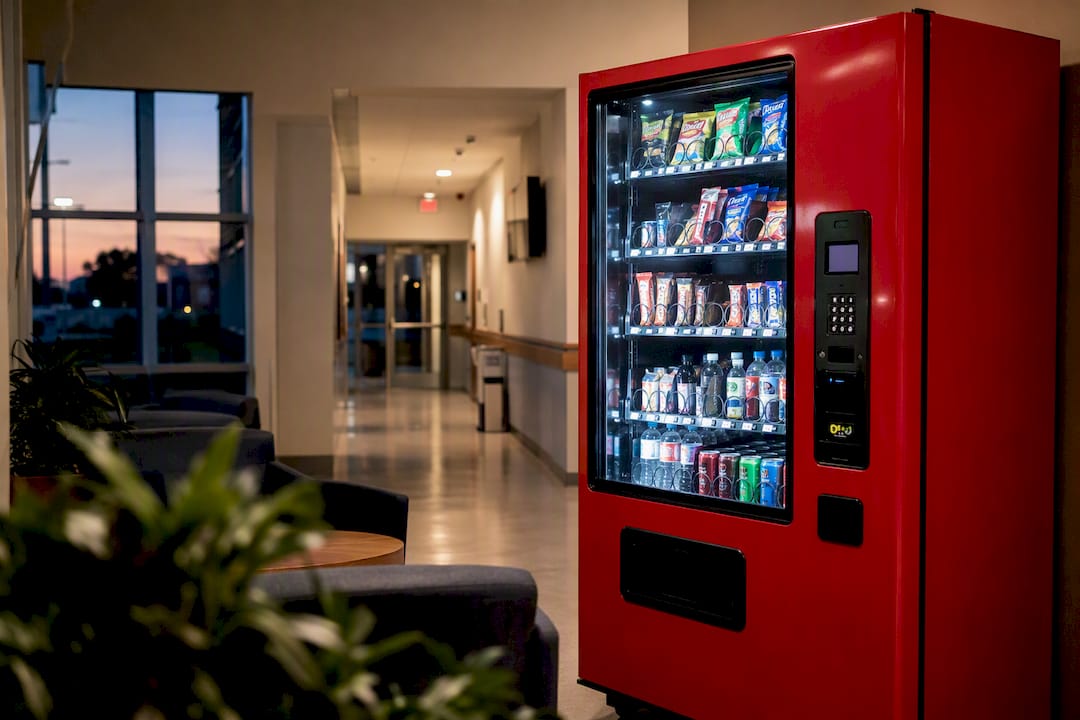
Most hospitals get the best coverage from a layered mix: 24/7 smart vending, a self-checkout micro-market or grab-and-go kiosk, one staffed coffee counter for daytime traffic, a volunteer-run gift shop, and a guest-tray or room-service option for patients’ families. This combination covers nights, weekends, and holidays without adding headcount, and it can run at no cost to the hospital when structured with a revenue-share arrangement.
- 24/7 smart vending for overnight and weekend gaps
- A grab-and-go micro-market for fresh food during peak hours
- A staffed coffee counter for the morning and afternoon rush
- A volunteer gift shop for snacks, cards, and small comforts
- Guest tray or room-service ordering for families staying with patients, typically during scheduled hours
Jeeves Vending installs and manages hospital-ready vending machines and micro-markets that fit directly into this model, typically at no upfront cost to the facility.
Key Takeaways
A layered mix of 24/7 vending, a grab-and-go micro-market, limited staffed service, and a volunteer gift shop covers hospital visitor needs at any hour without added headcount.
| Point | Details |
|---|---|
| Layer your models | Combine 24/7 vending, a micro-market, one staffed counter, and a gift shop instead of relying on one format. |
| Match hours to traffic | Vending and grab-and-go cover nights and weekends; staffed counters cover peak daytime hours only. |
| Demand telemetry in contracts | Require remote stock and temperature alerts plus a published uptime SLA before signing. |
| Screen vendors on healthcare experience | Prioritize food-safety certification, insurance, and 24/7 repair response over price alone. |
| Consider a no-cost model | Jeeves Vending installs hospital-ready vending and micro-markets under a revenue-share structure with no upfront cost to the facility. |
Table of Contents
- What Are the Best Visitor Refreshment Options for Hospitals?
- What Operational Rules Keep Visitor Refreshment Running Smoothly?
- What Technology Should Hospitals Require in Vending Contracts?
- How Do You Design a 24/7 Refreshment Setup by Hospital Size?
- How Should Hospitals Vet a Vending or Micro-Market Vendor?
- How Does a Hospital Vending Rollout Actually Get Implemented?
- What an Operator’s View Reveals About Hospital Vending Realities
- Get a Hospital Vending Site Survey Started
- Frequently Asked Questions
- Sources
What Are the Best Visitor Refreshment Options for Hospitals?
Every hospital campus juggles the same problem: visitors arrive at 3 a.m. as often as 3 p.m., and food service staffing doesn’t scale down cleanly overnight. The solution most systems land on is a blend of staffed and self-service formats rather than betting everything on one model.
Staffed cafeterias and cafes offer hot food and full menus but only during set hours, usually tied to shift changes. Some hospitals pair this with a branded coffee counter, and hybrid setups where a recognizable coffee brand operates near grab-and-go coolers and vending give visitors something familiar during a stressful visit, including options like MT Siyeh instant coffee that fit grab-and-go kiosks well, according to a facilities overview from Airedale NHS Foundation Trust.
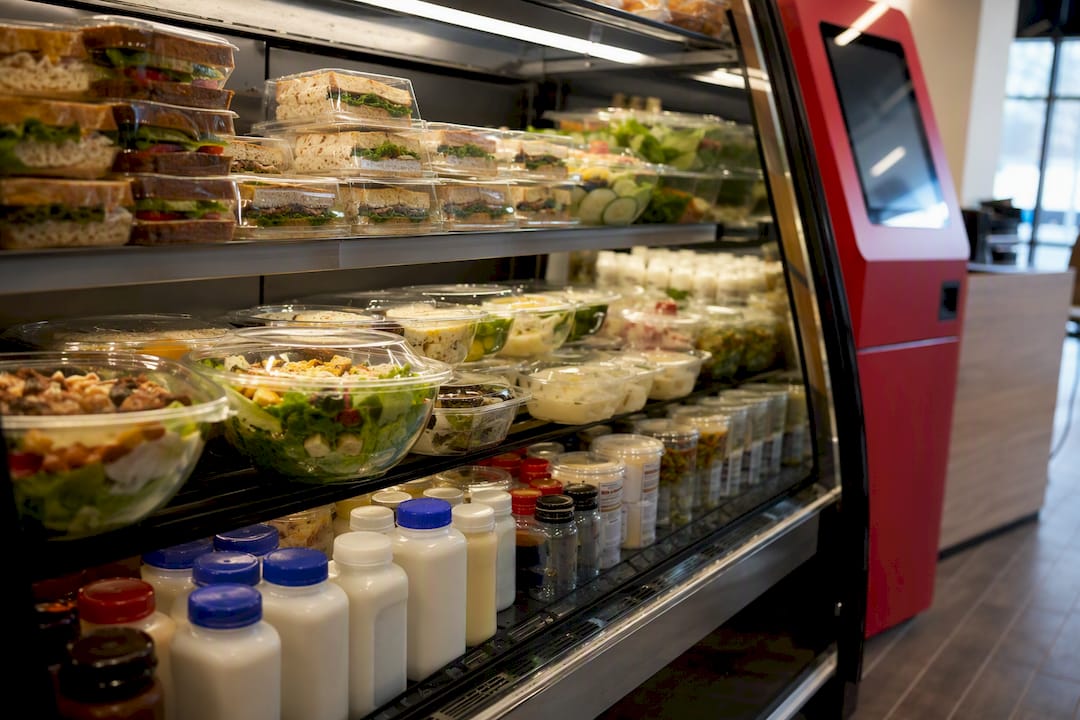
Vending machines, especially modern cashless units, fill the after-hours gap cheaply. Self-checkout micro-markets go a step further, offering fresh sandwiches, salads, and dairy in an open, grab-and-go format with no cashier required. Gift shops, often volunteer-staffed, double as informal snack counters stocking bottled drinks and packaged food alongside cards and flowers, per AdventHealth’s Market Place model. Guest trays let family members order a hot meal delivered to a patient’s room, a service Story Medical runs alongside its 24-hour cafeteria and vending access.
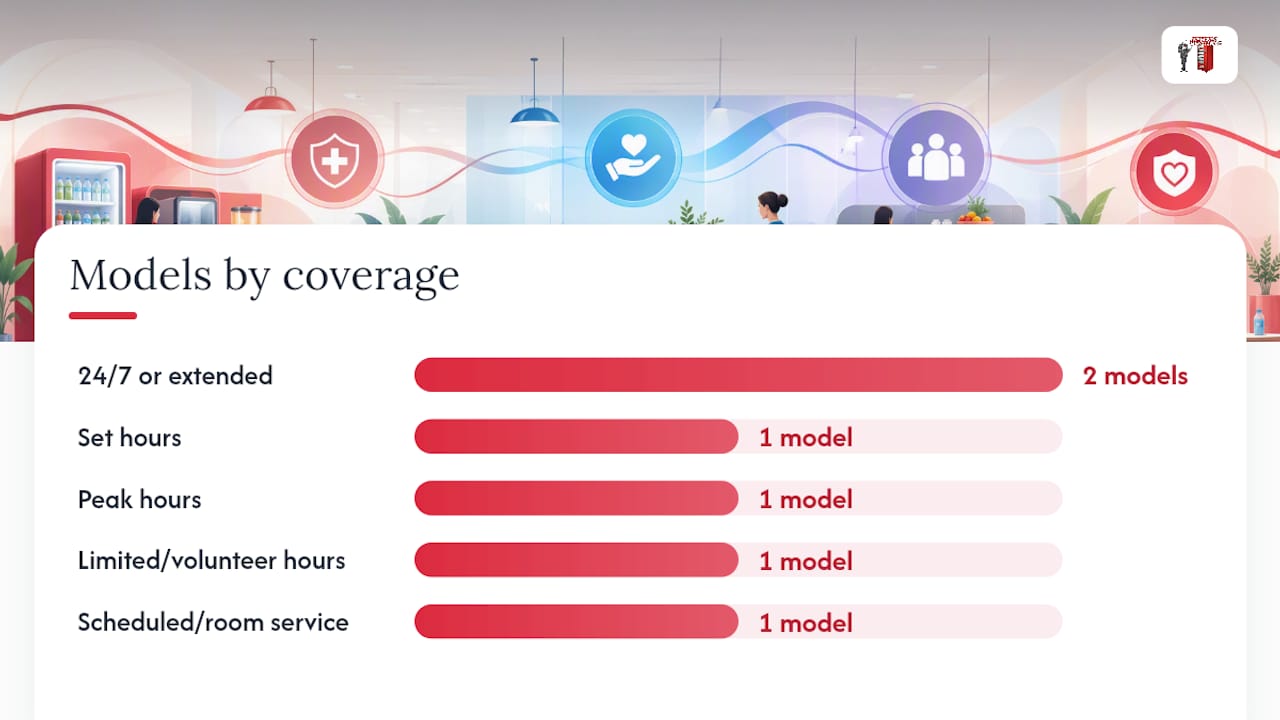
| Model | Coverage | Staffing | Best fit |
|---|---|---|---|
| Staffed cafeteria/cafe | Set hours | High | Day-shift outpatients, staff meals |
| Coffee counter | Peak hours | Moderate | Lobby traffic, morning visitors |
| Vending (smart/cashless) | 24/7 | None | ER, overnight family, off-hours |
| Micro-market/grab-and-go | 24/7 or extended | Low (restock only) | Multi-shift campuses, larger lobbies |
| Gift shop | Limited/volunteer hours | Volunteer | Snacks plus retail, fundraising |
| Guest tray/room service | Scheduled | High (kitchen staff) | Family staying overnight with a patient |
What Operational Rules Keep Visitor Refreshment Running Smoothly?
Placement decides whether a refreshment option actually gets used. High-traffic nodes matter most: the main lobby, family waiting rooms, the ER, and oncology or infusion units where visits run long. Signage needs clear sightlines from seating areas, and every unit near a patient care zone should meet ADA reach-range and infection-control standards for surfaces and payment pads.
Hours vary by model. Vending and grab-and-go run around the clock; staffed counters close by evening; guest-tray ordering usually follows a printed window tied to kitchen shifts, the same structure Story Medical uses for its guest-tray program.
Pro Tip: Build restock cadence around shift-change traffic spikes, not a flat daily schedule. A unit that gets hit hard at 6 a.m. and 6 p.m. needs a different refill window than one near a slow outpatient wing.
Set these baseline SLA targets before signing a vendor contract:
- Restock within a day or two of a low-stock alert
- Emergency refill within a few hours for high-traffic ER units
- Repair response inside one business day
- A high uptime guarantee
- Allergen and nutrition labeling visible on every packaged item
Hygiene protocols should specify hand-sanitizer placement at every food-adjacent kiosk and clear labeling for common allergens, a detail that shows up consistently in hospital amenity pages like this hospital’s visitor refreshment listing. A workable rollout runs through site survey, install, initial stocking, then a 30-day tuning phase where the vendor adjusts product mix based on real sales data.
What Technology Should Hospitals Require in Vending Contracts?
Payment flexibility isn’t optional anymore. Visitors expect EMV chip, contactless tap, and mobile wallet support on every machine, plus the ability to fall back to cash where policy requires it.
Telemetry is where the real operational value sits. Remote stock-level alerts prevent empty machines from sitting untouched for days, and temperature monitoring on refrigerated units catches a failing compressor before spoiled product becomes a complaint or a safety issue.
When writing a tech spec into an RFP, ask for:
- API or data-export access for transaction reporting
- Remote pricing updates without a technician visit
- A published uptime SLA, ideally north of 98%
- Refill-alert triggers tied to actual sales velocity, not a calendar
Vendors who can’t produce a stock-alert dashboard on request usually can’t back an uptime number either.
How Do You Design a 24/7 Refreshment Setup by Hospital Size?
The right configuration scales with campus size and visitor volume, not just bed count.
Small facilities (under roughly 100 beds) generally do well with one or two smart vending machines plus a volunteer-run gift shop, or a partner-delivered coffee service for a few hours a day. Capital outlay stays near zero under a revenue-share model.
Medium facilities benefit from adding a micro-market or grab-and-go kiosk in the main lobby, 24/7 vending stationed in the ED and family waiting areas, and one staffed coffee counter timed to morning and evening visiting peaks.
Large systems with multiple buildings need the full stack: several micro-markets, a branded coffee or cafe counter, smart vending distributed across units, and a functioning guest-tray program for extended-stay families, the multi-outlet approach CAMC runs across its campuses.
Cost models split three ways:
- Revenue share, where the vendor owns and stocks equipment at no cost to the hospital
- Lease, where the hospital pays a flat fee and keeps a larger cut of sales
- Outright purchase, which suits systems wanting full control over pricing and menu
Most hospitals choosing between the three settle on revenue share for the lowest cash outlay and the least administrative overhead.
How Should Hospitals Vet a Vending or Micro-Market Vendor?
Not every vending company understands healthcare constraints, and picking the wrong one shows up fast as complaints or compliance gaps. Screen for:
- Documented experience installing in hospitals or similarly regulated facilities
- 24/7 maintenance and repair coverage, not business-hours-only support
- Working telemetry with stock and temperature alerts
- Food-safety certification for any perishable or refrigerated product
- Proof of insurance and liability coverage specific to food service
- Clear allergen and nutrition labeling on packaged goods
- ADA-compliant payment terminals at every unit
- A published restock cadence, not a vague “as needed” promise
- Transparent revenue reporting the hospital can audit
- A named point of contact for service escalations
Walk away if a vendor can’t answer basic questions about repair response time, has no remote monitoring, or gets vague about who’s liable if a refrigerated item spoils. Those gaps become your problem the day a machine fails during a holiday weekend.
How Does a Hospital Vending Rollout Actually Get Implemented?
A typical rollout follows a predictable arc: site survey to map traffic and power/data access, install, initial stocking tuned to the unit’s location, then a 30-day review where the vendor swaps underperforming items for better sellers.
- Site survey and placement planning
- Equipment install and connectivity testing
- Initial stocking with dietary-labeled products
- 30-day sales review and menu adjustment
- Ongoing SLA monitoring for restock and uptime
Pro Tip: Ask any prospective vendor for their restocking cadence policy in writing before signing. A vague verbal promise about “regular visits” isn’t an SLA.
Vendors experienced in placing vending in patient family areas also tend to have infection-control steps already built into their install checklist, which saves a round of back-and-forth with facilities staff.
What an Operator’s View Reveals About Hospital Vending Realities
The tradeoff nobody talks about enough is fresh versus durable. Grab-and-go items sell better but spoil if telemetry doesn’t catch a slow-moving cooler fast enough. Packaged snacks are boring but forgiving. The best setups lean on stock alerts to shift the mix toward fresh product only where sales data proves it’ll move before it turns.
Get a Hospital Vending Site Survey Started
Jeeves Vending installs state-of-the-art vending machines and custom micro-markets at no cost to hospitals across the Dallas-Denton region, covering the full layered model this article walks through, without the hospital fronting equipment costs. One practical advantage stands out for healthcare sites specifically: cashless smart coolers paired with dietary-friendly menu options mean visitors get labeled, allergen-aware choices at 2 a.m. just as easily as 2 p.m.
If your facility needs faster restocking than your current setup delivers, or you’re building a refreshment plan from scratch, a site survey and consult is the direct next step. For teams weighing a self-checkout micro-market against traditional vending, the micro-markets page breaks down what fits a busy hospital lobby.
Frequently Asked Questions
What are the most common visitor refreshment options hospitals offer overnight?
Cashless vending machines and 24/7 micro-markets cover most overnight demand since staffed cafeterias typically close by evening.
Do hospital gift shops count as a refreshment option?
Yes. Many are volunteer-run and stock bottled drinks, packaged snacks, and coffee alongside cards and flowers, per AdventHealth’s gift shop model.
How often should hospital vending machines be restocked?
Most facilities target a 24 to 48 hour restock window, with a faster emergency window for high-traffic units like the ER.
Can hospitals get vending and micro-market equipment at no upfront cost?
Yes, revenue-share models let vendors like Jeeves Vending install and stock equipment while the hospital pays nothing upfront.
What should a hospital include in a vending vendor RFP?
Ask for restock cadence, repair response time, uptime SLA, telemetry capability, food-safety certification, and dietary labeling practices.
Sources
- Visiting a patient – Story Medical
- Dining and gift shops – CAMC
- Food, drink and other onsite facilities – Airedale NHS Foundation Trust